
Our take on the latest Ready-mixed concrete (Wed 12 Feb 2025)

Concrete volumes down 4.7% from September 2024 (sa)
Annual concrete volumes down by 6.2%pa
Weakest quarterly result since Jun 2014 (excl. lockdowns, sa)
The key numbers...
- Quarterly ready-mixed concrete volumes fell 4.7% between September and December 2024 to 928,000 cubic metres, more than reversing out the rises in the previous two quarters. Volumes have now been below 1.0m cubic metres for five consecutive quarters, whereas previously they hadn’t been below this level for more than one quarter at a time since September 2015 (all figures seasonally adjusted).
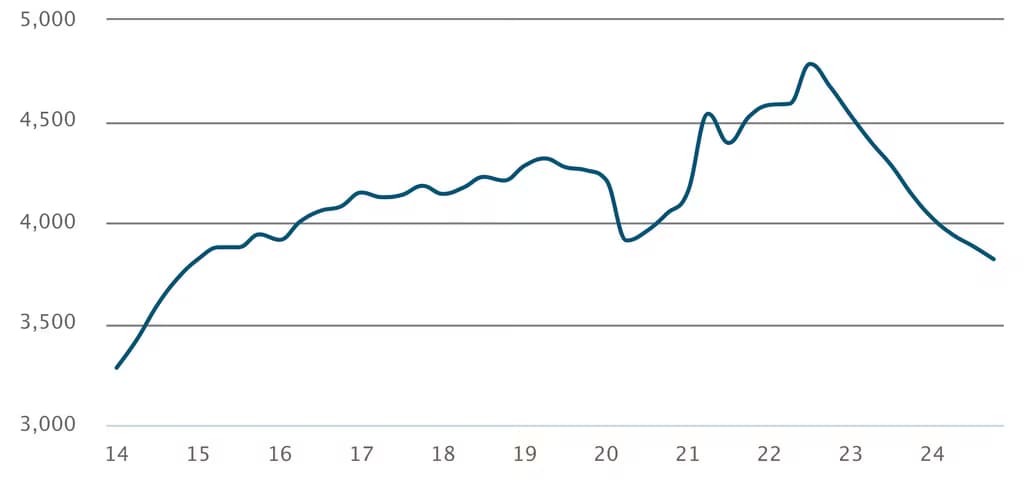
- Annual ready-mixed concrete volumes fell to 3.81m cubic metres in December 2024, down 6.2% from the December 2023 year to their lowest level in a decade.
- Results at the regional level were mostly lower than the September 2024 quarter, led by Canterbury (down 17%), followed by Northland (down 8.4%) and Waikato, Bay of Plenty (down 3.6%). Only two of the eight broad regions rose, led by West Coast, Tasman, Nelson, Marlborough (up 1.3%) and Auckland (up 0.1%).
- The Christchurch Metropolitan area had previously been showing considerable relative strength, rising throughout the first three quarters of 2024. However, concrete volumes fell 19% in the December quarter to reverse the earlier gains. The Wellington Metropolitan area continued to show weakness, with volumes falling 6.5% in December. Volumes in the Auckland Metropolitan area rose 1.3%, increasing for the second consecutive quarter following a revision to the September quarter (all figures seasonally adjusted).
Lowest annual concrete volumes in a decade
000m3, annual running totals, ready-mixed concrete volumes
...and our reaction
- After two consecutive quarterly increases in volumes over the six months to September 2024 (seasonally adjusted), the December quarter saw volumes resume their decline, dropping to their lowest level since June 2014 (excluding the lockdown-affected June 2020 quarter). The average quarterly volume over 2024 (955,000 cubic metres) was 10% below the average in 2019 (1.06m cubic metres), when demand conditions were more normal prior to the pandemic.
- Residential consents have stabilised throughout the second half of 2024, although there is still some volatility in attached dwelling consents. Soft economic conditions and slow population growth mean that any recovery in consent numbers for 2025 is likely to be limited, and residential work put in place is likely to continue tracking lower, weighing on concrete usage.
- Non-residential building consents temporarily showed a bit of strength in October and November before recording a much weaker month in December. However, the pipeline of non-residential work is showing signs of contracting, and we expect and weak economic conditions and restricted business investment to drag down demand for concrete in 2025. Tight fiscal conditions will also limit the scope for additional public sector projects not yet signalled from entering the pipeline.
- There is some upside risk to our view of a limited recovery in residential consent numbers, as the government focuses on growing housing supply. The government’s appetite to boost investment in infrastructure could also help put a floor under concrete volumes over the next 18 months. However, overall we expect weak investment intentions and tight fiscal conditions to dominate, meaning the pipeline of construction activity and concrete demand is likely to continue to narrow.
Latest updates
Premium

Ready-mixed concrete
Further concrete rise supported by South Island growth
Wed 12 Aug 2026
Quarterly
 12%pa Concrete volumes in Jun 2026 quarter
 22%pa Concrete volumes in the South Island
 Volumes above 1 million m3 for the first time in 2½ years
Premium
Ready-mixed concrete
South Island drives continued growth in concrete
Tue 12 May 2026
Quarterly
1.8%pa Concrete volumes in Mar 2026 quarter1.1% Concrete volumes from Dec 2025 quarter (sa)21% Christchurch concrete volumes from Mar 2025 quarterReady-mixed concrete
A turning point for concrete volumes?
Wed 11 Feb 2026
Quarterly
0.4%pa Concrete volumes from Dec 2024 quarter2.4% Concrete volumes from Sep 2025 quarter (sa)South Island leads growthReady-mixed concrete
Concrete volumes still under pressure
Wed 12 Nov 2025
Quarterly
Concrete volumes in Sep quarter up 2.3% from Jun (sa)Annual concrete volumes down by 6.2%paAnnual concrete volumes in Otago/Southland up by 5.1%pa