
Our take on the latest Labour market statistics (Wed 5 Feb 2025)



Unemployment rate up to 5.1%
Employment down 1.1% from December 2023
Labour cost growth slowed to 3.3%pa
The key numbers...
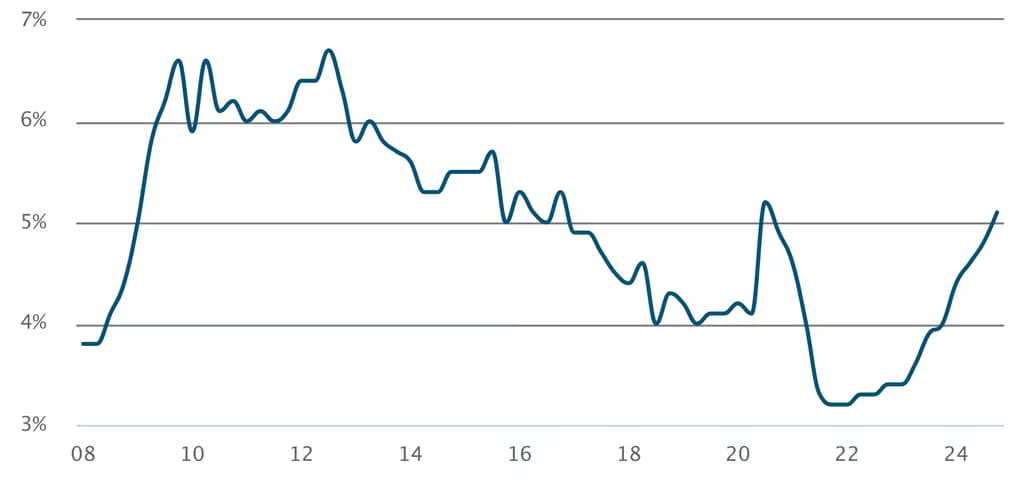
- The unemployment rate rose from 4.8% in September to 5.1% in the December 2024 quarter (seasonally adjusted). The lift was in line with market expectations, taking the rate to its highest level since September 2020.
- Growth in the labour cost index continues to moderate as the labour market weakens, easing from 3.8%pa in September to 3.3%pa in December. At 4.5%pa, public sector labour cost growth continues to track well above private sector growth, which slowed to 3.0%pa.
- Employment fell for the third consecutive quarter, declining 0.1% (4,000 people) between September and December 2024. The annual decline in employment of 1.1%pa was the largest since December 2012.
- The labour force participation rate fell from 71.1% (revised from 71.2%) to 71.0%, the lowest rate since June 2022. Further falls in participation indicate that people are discouraged by the lack of opportunities in the labour market, and they are either moving into education or training or otherwise not actively searching for work.
Highest unemployment rate in over four years
Unemployment rate, seasonally adjusted
...and our reaction
- We expect it to be another six months before the unemployment rate peaks at 5.3% in the June 2025 quarter, adding as many as 10,000 people to current unemployment numbers of 156,000. We forecast the unemployment rate will stay above 5.0% throughout 2025, with businesses continuing to be under pressure as consumers remain cautious with spending.
- Quarterly public sector labour cost growth (0.5%) was slower than in the private sector (0.6%) in December, for the first time since June 2023. The quarterly increase in private sector labour costs has not been slower since March 2021 (all figures seasonally adjusted).
- The underutilisation rate rose to 12.1%, its highest since March 2021, showing the slack in the labour market and availability of people to work additional hours where needed. The proportion of youth not in employment, education, or training also rose to 13.5%, the highest rate since December 2012 (excluding a rogue result in December 2018).
- Today’s data reinforces our view of a 50 basis point cut to the official cash rate on 19 February, with the unemployment rate in line with the Reserve Bank’s forecast. At 2.2%pa, inflation is close to the mid-point of the Bank’s target band, and the weak economy has pushed unemployment to its highest in more than four years. Upside risks to tradable inflation from the exchange rate and international trade policy are unlikely to affect the Bank’s decision later this month, but could affect the scope for further rate cuts later this year.
Latest updates
Premium

Labour market statistics
Unemployment jumps higher than expected
Wed 5 Aug 2026
Quarterly
5.6% Unemployment rate in the June 2026 quarter (s.a.) 70.7% Participation rate the highest in over a year0.5% Employment growth in June from March (s.a.)
Premium
Labour market statistics
More people, more working, more not participating
Wed 6 May 2026
Quarterly
5.3% Unemployment rate eased slightly in the March 2026 quarter70.4% Participation rate fell slightly0.2% Employment rose in March from December (s.a.)Labour market statistics
Higher participation drives unemployment increase
Wed 4 Feb 2026
Quarterly
5.4% Unemployment rate December 2025 quarter (sa)70.5% Participation rate December 2025 quarter (sa)2.0%pa Labour Cost Index Year to December 2025Labour market statistics
Unemployment rate rises to 5.3%
Wed 5 Nov 2025
Quarterly
Unemployment rate edges up to 5.3%Youth NEET rate rises to 13.2% (annual average)Labour cost growth slows to 2.1%pa