
Our take on the latest Real estate statistics (Tue 15 Oct 2024)


House sales up 1.8% from August (sa)
House prices up 0.6% from August (sa)
Stock of properties for sale continues to rise
The key numbers...
- House sales in September rose 1.8% from August (based on Infometrics seasonal adjustment), but were 1.1%pa lower than a year ago. House sales remain volatile, making it difficult to gauge any shift in trend, although sales are still tracking broadly sideways.
- House prices edged up 0.6% in September from August (seasonally adjusted) for the first time since April, after months of decline. On an annual basis, house prices remain lower than a year ago, down 0.4%pa.
- Prices rose in most regions from August, led by Taranaki (2.7%), Marlborough (2.7%), and Auckland (1.5%). Prices fell in just four regions: Nelson (-2.2%), Gisborne (-1.7%), Otago (-1.6%) and Manawatū-Whanganui (-0.3%, all figures seasonally adjusted).
- The stock of properties for sale rose 0.3% from August –the tenth consecutive monthly rise – and the stock of properties available for sale is just above 33,000, equivalent to nearly half a year of sales. New listing numbers rose 5.5% from August, largely reversing the 5.7% fall in the previous month, to remain higher than a year ago (up 19%pa).
Average time on the market continues to rise
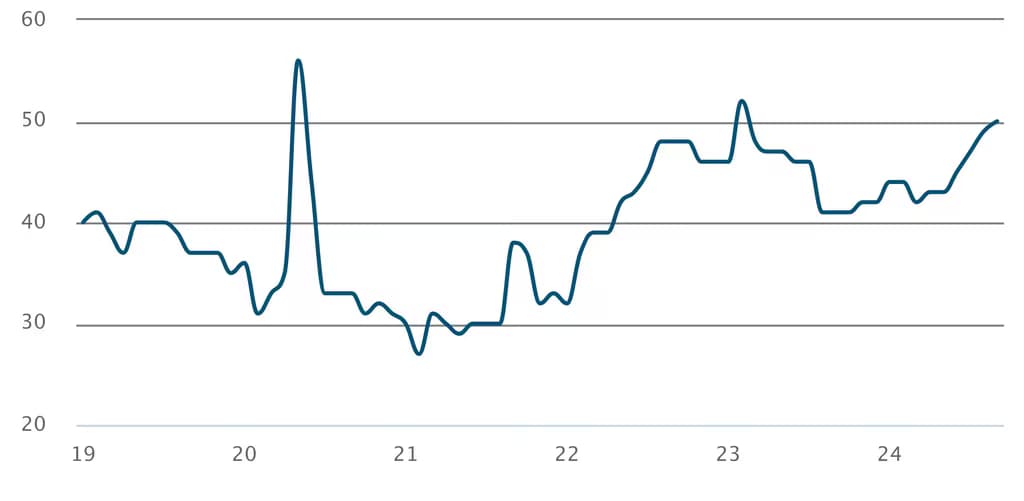
Monthly average days on the market, seasonally adjusted
...and our reaction
- It continues to take longer to sell a house, with the average length of time on the market increasing 2.6% from August (seasonally adjusted). It now takes a median of 50 days to sell (seasonally adjusted), the longest time to sell since February last year. The series continues to be volatile month on month, but it is now 23% higher than a year ago.
- Potential buyers will continue to have wider choice in the market, as the stock of property for sale remains high. As excess stock remains on the market, we expect house price growth to remain relatively subdued. We expect buyer numbers to remain relatively low as there remains limited opportunities in the labour market, and job security concerns continue.
- The first increase in house prices in early half a year is notable, and it could potentially signal a very early sign of a shift in the market. However, with stock levels high and since it is taking longer to sell a house, we don’t anticipate this is the start of a rapid reacceleration in the housing market. Instead, it reflects a slight shift in sentiment after interest rates began to be cut.
- Since September, mortgage rates have continued to fall as banks compete for limiting lending opportunities, with sales activity still subdued. There is still scope for another bumper interest rate cut in November from the Reserve Bank, following the recent 50-basis-point cut, contingent on economic data continuing to show continued weakness in line with the Bank’s expectations.
Latest updates
Premium

Real estate statistics
House sales and prices still falling
Thu 13 Aug 2026
Monthly
 10%pa House sales in July 20260.4%pa House prices from a year earlier9.3%pa Stock of homes for sale in July 2026
Premium
Real estate statistics
Conflict continues to drag on housing market in June
Wed 15 Jul 2026
Monthly
8.8% House sales between Feb and Jun 2026 (seas adj)0.8% House prices since February (seas adj)4.8% Stock of homes for sale since February (seas adj)Real estate statistics
House buyers dry up ahead of interest rate rises
Mon 15 Jun 2026
Monthly
13%pa House sales in May 20260.6%pa House prices from May 2025 Stock of homes for sale at an 11-year high
Real estate statistics
House prices and sales fall
Thu 14 May 2026
Monthly
7.9%pa House sales in Apr 20260.5% House prices from Mar 2026 (sa)1.2% Stock of homes for sale since Feb 2026 (sa)