Building work put in place
Construction activity continues to decline as expected
6 Sept 2024

Our take on the latest Building work put in place (Fri 6 Sept 2024)



Residential volumes down 0.7% from Mar 2024 (sa)
Non-residential volumes down 0.1% from Mar 2024 (sa)
Total quarterly activity in line with our forecasts, just 0.1% above expectations
The key numbers...
- Building work put in place fell 0.2% in the June 2024 quarter from the quarter before. The drop was driven by a 0.7% fall in residential activity, with a smaller 0.1% fall in non-residential activity (all figures seasonally adjusted).
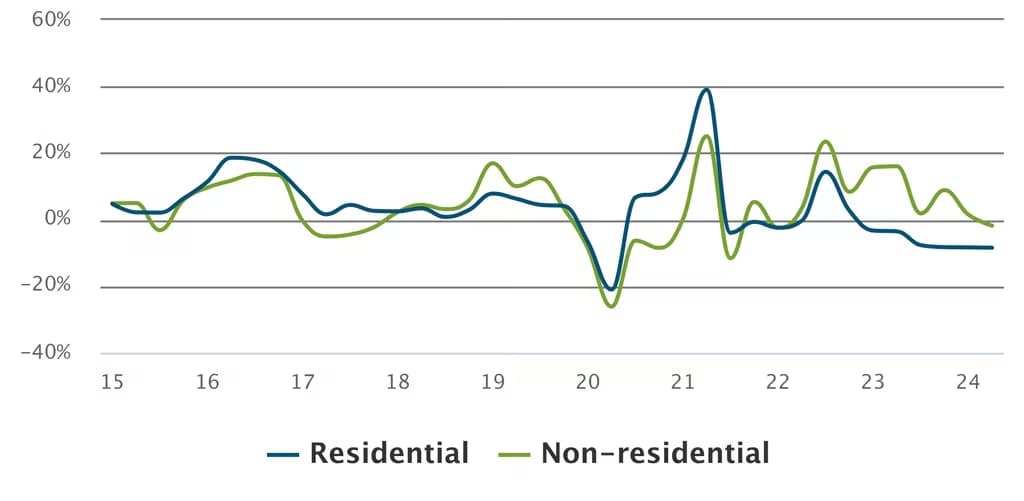
- The level of building activity in the June quarter was 6.1% lower than a year earlier, the largest annual decline since the Delta-lockdown-affected September 2021 quarter. The drop was driven by the sixth consecutive annual fall in residential activity.
- The volume of non-residential work fell 1.8%pa, the first annual fall for non-residential work volumes since the start of 2022.
Non-res volumes decline for the first time since March 2022
Annual % changes in building work put in place volumes
...and our reaction
- Construction activity continued to decline in June, although the pace of the decline in residential activity appeared to slow, with the 0.7% seasonally-adjusted fall being the smallest quarterly decline in a year. Residential additions and alterations continue to track higher than expected, reflecting the shift in tradespeople addressing the backlog of alterations work, with volumes up 8.8% from a year earlier.
- The first annual fall in non-residential volumes in two years reflects the shift in trend for this building type, with the reduction non-residential consent values over the first half of 2024 pointing towards a continued slowdown in non-residential work put in place.
- Overall, the fall in total building work put in place was in-line with our expectations in the June quarter, just 0.1% above our forecast. Both non-residential activity and residential activity were in-line with our expectations, at 0.2% and 0.1% higher than predicted respectively.
- The narrow non-residential outperformance was driven by accommodation building ($73m higher than expected). Some other outperformers were storage and education building types, which were $60m and $52m higher than expect respectively. This outperformance was offset by underperformance across other building types, with factories and offices being $77m and $59m lower than expected respectively.
- Residential activity was also largely in line with expectations, just 0.1% above our forecast. Although new dwellings make up the majority of residential construction and new building work was 2.8% lower than expected, residential alterations and additions were 20% higher than forecast, driving the narrow outperformance in residential activity.
- Despite interest rates starting to track lower following the first cut of the official cash rate from the Reserve Bank, building activity is still falling and it is too soon to start thinking about an upturn in activity, particularly given the tendency of non-residential construction to lag the rest of the economic cycle.
- We continue to forecast that overall construction activity will weaken throughout the remainder of 2024. Today’s data was aligned with our forecast at the aggregate level, suggesting the pace of this downturn is continuing to progress as expected.
Latest updates
Premium

Building work put in place
Construction activity at a 10-year low
Thu 4 Jun 2026
Quarterly
 13% Non-residential activity in March 2026 from March 20253.9% Residential activity from March 2025Total building activity at its lowest level (excl lockdowns) since 2015
Premium
Building work put in place
Non-residential work hammered as residential softens further
Thu 5 Mar 2026
Quarterly
6.5% Non-residential activity from September 2025 (sa)1.1% Residential activity from September 2025 (sa)Total building activity at its lowest level (excl lockdowns) since 2015Building work put in place
Non-residential activity continues to decline
Thu 4 Dec 2025
Quarterly
 Residential volumes up 3.3% in September from June 2025 (sa)Non-residential volumes down 1.3% in September from June 2025 (sa)Total quarterly activity now down 5.3% from September 2024
Building work put in place
Lower residential activity leads construction decline
Thu 4 Sept 2025
Quarterly
Residential volumes down 2.9% in June from March 2025 (sa)Non-residential volumes down 0.4% in June from March 2025 (sa)Total quarterly activity now down 9.6% from June 2024