
Our take on the latest Real estate statistics (Fri 13 Sept 2024)



House sales down 3.9% from July (sa)
House prices down 0.1% from July (sa)
Stock of properties for sale continues to rise
The key numbers...
- House sales in August declined 3.9% from July (seasonally adjusted), following a 19% jump in the previous month. The series has remained volatile since the turn of the year, although average monthly sales over the past 12 months are 13% above the year to August 2023.
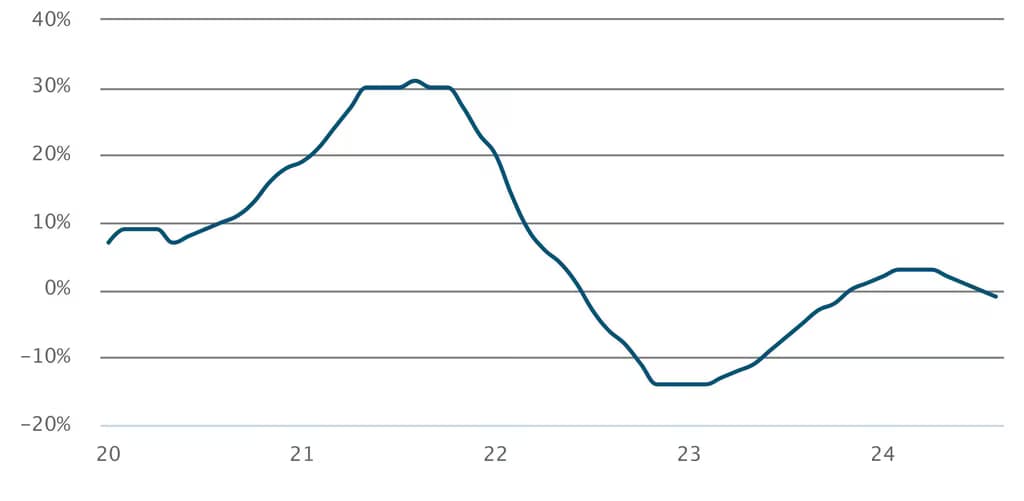
- House prices edged down 0.1% in August from July (seasonally adjusted). Annual house price slipped from +0.2% in July to -0.8%pa, turning negative for the first time since November 2023.
- Prices fell by as much as 3.5% on a regional basis from July, led by Marlborough (-3.5%), Gisborne (-2.6%), and Tasman (-2.0%). A few outliers that saw growth were Nelson (1.8%), Northland (1.6%), and Auckland (0.9%, all figures seasonally adjusted).
- The stock of properties for sale rose 0.9% from July, the ninth consecutive monthly rise, taking the stock over 33,000 for the first time since June 2015. New listing numbers fell 6.0% from July, although they remain 8.1% higher than a year ago (all figures seasonally adjusted).
Annual house price growth turns negative
REINZ House Price Index, annual % change
...and our reaction
- Most regions saw a decline in sales volumes in August compared to July, with Otago (17%), Gisborne (13%) and Southland (13%) seeing the biggest moderations (all figures seasonally adjusted).
- The average length of time on the market jumped up 4.7% from July (seasonally adjusted). The series continues to be volatile month on month, but it is now (19%) higher than a year ago.
- The lack of opportunities in the labour market along with decreasing job security will be at the forefront of homeowners’ and potential buyers’ minds. As a result, we expect it to be mid-2025 before buyer numbers start to pick up, despite the beginning of easier monetary policy by the Reserve Bank and falling mortgage rates.
- Once buyer numbers eventually pick up, we do not expect it to translate into material house price growth while there continues to be an excess stock of properties for sale.
Latest updates
Premium

Real estate statistics
House sales and prices still falling
Thu 13 Aug 2026
Monthly
10%pa House sales in July 20260.4%pa House prices from a year earlier9.3%pa Stock of homes for sale in July 2026Premium
Real estate statistics
Conflict continues to drag on housing market in June
Wed 15 Jul 2026
Monthly
8.8% House sales between Feb and Jun 2026 (seas adj)0.8% House prices since February (seas adj)4.8% Stock of homes for sale since February (seas adj)Real estate statistics
House buyers dry up ahead of interest rate rises
Mon 15 Jun 2026
Monthly
13%pa House sales in May 20260.6%pa House prices from May 2025 Stock of homes for sale at an 11-year high
Real estate statistics
House prices and sales fall
Thu 14 May 2026
Monthly
7.9%pa House sales in Apr 20260.5% House prices from Mar 2026 (sa) 1.2% Stock of homes for sale since Feb 2026 (sa)