Labour market statistics
Unemployment rises, public sector settlements lift labour costs
7 Aug 2024

Our take on the latest Labour market statistics (Wed 7 Aug 2024)


Unemployment rate up to 4.6%
Public sector labour cost index up record 6.9%pa
Underutilisation rate up at 11.8%
The key numbers...
- The unemployment rate rose to 4.6% in the June 2024 quarter from a revised 4.4% (seasonally adjusted) rate in March, lifting slightly less than analysts anticipated (4.7%) to remain at the highest level since March 2021.
- The underutilisation rate lifted from 11.2% to 11.8%, showing further slack in the labour market. Increasing youth (15-24-year-olds) underutilisation has contributed to almost half (44%) of the annual increase in underutilisation.
- The NEET rate, (the proportion of young people 15-24 not in employment, education, or training) increased to 12.8% from 11.7% last quarter (seasonally adjusted). Growth in the labour force outpaced employment growth for seventh consecutive quarter with employment rising 0.4% (having fallen 0.3% last quarter), as the labour force grew 0.7%. The working age population continued to grow (0.44%) but at a slower rate as net migration has eased.
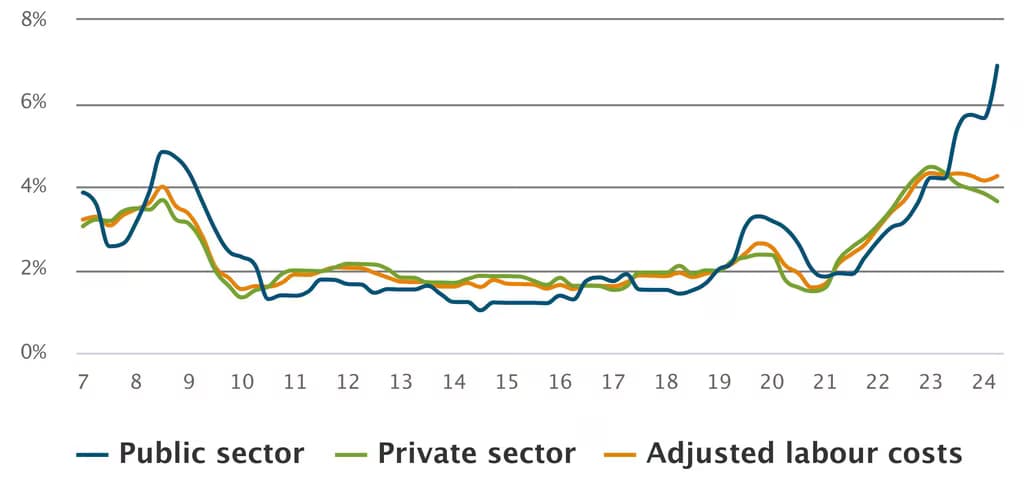
- The labour cost index rose to 4.3%pa in June 2024 (seasonally adjusted), up from 4.1%pa in the previous quarter, with the reacceleration driven by higher growth in public sector pay. Public sector wage inflation rose from 5.6%pa in March to a series high 6.9%pa in June, even as private sector wage growth continued to ease for the fifth consecutive quarter, to 3.6%pa.
Public sector pay settlements push up LCI
Labour cost index, annual % changes
...and our reaction
- The labour market is weakening further, as expected, and today’s data indicates that this weakening is “on track” and broadly in line with expectations.
- Importantly, the labour market data released today wasn’t so overly weak that it should force an about-face, and an interest rate cut when the Monetary Policy Committee issues its Monetary Policy Statement next week.
- The labour market is clearly weaker, with unemployment and underutilisation up, but the rise in employment, after an unexpected fall last quarter, does make it slightly trickier to understand the speed of this weakening.
- Regardless, we expect the unemployment rate to push up to 5.0% towards the end of 2024, reinforcing the easing in economic pressures which the Reserve Bank wants to see before it is confident that inflation will return to and stay within the 1-3%pa target band.
- Of some concern is the fact that labour costs are higher, but only because public sector labour cost growth has not yet shown any sign of easing. That trend is due to previous settlements coming into effect, and we take more from the easing in private sector labour cost growth that shows that job availability is limiting wage demands.
- Increasing underutilisation indicates that the cost-of-living pressures are continuing to hit household budgets as workers look for additional hours to meet mortgage costs and other essentials, but that the weaker labour market makes it harder to find those hours.
- We would highlight that the unemployment rate was exactly what the Reserve Bank picked in its May MPS, and is consistent with its forecast to not reduce the official cash rate until August 2025! Despite no one believing this forecast, we’re not sure what the Bank will do next, and as a result we’ll wait until we hear an explanation and revised view from the Bank next week before we formally review our interest rate expectations.
Latest updates
Premium

Labour market statistics
Unemployment jumps higher than expected
Wed 5 Aug 2026
Quarterly
5.6% Unemployment rate in the June 2026 quarter (s.a.)70.7% Participation rate the highest in over a year0.5% Employment growth in June from March (s.a.)Premium
Labour market statistics
More people, more working, more not participating
Wed 6 May 2026
Quarterly
 5.3% Unemployment rate eased slightly in the March 2026 quarter
 70.4% Participation rate fell slightly0.2% Employment rose in March from December (s.a.)
Labour market statistics
Higher participation drives unemployment increase
Wed 4 Feb 2026
Quarterly
5.4% Unemployment rate December 2025 quarter (sa)70.5% Participation rate December 2025 quarter (sa)2.0%pa Labour Cost Index Year to December 2025Labour market statistics
Unemployment rate rises to 5.3%
Wed 5 Nov 2025
Quarterly
Unemployment rate edges up to 5.3%Youth NEET rate rises to 13.2% (annual average)Labour cost growth slows to 2.1%pa