
Our take on the latest Ready-mixed concrete (Thu 9 May 2024)

Concrete volumes down 3.7% from Dec 2023 (sa)
Annual concrete volumes down by 11%pa
Weakest Wellington result since Dec 2014 (excl. lockdowns)
The key numbers...
- Annual ready-mixed concrete volumes fell to 4.02m cubic metres in March 2024, down 11% from the March 2023 year.
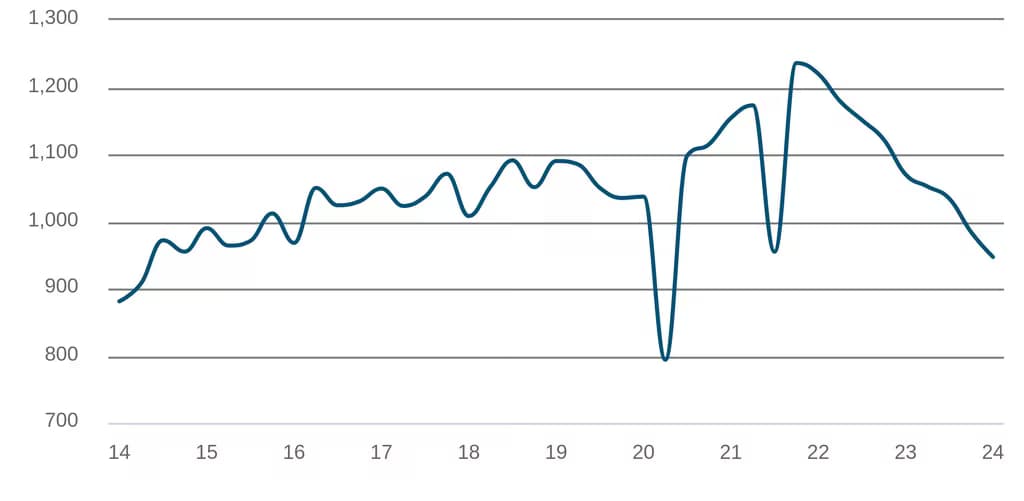
- On a seasonally adjusted basis, ready-mixed concrete volumes fell 3.7% from the December 2023 quarter, taking volumes to their lowest level since June 2014 excluding the pandemic period.
- Most regions continue to struggle, with the largest quarterly decline of 13% occurring in the Waikato/Bay of Plenty region. Volumes in the Wellington Metropolitan area fell to their lowest level since December 2014, as residential consent numbers have fallen substantially, and non-residential work in the area is also slowing substantially as public sector spending and employment come under the spotlight.
- The only regions with an increase in volumes from the December 2023 quarter were Gisborne/Hawke’s Bay (up 10%) and Canterbury (up 2.1%). Both regions had recorded sharp declines in volumes in the previous two quarters.
Concrete volumes fall even further
000m3, quarterly ready-mixed concrete volumes, seas. adj.
...and our reaction
- Concrete volumes remain on a downward trajectory as construction activity continues to slow across New Zealand.
- Residential consents are still falling, although there are signs of a possible stabilisation later this year, as the annual decline in standalone house consents has moderated in the past few months.
- Tight public sector spending conditions, combined with weakness in private sector consents across many building types, including retail and storage buildings have resulted in weaker non-residential consents over the last nine months.
- Although there is a considerable amount of non-residential consented work in the pipeline, concrete volumes are still expected to continue moderating over the next two years as construction work eases, particularly given that concrete usage tends to be relatively early in the construction process.
Latest updates
Premium

Ready-mixed concrete
Further concrete rise supported by South Island growth
Wed 12 Aug 2026
Quarterly
 12%pa Concrete volumes in Jun 2026 quarter
 22%pa Concrete volumes in the South Island
 Volumes above 1 million m3 for the first time in 2½ years
Premium
Ready-mixed concrete
South Island drives continued growth in concrete
Tue 12 May 2026
Quarterly
1.8%pa Concrete volumes in Mar 2026 quarter1.1% Concrete volumes from Dec 2025 quarter (sa)21% Christchurch concrete volumes from Mar 2025 quarterReady-mixed concrete
A turning point for concrete volumes?
Wed 11 Feb 2026
Quarterly
0.4%pa Concrete volumes from Dec 2024 quarter2.4% Concrete volumes from Sep 2025 quarter (sa)South Island leads growthReady-mixed concrete
Concrete volumes still under pressure
Wed 12 Nov 2025
Quarterly
Concrete volumes in Sep quarter up 2.3% from Jun (sa)Annual concrete volumes down by 6.2%paAnnual concrete volumes in Otago/Southland up by 5.1%pa