Labour market statistics
Labour market eases slowly, cost increases lingering
7 Feb 2024

Our take on the latest Labour market statistics (Wed 7 Feb 2024)


Labour cost growth steady at 4.3%pa
Unemployment rate up to 4.0%
Modest quarterly employment growth of 0.4%
The key numbers...
- The unemployment rate rose from 3.9% to 4.0% (seasonally adjusted) in the December 2023 quarter, reaching its highest level in 2½ years. However, the softening in the labour market was at the smaller end of market expectations.
- The underutilisation rate lifted from 10.4% to 10.7%, and it has not been higher since March 2021. The 39%pa lift in the number of people underemployed and actively seeking more hours was the biggest increase since 2009.
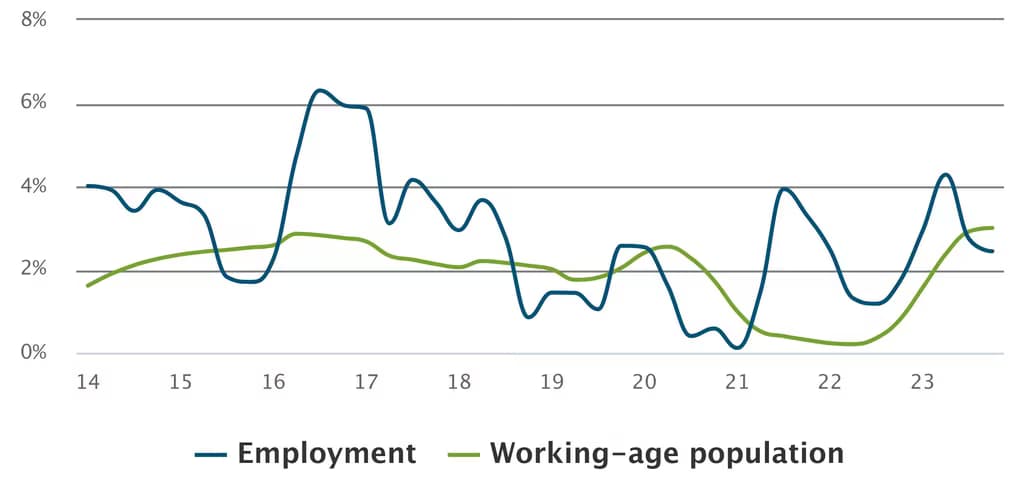
- For the fifth quarter in a row, quarterly employment growth was slower than growth in the labour force. During that period, the working-age population has expanded by 3.5%, with immigration lifting substantially since the borders were reopened in mid-2022.
- Growth in the labour cost index held steady at 4.3%pa. Public sector labour cost growth accelerated to a record high of 5.7%pa, with a catch-up period following the public sector Covid pay freeze between 2020 and March 2023. Underpinning the latest result were collective agreements for primary and secondary teachers and pay equity for nurses.
- In contrast to the public sector, private sector labour cost growth has eased from 4.3% to 3.9%pa since mid-2023.
Working-age population now outpacing employment
Annual % changes
...and our reaction
- Although today’s data showed a gradual easing in the labour market to finish 2023, it was a modest easing, which was less than either the market or Reserve Bank were expecting.
- With the unemployment rate back to a neutral level of 4.0%, the key for the Reserve Bank now is to see a more definite easing in labour cost pressures, to give the Bank confidence that lingering wage growth will not lead to more persistent inflation during 2024/25.
- Record high net migration is fuelling growth in the labour supply that is outpacing employment growth, even though the latter has remained relatively positive. Although migration is set to ease during 2024, the flow of people into New Zealand is likely to create more slack in the labour market throughout this year.
- As a result, private sector labour cost growth is likely to continue its slowing trend during 2024. Central government restraint in terms of both spending and staffing numbers is likely to also see public sector cost growth easing by the end of this year.
- We continue to expect the unemployment rate to push up to 5.0% by the second half of 2024, facilitating cuts to the official cash rate from August this year.
Latest updates
Premium

Labour market statistics
Unemployment jumps higher than expected
Wed 5 Aug 2026
Quarterly
 5.6% Unemployment rate in the June 2026 quarter (s.a.)70.7% Participation rate the highest in over a year0.5% Employment growth in June from March (s.a.)
Premium
Labour market statistics
More people, more working, more not participating
Wed 6 May 2026
Quarterly
 5.3% Unemployment rate eased slightly in the March 2026 quarter
 70.4% Participation rate fell slightly0.2% Employment rose in March from December (s.a.)
Labour market statistics
Higher participation drives unemployment increase
Wed 4 Feb 2026
Quarterly
5.4% Unemployment rate December 2025 quarter (sa)70.5% Participation rate December 2025 quarter (sa)2.0%pa Labour Cost Index Year to December 2025Labour market statistics
Unemployment rate rises to 5.3%
Wed 5 Nov 2025
Quarterly
Unemployment rate edges up to 5.3%Youth NEET rate rises to 13.2% (annual average)Labour cost growth slows to 2.1%pa