Real estate statistics
House price momentum weakens and sales remain soft in December
18 Jan 2024

Our take on the latest Real estate statistics (Thu 18 Jan 2024)

House prices ease 0.6% in December (seasonally adjusted)
Sales 11% below Sep 2023 peak (seasonally adjusted)
Median period to sell reduces to 36 days
The key numbers...
- Nationwide house price growth stalled in December, with prices easing 0.6% from November on a seasonally adjusted basis. This softness was driven by Auckland, where prices eased 1.7%, compared to a 0.1% increase across the rest of New Zealand.
- Annual house price growth remained positive in Auckland, the West Coast, Canterbury, and Southland. Growth turned positive in Northland and Tasman for the first time since mid-2022.
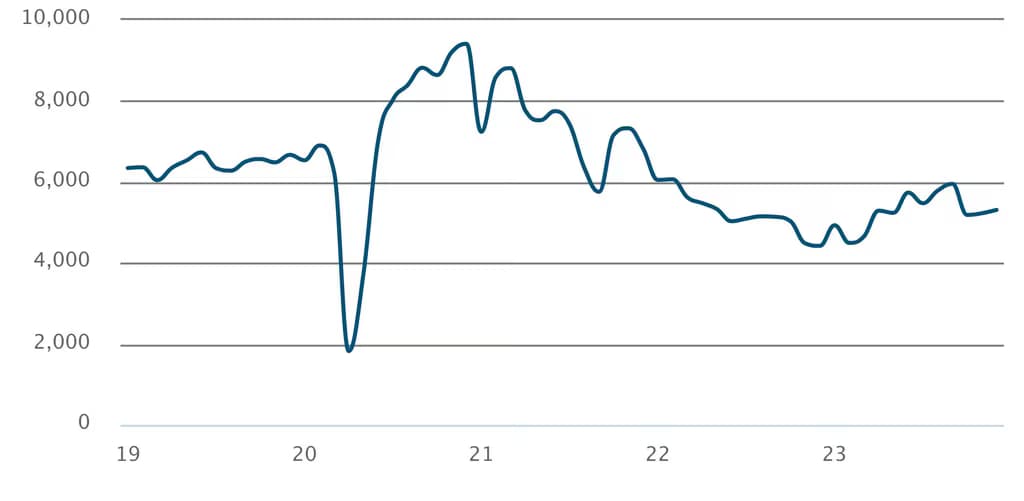
- House sales rose 1.6% from November (seasonally adjusted), but a failure in sales volumes to recover from a particularly sharp decline in October around election time means that sales remain considerably below June to September levels.
House sales stumble in late 2023
Seasonally adjusted monthly house sales (REINZ)
...and our reaction
- Weakness in prices and the loss of momentum in sales activity compared to earlier in 2023 points to some post-election uncertainty still hanging over the market. Mortgage rates are also considerably higher compared to pre-election, with the fixed one-year rate rising from 7.15% in September, to 7.3%, which could be further subduing demand.
- Although affordability is the key constraint on the housing market, continued softness in sales suggests some potential buyers are still uncertain how the election result will affect the property market and wider economy. Part of the National government’s 100-day plan includes repealing the Spatial Planning and Natural and Built Environment Act and introducing a fast-track consenting regime; sentiment may begin to improve in the market as these actions firm up and looser investor taxation is implemented.
- In November, the Reserve Bank signalled that it believes the official cash rate will stay higher for longer, and rising shipping costs due to conflict around the Red Sea now present an additional inflationary risk. Plunging wholesale interest rates towards the end of 2023 did start to see two- and three-year mortgage rates ease, but they remain at very high levels. Essentially, rates are unlikely to come down meaningfully any time soon.
- The housing market should move over this hump and continue improving modestly into 2024 as the new government reduces regulation and taxation. Migration is likely to stabilise and moderate demand for housing, while difficult affordability conditions remain a large barrier for market entrants, limiting the scope for rapid house price growth.
Latest updates
Premium

Real estate statistics
House sales and prices still falling
Thu 13 Aug 2026
Monthly
 10%pa House sales in July 20260.4%pa House prices from a year earlier
 9.3%pa Stock of homes for sale in July 2026
Premium
Real estate statistics
Conflict continues to drag on housing market in June
Wed 15 Jul 2026
Monthly
8.8% House sales between Feb and Jun 2026 (seas adj)0.8% House prices since February (seas adj)4.8% Stock of homes for sale since February (seas adj)Real estate statistics
House buyers dry up ahead of interest rate rises
Mon 15 Jun 2026
Monthly
13%pa House sales in May 20260.6%pa House prices from May 2025 Stock of homes for sale at an 11-year high
Real estate statistics
House prices and sales fall
Thu 14 May 2026
Monthly
7.9%pa House sales in Apr 20260.5% House prices from Mar 2026 (sa) 1.2% Stock of homes for sale since Feb 2026 (sa)