Building work put in place
Non-residential construction softens amid worsening residential decline
5 Dec 2023

Our take on the latest Building work put in place (Tue 5 Dec 2023)

Total construction work volumes down 2.4% in September quarter (seasonally adjusted)
Residential construction declines accelerate to 7.7%pa (inflation adjusted)
Waning momentum in factory, farm, retail, and office building
The key numbers...
- Construction work volumes eased 2.4% from the June quarter on a seasonally adjusted basis, with a larger fall in non-residential volumes (down 5.9%) than residential (down 0.6%).
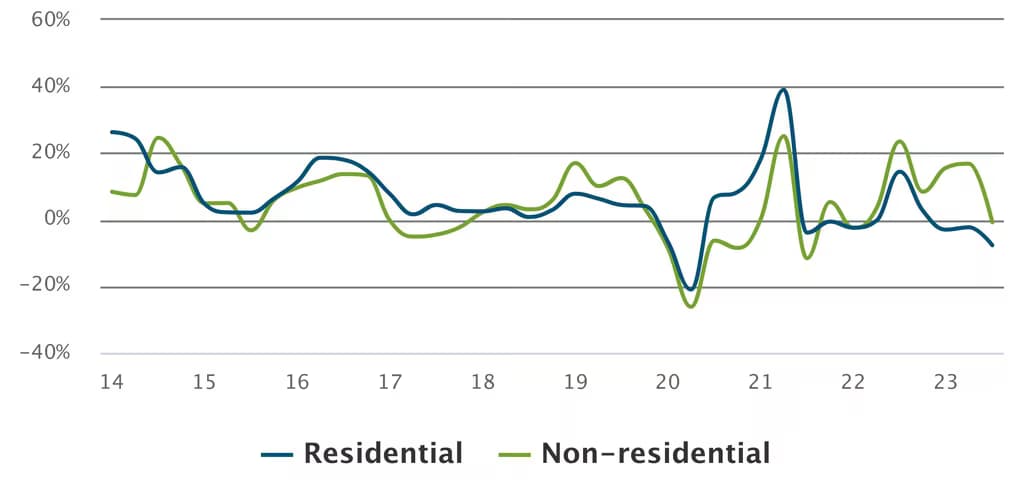
- After adjusting for the rise in building costs, the annual decline in residential construction is estimated to have accelerated to 7.7%pa in the September quarter.
- New dwelling construction eased 4.5%pa in the September quarter in nominal terms, while alteration and addition values rose 11%pa.
- Wellington continues to lead the residential construction decline, with volumes easing 15%pa. Residential construction growth remained weakly positive in Auckland, at 3.2%pa.
- Non-residential construction volumes eased 0.8%pa in the September quarter in real terms, the first annual decline for the sector since early 2022.
- The value of storage and factory building declined notably from the September 2022 quarter, easing by $29m and $16m respectively. There were also large declines in farm (-$12m) and retail (-$11m) construction. Growth in office construction slowed to 4.4%pa after two years of double-digit growth.
- The value of quarterly hospital construction lifted 44%pa in the September quarter, by far the most rapid growth across the building types.
- The value of non-residential construction eased 21%pa in Wellington in the September quarter, and persistent building cost inflation points to an even greater decline in actual activity. Non-residential construction values grew 22%pa in Waikato and 11%pa in Auckland.
Residential decline continues as non-res plateaus
Annual % changes, Sept 1999 prices
...and our reaction
- Annual residential construction activity eased (in real terms) at its fastest rate since 2011, excluding the 2020 lockdown. Declining consents over the last few quarters are translating rapidly to weaker activity, and the backlog of consents from 2021 and early-2022 that has supported the residential pipeline thus far might be approaching completion.
- However, nominal residential construction growth was stronger in the September quarter than we had previously forecast, particularly for alterations and additions. The lift to employment from strong net migration is likely to have alleviated some capacity pressures across the industry, helping boost work on previously deferred alterations projects.
- The outlook for residential construction remains subdued, despite the slight uptick in house prices, with residential consent numbers having fallen 21% over the last year.
- Non-residential construction weakened slightly in the September quarter, suggesting that activity is at, or near, its peak. Private sector consenting has begun to decline over the past few months, and is now filtering through to weaker activity across a variety of building types. Hospital and education building continue to grow strongly, and will moderate the broader downturn in activity during 2024 and 2025.
- Several large projects remain in the pipeline, including major hospital redevelopments in the Hawke’s Bay, Tauranga, and Whangārei, which will help to keep non-residential construction above pre-pandemic levels even as it softens from a peak.
Latest updates
Premium

Building work put in place
Construction activity at a 10-year low
Thu 4 Jun 2026
Quarterly
 13% Non-residential activity in March 2026 from March 20253.9% Residential activity from March 2025
 Total building activity at its lowest level (excl lockdowns) since 2015
Premium
Building work put in place
Non-residential work hammered as residential softens further
Thu 5 Mar 2026
Quarterly
6.5% Non-residential activity from September 2025 (sa)1.1% Residential activity from September 2025 (sa)Total building activity at its lowest level (excl lockdowns) since 2015Building work put in place
Non-residential activity continues to decline
Thu 4 Dec 2025
Quarterly
 Residential volumes up 3.3% in September from June 2025 (sa)Non-residential volumes down 1.3% in September from June 2025 (sa)Total quarterly activity now down 5.3% from September 2024
Building work put in place
Lower residential activity leads construction decline
Thu 4 Sept 2025
Quarterly
Residential volumes down 2.9% in June from March 2025 (sa)Non-residential volumes down 0.4% in June from March 2025 (sa)Total quarterly activity now down 9.6% from June 2024