Labour market statistics
Weaker employment points to slowing labour costs next year
1 Nov 2023

Our take on the latest Labour market statistics (Wed 1 Nov 2023)



Labour cost growth unchanged at 4.3%pa
Unemployment rate up to 3.9%
Employment rate falls for first time since March 2022
The key numbers...
- The unemployment rate rose to 3.9% in the September quarter, in line with market expectations. Underutilisation pushed up to a new post-pandemic high of 10.4%, driven primarily by an increase in unemployed people of 8,000. An increase of 7,000 to the number of underemployed people – those people working part-time but available for or wanting more hours – was also a major contributor to rising underutilisation.
- The seasonally adjusted working age population expanded by 31,000 people from the June 2023 quarter, with almost all this growth ending up in the ”not in labour force” group. Illness and study or training were the top contributing reasons for the increase in people in the ”not in labour force” group.
- The number of employed people fell by 6,000 from the June quarter (seasonally adjusted), having previously increased for more than a year. Falling employment at the same time as the working age population increased caused the employment rate to ease 0.7 percentage points, to 69.1%. This result is the first quarterly decline since March 2022, and the largest decline since late 2020, but the employment rate remains significantly elevated compared to the long-term average.
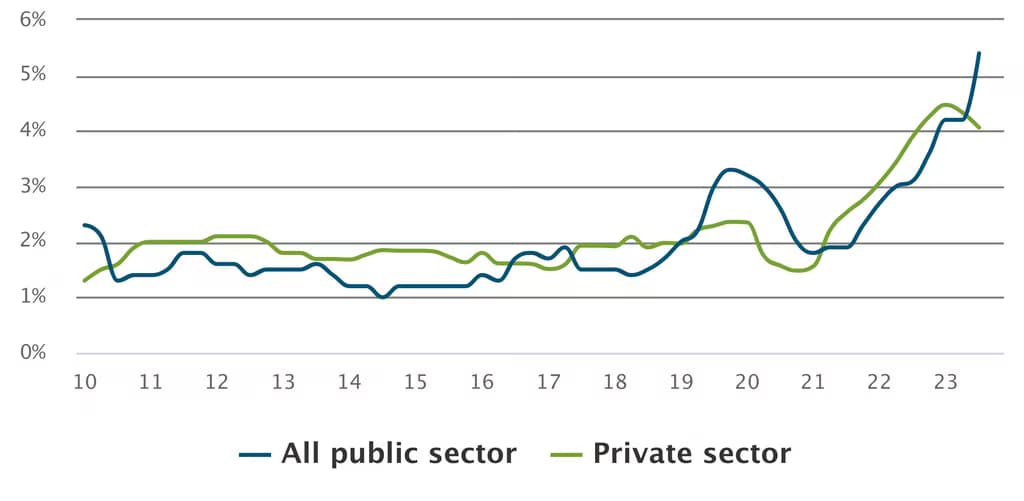
- Labour cost inflation remained steady at 4.3%pa, kept elevated by increasing public sector salaries and wages. Annual labour cost inflation for the public sector accelerated from 4.2% in June to 5.4% in September. This result was highly influenced by collective agreements for teachers, nurses, and the Defence Force coming into effect.
- Annual private sector labour cost inflation eased 0.2 percentage points from June to 4.1%, with the number of private sector jobs experiencing pay increases also easing for the fourth consecutive quarter.
Health, defence, and teacher agreements keep labour cost inflation high
Adjusted labour cost index, annual % changes
...and our reaction
- Rising unemployment and underutilisation affirmed that spare capacity in the labour market is increasing.
- Young people aged 15-24 were responsible for around half the total annual increase in underutilisation, suggesting renewed interest in study or training as new job advertisements decline and migration heats up competition for jobs.
- Softening employment will help relieve some of the Reserve Bank’s concerns around demand-side inflationary risks. Although labour cost growth remained stubbornly high in the September quarter, much of this result is likely to be temporary, due to collective agreements in the public sector. Following these agreements, public sector wage growth will remain elevated, but quarterly increases should be smaller in the final quarter of 2023 and into 2024.
- Slower growth in private sector wages and salaries is an encouraging sign that labour shortages are posing fewer constraints for businesses, and that the contribution of migrants to the labour force will continue to be a relief valve for wage cost pressures. We expect that annual employment growth will ease during 2024 as remaining labour market holes are filled and businesses slow down hiring in response to softer consumer demand.
Latest updates
Premium

Labour market statistics
Unemployment jumps higher than expected
Wed 5 Aug 2026
Quarterly
 5.6% Unemployment rate in the June 2026 quarter (s.a.)70.7% Participation rate the highest in over a year0.5% Employment growth in June from March (s.a.)
Premium
Labour market statistics
More people, more working, more not participating
Wed 6 May 2026
Quarterly
5.3% Unemployment rate eased slightly in the March 2026 quarter 70.4% Participation rate fell slightly0.2% Employment rose in March from December (s.a.)
Labour market statistics
Higher participation drives unemployment increase
Wed 4 Feb 2026
Quarterly
5.4% Unemployment rate December 2025 quarter (sa)70.5% Participation rate December 2025 quarter (sa)2.0%pa Labour Cost Index Year to December 2025Labour market statistics
Unemployment rate rises to 5.3%
Wed 5 Nov 2025
Quarterly
Unemployment rate edges up to 5.3%Youth NEET rate rises to 13.2% (annual average)Labour cost growth slows to 2.1%pa