Real estate statistics
House prices rise further in October, momentum wanes in sales
16 Nov 2023

Our take on the latest Real estate statistics (Thu 16 Nov 2023)


Nationwide house prices up 0.6% from September (seasonally adjusted)
Quarterly sales growth eases to 2.1% (seasonally adjusted)
Median period to sell falls to 37 days
The key numbers...
- House prices across New Zealand rose 0.6% in October (seasonally adjusted), driven by a 1.0% increase in Auckland. The average increase outside of Auckland was 0.2%.
- In all regions, annual house price declines eased over the three months to October. Three-month annual house price growth remained positive in Southland (up 1.3%pa). Taranaki and Canterbury are likely to turn positive soon, with declines easing to 0.9%pa and 0.7%pa respectively.
- The median sales period continued to fall in October, easing 2.3% from September (seasonally adjusted) to 37 days.
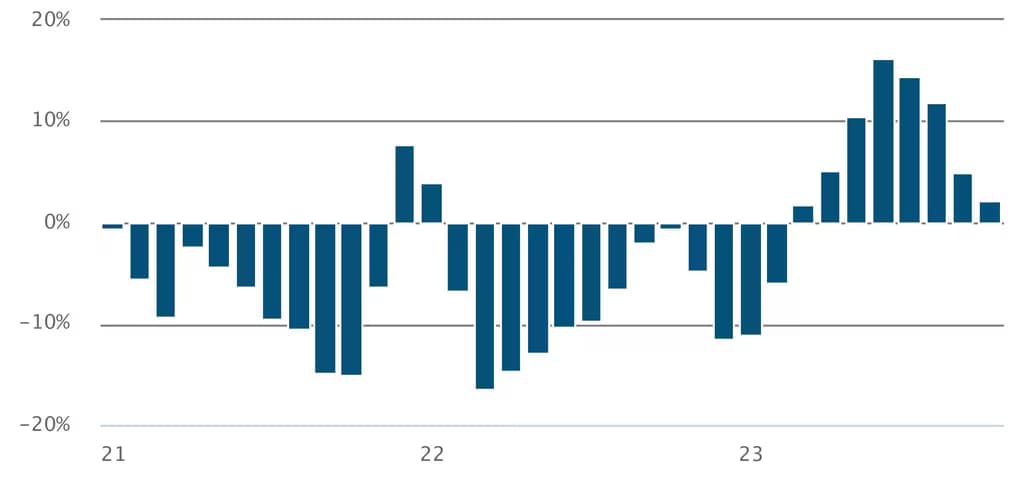
- On a seasonally adjusted basis, nationwide house sales rose 2.1% over the three months to October, compared to the previous three months. However, this result is down from a peak of 16% over the three months to June.
Sales growth positive, but becoming more muted
REINZ house sales, quarterly % changes (sa)
...and our reaction
- Continued growth in sales and prices, as well as a falling sales period, indicates that the housing market is maintaining its upward trend.
- The election result has likely also helped to firm up investor confidence, with investor taxation set to be more relaxed under a National government. Because the election was in mid-October, its effect should be more evident in the November figures.
- However, falling momentum in sales makes it clear that the scope for housing market growth is limited. Affordability is the major constraint, with one-year fixed mortgage rates pushing to 7.7% in October, up from 6.2% in October 2021.
- We expect sales activity to be supported into 2024 by the lagged effect from the migration surge and looser tax regulations under National, but high debt-servicing costs and a weaker labour market will keep a lid on growth.
Latest updates
Premium

Real estate statistics
House sales and prices still falling
Thu 13 Aug 2026
Monthly
 10%pa House sales in July 20260.4%pa House prices from a year earlier
 9.3%pa Stock of homes for sale in July 2026
Premium
Real estate statistics
Conflict continues to drag on housing market in June
Wed 15 Jul 2026
Monthly
8.8% House sales between Feb and Jun 2026 (seas adj)0.8% House prices since February (seas adj)4.8% Stock of homes for sale since February (seas adj)Real estate statistics
House buyers dry up ahead of interest rate rises
Mon 15 Jun 2026
Monthly
13%pa House sales in May 20260.6%pa House prices from May 2025 Stock of homes for sale at an 11-year high
Real estate statistics
House prices and sales fall
Thu 14 May 2026
Monthly
7.9%pa House sales in Apr 20260.5% House prices from Mar 2026 (sa)1.2% Stock of homes for sale since Feb 2026 (sa)