Building work put in place
Residential downturn weighs on construction activity
6 Sept 2023

Our take on the latest Building work put in place (Wed 6 Sept 2023)



Total construction work volumes down 0.1% in June quarter (seasonally adjusted)
Residential construction activity down 2.0% in June quarter (seasonally adjusted)
Health and social/cultural construction activity driving non-residential growth
The key numbers...
- Construction work put in place volumes eased 0.1% in the June quarter from March.
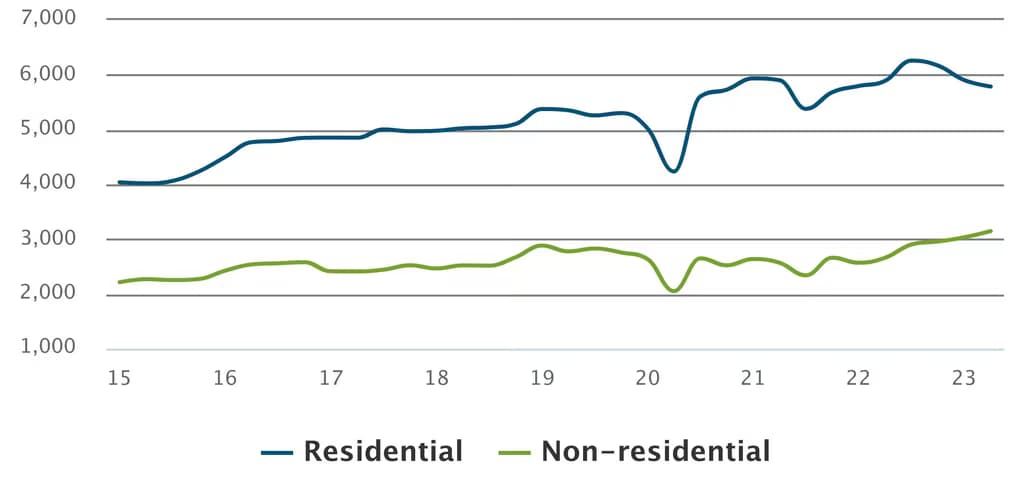
- The fall in overall construction activity was driven by residential construction activity, with residential work put in place volumes down 2.0% (seasonally adjusted) in June – and having now fallen for three consecutive quarters.
- The weaker residential building activity seen in June come on top of a downwards revision of 3.5% to March 2023 quarter residential work put in place, leaving residential work down 6.2% over 2023 so far.
- Residential construction volumes are now lower than a year ago, falling 1.9%pa in June. Wellington region led the annual decline with a 13%pa fall in residential work put in place, suggesting an even more substantial fall in volumes given higher building costs.
- Non-residential construction moved in the opposite direction and gained further momentum, supporting overall volumes with a 3.7% increase in June (seasonally adjusted).
- The continue rise in non-residential construction work put in place has seen volumes up 18%pa from June 2022. Waikato and Canterbury continue to drive growth, with the value of non-residential construction growing 52%pa and 37%pa respectively.
- Growth in health and social/cultural building types led growth in non-residential activity in the June quarter, rising 50%pa and 49%pa respectively. Farm construction declined on an annual basis for the first time since mid-2020.
Residential activity eases as non-res grows
Quarterly WPIP, seasonally adjusted, Sep-22 $m
...and our reaction
- Weakening residential consent figures over the past few quarters are now filtering through into less building activity. Nominal residential construction softened to 5.8%pa in the June quarter, considerably behind estimated residential building cost inflation of 7.8%pa. Growth in Auckland residential construction activity continues to slow, pointing to a levelling out of real construction volumes as building costs keep rising.
- Nominal residential construction growth was softer in the June quarter than we had previously forecast. Although this result was made more pronounced by Stats NZ’s revisions, weakening residential construction trends over the last three quarters reinforces our view of the continued residential construction downturn across New Zealand.
- Growth in non-residential construction accelerated further in June, supported by government investment in health infrastructure. Construction of a new Waikato Regional Renal Centre began in April, and the new Dunedin Hospital build remains a major project.
- Construction of the Te Kaha stadium continued in Canterbury during the June quarter, and is expected to open in mid-2026.
- We expect non-residential construction volumes to continue supporting building activity, reaching a peak in late-2023 but softening over 2024 and 2025 as weak economic conditions weigh on the sector.
Latest updates
Premium

Building work put in place
Construction activity at a 10-year low
Thu 4 Jun 2026
Quarterly
13% Non-residential activity in March 2026 from March 20253.9% Residential activity from March 2025 Total building activity at its lowest level (excl lockdowns) since 2015
Premium
Building work put in place
Non-residential work hammered as residential softens further
Thu 5 Mar 2026
Quarterly
6.5% Non-residential activity from September 2025 (sa)1.1% Residential activity from September 2025 (sa)Total building activity at its lowest level (excl lockdowns) since 2015Building work put in place
Non-residential activity continues to decline
Thu 4 Dec 2025
Quarterly
Residential volumes up 3.3% in September from June 2025 (sa)Non-residential volumes down 1.3% in September from June 2025 (sa)Total quarterly activity now down 5.3% from September 2024Building work put in place
Lower residential activity leads construction decline
Thu 4 Sept 2025
Quarterly
Residential volumes down 2.9% in June from March 2025 (sa)Non-residential volumes down 0.4% in June from March 2025 (sa)Total quarterly activity now down 9.6% from June 2024