
Our take on the latest Real estate statistics (Wed 13 Sept 2023)


House prices excl. Auckland up 0.8% in July (seasonally adjusted)
Auckland house prices up 1.1% in July (seasonally adjusted)
Median period to sell falls to 43 days
The key numbers...
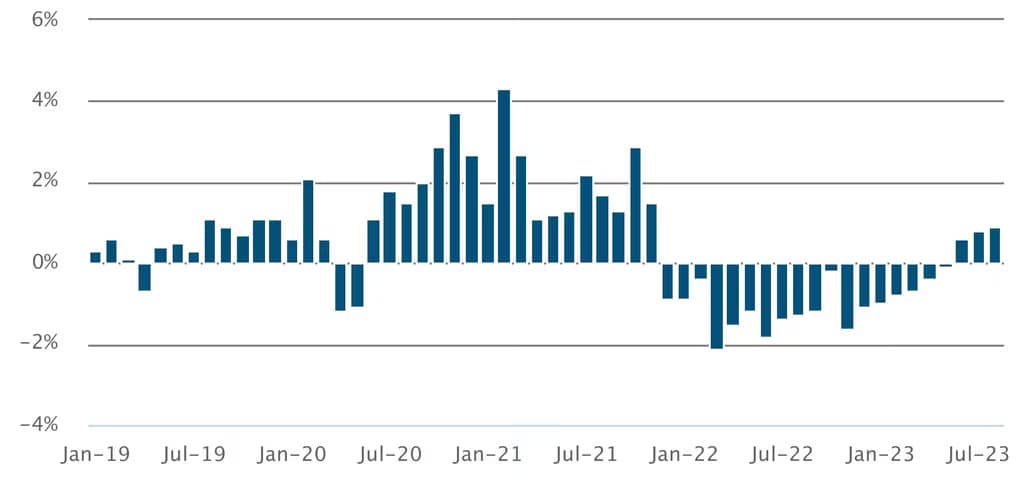
- House prices rose for a third consecutive month in August, providing further evidence of a shift in trend after more than a year of declines. Nationwide prices rose 0.9% from July, lifting slightly faster (1.1%) in Auckland (all figures seasonally adjusted).
- Prices are now higher on an annual basis in Taranaki and Southland. Across almost all other regions, declines are continuing to ease, and Canterbury is likely the next to turn positive on an annual basis.
- The median sales period fell to 43 days in August, an 8.2% decline from July on a seasonally adjusted basis. The current time to sell is now the fastest since mid-2022 and is 20% below the February 2023 peak.
- Over the three months to August, house sales rose on an annual basis in all regions except Gisborne, Southland, and Tasman. The most rapid house sale growth has been in Canterbury, with house prices up 20%pa over the last three months.
House prices rise for a third consecutive month
REINZ House Price Index, monthly % changes (sa)
...and our reaction
- Another slight increase in house prices and a fall in the median sales period in August affirms our view that housing market activity is picking up from lower levels. The expectation that mortgage rates have broadly peaked, as well as the boost to demand from migration, are key contributors to this trend.
- Both RBNZ and the latest Treasury forecasts indicate that prices are expected to rise gently over the next few quarters. However, affordability conditions are still poor, with prices now permanently elevated from pre-pandemic levels, and one-year fixed mortgage rates sitting at 7.1% as of August. As a result, prices over the next few years are expected to settle at an annual growth rate considerably below the long-term average.
- Sales have been trending upwards since the beginning of 2023, but are still below pre-pandemic levels, with around 700 fewer houses sold in August than at the beginning of 2019 (seasonally adjusted). Migration should help to support sales growth by increasing the pool of potential new buyers, but with some delay as this demand filters through to sales.
- Residential building intentions are continuing to slow as building costs rise and demand remains subdued, especially given house prices are still lower than their 2021 peak. Softening consents are narrowing the pipeline of building activity into the future, limiting medium term housing supply.
Latest updates
Premium

Real estate statistics
House sales and prices still falling
Thu 13 Aug 2026
Monthly
10%pa House sales in July 20260.4%pa House prices from a year earlier 9.3%pa Stock of homes for sale in July 2026
Premium
Real estate statistics
Conflict continues to drag on housing market in June
Wed 15 Jul 2026
Monthly
8.8% House sales between Feb and Jun 2026 (seas adj)0.8% House prices since February (seas adj)4.8% Stock of homes for sale since February (seas adj)Real estate statistics
House buyers dry up ahead of interest rate rises
Mon 15 Jun 2026
Monthly
13%pa House sales in May 20260.6%pa House prices from May 2025 Stock of homes for sale at an 11-year high
Real estate statistics
House prices and sales fall
Thu 14 May 2026
Monthly
7.9%pa House sales in Apr 20260.5% House prices from Mar 2026 (sa)1.2% Stock of homes for sale since Feb 2026 (sa)