
Our take on the latest National population estimates (Wed 16 Aug 2023)
Total NZ population estimate
5,223,100

As at July 2023
Population growth accelerates to 2.1%pa in June quarter
Annual net migration lifts to 86,800
The key numbers...
- The resident population of New Zealand was estimated at 5,223,100 in the June 2023 quarter, up 2.1%pa from the June 2022 quarter. This result was the strongest annual growth in around five years.
- Both the number of private dwellings, and the number of households, continued to rise at 2.3%pa.
- Quarterly net migration of 20,200 people in the June 2023 quarter was more than double the level of quarterly net migration pre-pandemic (June 2019), and pushed annual net migration to 86,800.
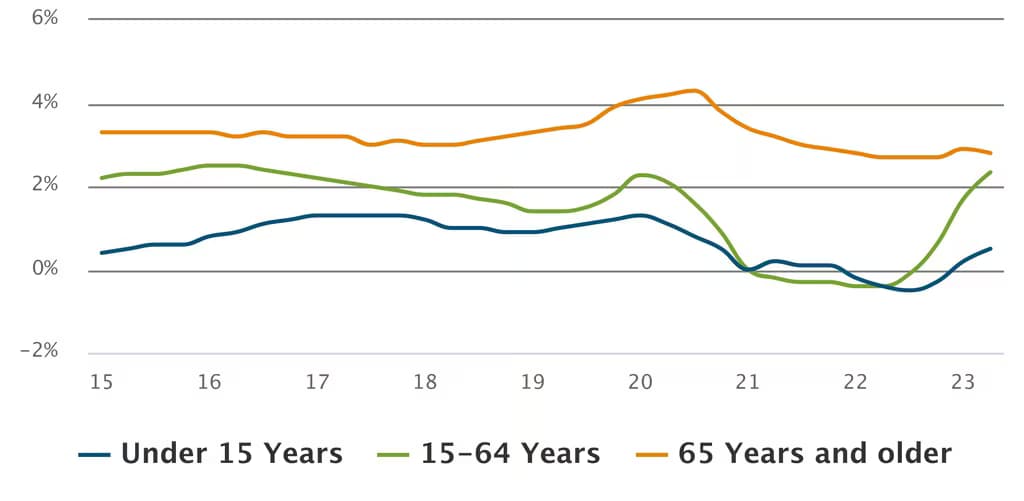
- Population growth among the under-30 age group accelerated to 1.2%pa, the second quarter of annual increase after a year of sustained decline. Growth in the working-age population (15-64) lifted to 2.3%pa, after plateauing through 2021 and 2022.
- Older people remain New Zealand’s fastest growing cohort, with the number of people aged 65 and over growing 2.8%pa in the June 2023 quarter.
Strong momentum in working-age population
Annual % change, NZ population
...and our reaction
- The population has grown considerably over the last year, as rapidly rising net migration adds people into the country, and increasingly the workforce. The 2.3%pa increase in the 15-64 population is the fastest rate since mid-2016.
- Net migration continues to be driven by a strong level of foreign migrant arrivals, with nearly 169,000 over the last year – up 59% from pre-pandemic levels. That strength highlights the work of the immigration Green List to bringing in skilled workers.
- But New Zealand departures are up too, with just over 61,000 Kiwis departing permanently over the last year, up 50% on pre-pandemic levels, highlighting the current people movements aren’t just a one-way street.
- Although migration remains high at present, adding to both demand and supply in the economy, job ads have declined 25% over the last year, leading to our view that migration will likely soften before the end of the year as remaining skills shortages are addressed and hiring activity slows down.
- With natural increase (births minus deaths) continuing to slow as the population ages, a stabilisation in net migration is expected which will likely bring a steadier, and more subdued, level of overall population growth.
Latest updates
Premium

National population estimates
Slight pick-up in population growth
Tue 18 Aug 2026
Quarterly
 5,357,300 Total NZ population estimate as at June 2026
 0.7%pa Population growth in June 2026 quarter17,600 Net migration gain over the year to June 2026
Premium
National population estimates
Population growth lifted by increasing migration
Mon 18 May 2026
Quarterly
5,361,300 Total NZ population estimate as at March 20260.8%pa Population growth in March 2026 quarter24,200 Net migration over the year to March 2026National population estimates
Population growth steady at 0.6%pa
Tue 17 Feb 2026
Quarterly
5,342,000 Total NZ population estimate as at December 2025 0.6%pa Population growth in December 2025 quarter14,200 Net migration over the year to December 2025
National population estimates
Population growth steady at 0.6%pa
Mon 17 Nov 2025
Quarterly
5,334,200 Total NZ population estimate as of September 2025
Population grows 0.6%pa in September 2025 quarterNet migration edges up to 12,500 for year ending September 2025