Real estate statistics
House prices increase in June for first time in 19 months
13 Jul 2023

Our take on the latest Real estate statistics (Thu 13 Jul 2023)

House prices excl. Auckland up 0.4% in June (seasonally adjusted)
Auckland house prices up 1.0% (seasonally adjusted)
House sales up 1.4%pa over three months to June
The key numbers...
- Nationwide house prices lifted 0.5% in June, the first monthly increase in 19 months. However, prices across New Zealand are still 17% below their November 2021 peak, and house prices in Auckland stayed around 22% below their peak (all figures seasonally adjusted).
- On an annual basis, the pace of house price declines slowed in all regions except Canterbury, where price declines accelerated slightly from 5.4%pa in May to 6.1%pa in June. Across New Zealand, the pace of house price declines has slowed from 14%pa in February to 9.0%pa in June.
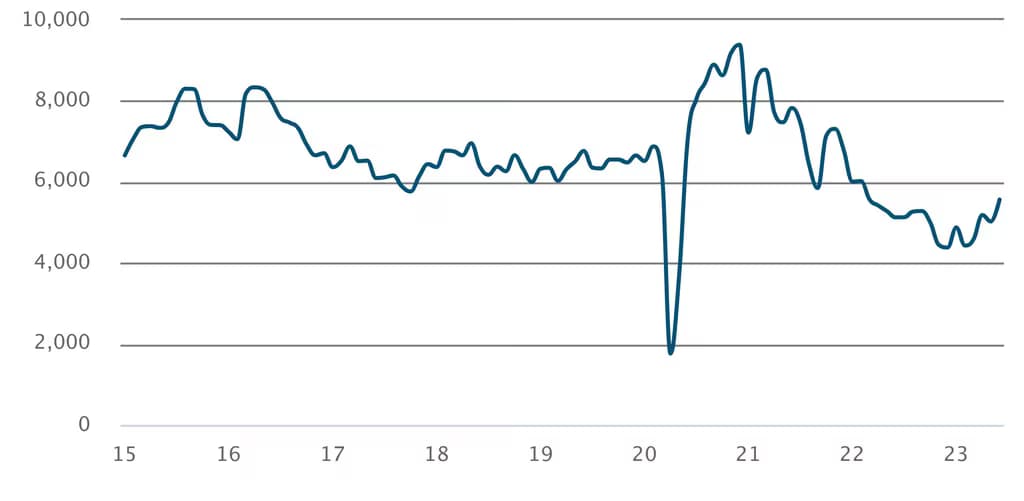
- There were 5,629 house sales in June, the strongest month for house sales since February 2022 on a seasonally adjusted basis. Even with this pick-up, sales activity remains relatively soft, with sales in June sitting 41% below their December 2020 peak (seasonally adjusted).
- The median period to sell remained at 49 days in June, consistently sitting 20% above pre-pandemic (June 2019) levels.
Sales trend turning around
REINZ monthly house sales, seas. adj
...and our reaction
- Although a single month of data is not yet enough to say definitively whether house prices have bottomed out in New Zealand, the first positive result in 18 months indicates we are indeed approaching the trough.
- House sales are beginning to trend upwards, with a 14% increase over the last three months, compared to the three months prior. We expect that strong net migration, reaching 77,800 over the year to May, will support this trend over the next year.
- Despite these positive signs in the housing market, it is worth noting that mortgage rates remain considerably elevated, and have been rising over the past few weeks even as the official cash rate (OCR) holds steady. Despite the Reserve Bank’s decision in July to keep the OCR unchanged, several factors (such as higher wholesale swap rates, and the burden of wholesale funding cost increases on banks) are expected to keep retail mortgage rates higher for longer than we would otherwise expect.
- Because of high debt-servicing costs, the support that net migration is providing to house sales activity is more likely to put a floor under house prices, rather than propel them upwards. Although the pace of annual house price declines is continuing to ease, it is too early to say that this month’s result points to the beginning of an upward trend.
Latest updates
Premium

Real estate statistics
House sales and prices still falling
Thu 13 Aug 2026
Monthly
 10%pa House sales in July 20260.4%pa House prices from a year earlier
 9.3%pa Stock of homes for sale in July 2026
Premium
Real estate statistics
Conflict continues to drag on housing market in June
Wed 15 Jul 2026
Monthly
8.8% House sales between Feb and Jun 2026 (seas adj)0.8% House prices since February (seas adj)4.8% Stock of homes for sale since February (seas adj)Real estate statistics
House buyers dry up ahead of interest rate rises
Mon 15 Jun 2026
Monthly
13%pa House sales in May 20260.6%pa House prices from May 2025 Stock of homes for sale at an 11-year high
Real estate statistics
House prices and sales fall
Thu 14 May 2026
Monthly
7.9%pa House sales in Apr 20260.5% House prices from Mar 2026 (sa)1.2% Stock of homes for sale since Feb 2026 (sa)