
Our take on the latest Building work put in place (Fri 2 Jun 2023)


Total construction volumes up 0.6% in March quarter (seasonally adjusted)
Residential construction activity fell 0.8% from December quarter (seasonally adjusted)
Non-residential construction activity increased 3.6% in March quarter (seasonally adjusted)
The key numbers...
- Construction volumes increased 0.6% in the March quarter on a seasonally adjusted basis, with activity totalling nearly $9.1b.
- Total construction activity was supported by higher non-residential construction volumes, which totalled almost $3.0b, a 3.6% increase from the December quarter after accounting for seasonal factors.
- Non-residential construction activity was higher in March compared to the previous year across all broad regions. Growth was particularly strong in Waikato and Canterbury, where the value of work put in place increased 41% and 66%pa respectively.
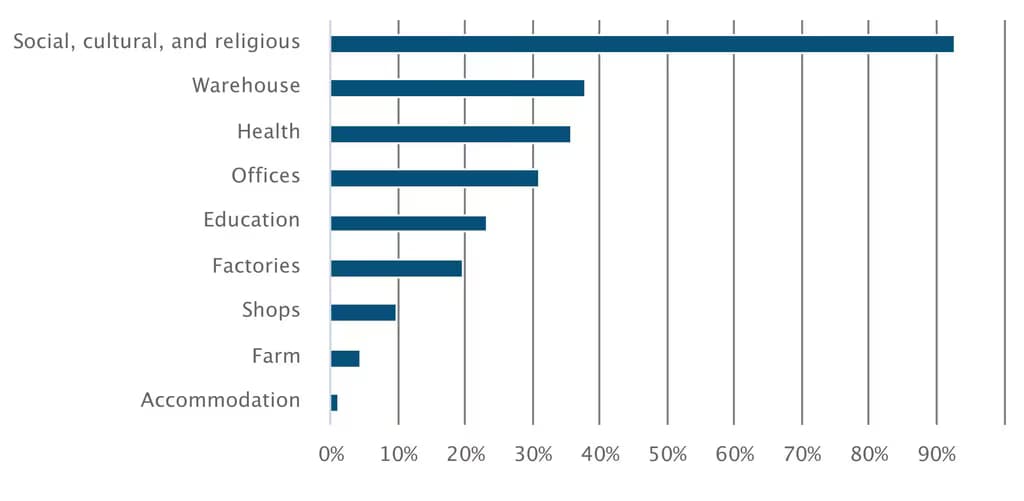
- Non-residential construction activity remained strong across a wide range of building types in March, with growth of 20%pa or more across the social, warehouse, health, office, and education building types. Social, cultural, and religious building activity was particularly strong, with the value of work put in place up 93% compared to March 2022.
- A soft residential construction sector limited growth in overall construction activity, with residential construction volumes falling 0.8% in the March quarter (seasonally adjusted). Residential construction activity in the quarter totalled $6.1b.
- The value of residential construction activity in Wellington, Waikato, and the rest of the North Island (excluding Auckland) increased 9.5%, 8.1%, and 4.7%pa respectively in March. However, residential building costs increased 11%pa, indicating a fall in the volume of residential construction activity in these areas.
Non-res activity strong across a range of building types
Annual % changes, Work put in place by building type
...and our reaction
- Momentum in the non-residential construction sector continued in March. Government programmes to redevelop hospitals and schools drove higher health and education building activity.
- Disruptions to global supply chains during the COVID-19 pandemic encouraged some businesses to source product locally, boosting strong factory building activity, and to hold more stock from outside and across New Zealand, supporting higher levels of warehouse building.
- The strong growth in social, cultural, and religious building activity is likely to have been driven by a few major projects, which are largely based in Wellington or Canterbury. Most notably in Canterbury, work on the Te Kaha multi-use arena is underway, along with construction activity on Canterbury Museum, the Robert McDougall Gallery, and Christ Church Cathedral. In Wellington, large projects include the Te Ngākau Civic Precinct redevelopment, and the construction of Te Matapihi Wellington Central Library.
- Residential construction activity’s decline reflects falling property values and higher building costs limiting development opportunities. Residential construction appears to be particularly soft in the North Island, especially outside Auckland, and we estimate real construction volumes have declined, once higher costs are taken into account.
- The recent surge in net migration might limit the decline in residential construction activity over the medium term, with new migrants improving both the demand for and the supply of new housing, particularly in Auckland where most migrants typically first arrive.
Latest updates
Premium

Building work put in place
Construction activity at a 10-year low
Thu 4 Jun 2026
Quarterly
 13% Non-residential activity in March 2026 from March 20253.9% Residential activity from March 2025
 Total building activity at its lowest level (excl lockdowns) since 2015
Premium
Building work put in place
Non-residential work hammered as residential softens further
Thu 5 Mar 2026
Quarterly
6.5% Non-residential activity from September 2025 (sa)1.1% Residential activity from September 2025 (sa)Total building activity at its lowest level (excl lockdowns) since 2015Building work put in place
Non-residential activity continues to decline
Thu 4 Dec 2025
Quarterly
Residential volumes up 3.3% in September from June 2025 (sa)Non-residential volumes down 1.3% in September from June 2025 (sa)Total quarterly activity now down 5.3% from September 2024Building work put in place
Lower residential activity leads construction decline
Thu 4 Sept 2025
Quarterly
Residential volumes down 2.9% in June from March 2025 (sa)Non-residential volumes down 0.4% in June from March 2025 (sa)Total quarterly activity now down 9.6% from June 2024