
Our take on the latest Real estate statistics (Thu 11 May 2023)


House prices down 0.2% in April 2023 (seasonally adjusted)
Sales volumes up 11% from March 2023 (seasonally adjusted)
Median days to sell down 0.8% in April 2023 (seasonally adjusted)
The key numbers...
- National house prices dropped 0.2% in April on a seasonally adjusted basis, the smallest monthly decline since house prices began to fall from the November 2021 peak. Auckland house prices declined a bit faster in April, down 0.8% from March after accounting for seasonal effects.
- House prices have generally fallen further across the North Island than the South Island. In April, prices in seven of the nine North Island regions had fallen more than 10% compared to April 2022, with house prices in Waikato and Taranaki only falling 9.1% and 3.9%pa respectively.
- In the South Island, only house prices in West Coast and Otago have fallen more than 10% from April 2022, with prices in Canterbury, Southland, Tasman, and Nelson/Marlborough only down 3-9%pa in April 2023.
- National house sales increased 11% from March on a seasonally adjusted basis, with 4,339 sales in April. Cyclone Gabrielle has depressed sales activity in some North Island areas, with sales across the North Island still down 18% from April 2022, and national sales down 16%pa.
- The median period to sell a house was 47 days in April, edging down 0.8% from March on a seasonally adjusted basis.
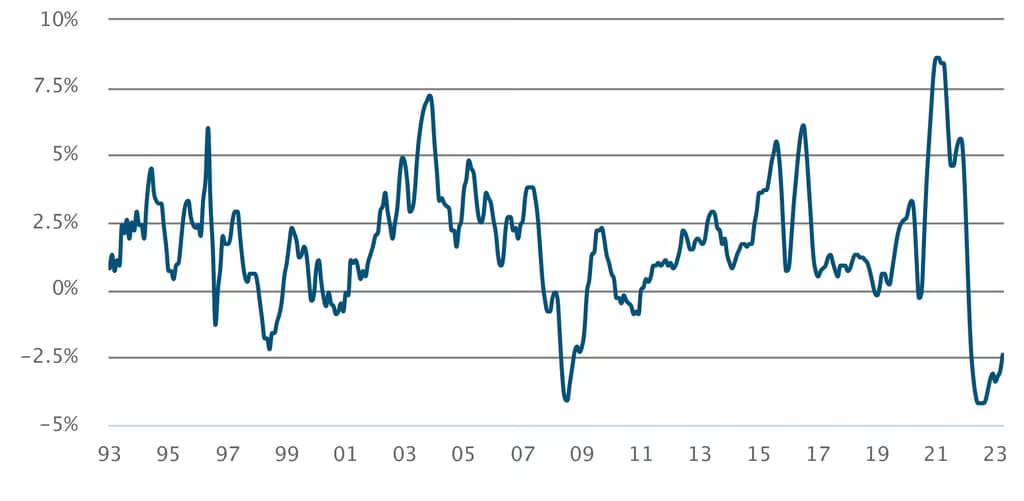
Pace of house price declines slowing
REINZ House Price Index, quarterly % changes (seasonally adjusted)
...and our reaction
- The pace of house price declines eased in April, with nationwide prices 17% below the November 2021 peak. We anticipate the Reserve Bank will add another 0.25-0.50% to the official cash rate (OCR), lifting one-year fixed mortgage rates to over 7.0%, which should drag house prices down further throughout 2023.
- We do see downside risks to our forecasts for interest rates, as mortgage rates currently seem less responsive to increases in the OCR. Wholesale markets appear to have taken the view that the Reserve Bank is overcooking the monetary policy response to high inflation, and expect fewer interest rate rises will be sufficient to tame inflation. Banks are also struggling to attract new customers, with higher interest rates and high inflation limiting the number of prospective home buyers, leading to stronger discounting of some retail mortgage rates.
- If wholesale and retail interest rates continue to be less responsive to hikes to the OCR, mortgage rates won’t increase as far as we expect, which is likely to limit further house price declines.
- House sales volumes picked up on a seasonally adjusted basis in April, although they remain very soft compared to sales activity in 2021 and 2022. We expect that higher net migration could bolster sales activity, as new migrants increase the pool of potential buyers, but there will likely be a delay before this potential demand starts to filter through to stronger house sales volumes.
Latest updates
Premium

Real estate statistics
House sales and prices still falling
Thu 13 Aug 2026
Monthly
 10%pa House sales in July 20260.4%pa House prices from a year earlier9.3%pa Stock of homes for sale in July 2026
Premium
Real estate statistics
Conflict continues to drag on housing market in June
Wed 15 Jul 2026
Monthly
8.8% House sales between Feb and Jun 2026 (seas adj)0.8% House prices since February (seas adj)4.8% Stock of homes for sale since February (seas adj)Real estate statistics
House buyers dry up ahead of interest rate rises
Mon 15 Jun 2026
Monthly
13%pa House sales in May 20260.6%pa House prices from May 2025 Stock of homes for sale at an 11-year high
Real estate statistics
House prices and sales fall
Thu 14 May 2026
Monthly
7.9%pa House sales in Apr 20260.5% House prices from Mar 2026 (sa) 1.2% Stock of homes for sale since Feb 2026 (sa)