
Our take on the latest Labour market statistics (Wed 3 May 2023)


Labour Cost Index up 4.3%
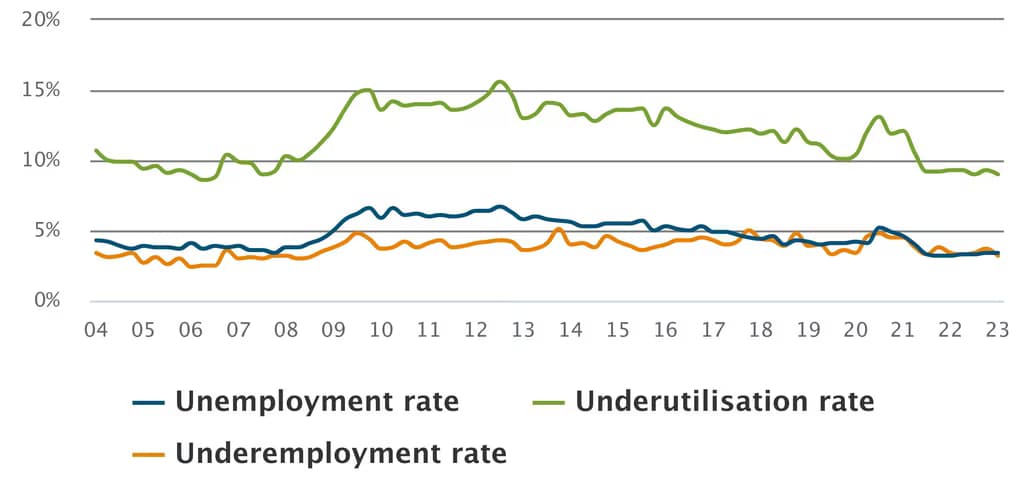
Unemployment unchanged, underutilisation falls to 9.0%
Participation and employment rates increase to new record highs
The key numbers...
- The unemployment rate remained at 3.4% in March 2023, and the underutilisation rate fell to 9.0%, remaining at very low rates. The fall in the underutilisation rate was driven by a decline in the number of underemployed (workers who want and are available for more work).
- The number of underemployed fell 4% over the last year, driven by a fall in the number of underemployed seeking more hours. Full-time and part-time employment both rose, by 2.5% and 2.4%pa respectively.
- The participation rate ratcheted up higher to 72.0%, a new record, as the employment rate also rose to a new record of 69.5%.
- The Labour Cost Index rose 4.3%pa, an acceleration to a new record high, with private sector and local government labour cost increases also advancing to new record paces. Central government labour cost rises accelerated too but haven’t yet reached a new record high.
- Weather events at the start of 2023 saw the largest number of people working less or not at all due to bad weather (with data going back to 2016), although hours worked in the economy only fell 0.3% (seasonally adjusted) from the December quarter.
Labour market remains tight
Unemployment and underutilisation rates are seas. adj., underemployment rate is not adjusted
...and our reaction
- The labour market is still tight, and there’s still more work that businesses want to get done, and more people coming into the labour market and getting jobs. The lower underemployment rate and increases to both full- and part-time employment reinforces this trend.
- Continued expansion in the labour market means wage pressures remain intense, and in many cases still accelerating. Over the last year, 39% of roles in the economy saw a pay increase of 5% or more – the largest proportion ever. Record increases across both public and private sectors shows the broad spread of pay growth.
- The labour market is generally the last part of the economy to slow down, but there’s not even a plateauing of employment or wage increases filtering through yet. Taken together, the various labour market figures show that there’s still a lot of pressure in the economy.
- The results strengthen our view that the Reserve Bank will want to raise the Official Cash Rate (OCR) again in May, by 25 basis points, to push back against sustained economic pressure.
- Recent inflation data seems to have convinced many commentators and the financial markets that the Reserve Bank had done enough lifting of interest rates to cool the economy sufficiently to rein in inflation. We remain unconvinced, and today’s data reinforces our view that it’s premature to declare victory over inflation yet and consider when rates will be cut.
Latest updates
Premium

Labour market statistics
Unemployment jumps higher than expected
Wed 5 Aug 2026
Quarterly
5.6% Unemployment rate in the June 2026 quarter (s.a.) 70.7% Participation rate the highest in over a year0.5% Employment growth in June from March (s.a.)
Premium
Labour market statistics
More people, more working, more not participating
Wed 6 May 2026
Quarterly
5.3% Unemployment rate eased slightly in the March 2026 quarter 70.4% Participation rate fell slightly0.2% Employment rose in March from December (s.a.)
Labour market statistics
Higher participation drives unemployment increase
Wed 4 Feb 2026
Quarterly
5.4% Unemployment rate December 2025 quarter (sa)70.5% Participation rate December 2025 quarter (sa)2.0%pa Labour Cost Index Year to December 2025Labour market statistics
Unemployment rate rises to 5.3%
Wed 5 Nov 2025
Quarterly
Unemployment rate edges up to 5.3%Youth NEET rate rises to 13.2% (annual average)Labour cost growth slows to 2.1%pa