
Our take on the latest Labour market statistics (Wed 1 Feb 2023)



Labour Cost Index up 4.1%
Unemployment rate edges up to 3.4%
Participation and employment rates remain at record highs
The key numbers...
- The unemployment rate edged up to 3.4% in the December 2022 quarter (seasonally adjusted), and the underutilisation rate rose from 9.0% to 9.4%.
- The rise in the underutilisation rate was due to an increase in the potential labour force, as 17% more people were counted as being available potential jobseekers who were not actively seeking, but available for and wanting, a job.
- Employment rose a further 0.2% in December 2022 (seasonally adjusted), in line with our expectations about limited further capacity in the labour market. The employment rate (69.3%) and the participation rate (71.7%) remain at record highs.
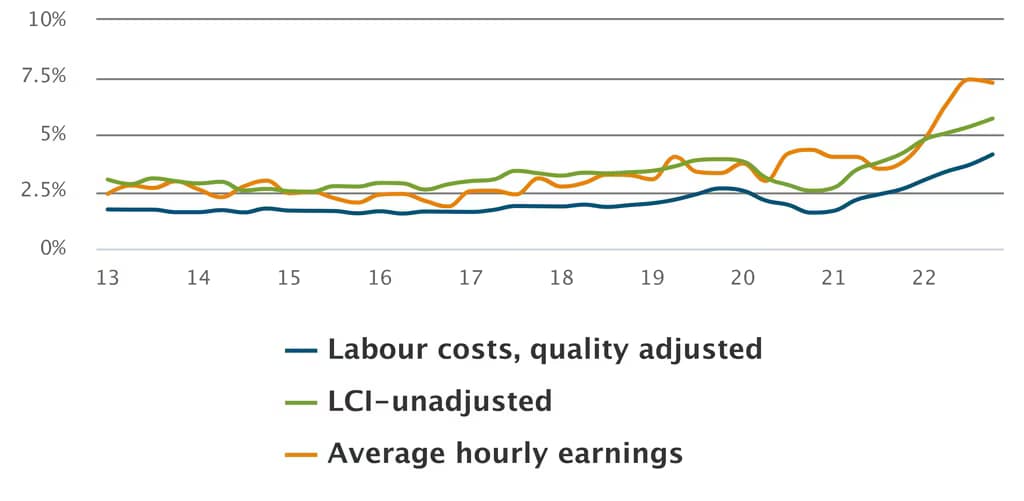
- Wage inflation is still strong on all the measures we track. The Labour Cost Index rose 4.1%pa, at the fastest pace on record (since 1992), and average hourly earnings rose 7.2%, just slightly slower than in September 2022.
- Over the last year, 36% of jobs got a pay increase of 5% or more, but 34% of jobs had no change in pay.
- Total hours worked rose a further 1.4% in December (seasonally adjusted).
Continued strong growth in labour costs
Labour cost measures, annual % changes
...and our reaction
- There’s no doubt that the labour market is still tight. Wage pressures remain intense, and the unemployment rate of 3.4% is still a long way below the 4.0% rate seen to be “maximum sustainable employment.”
- The continued rate of strong wage inflation, combined with still high expectations from businesses of rising cost and price pressures, will worry the Reserve Bank. There’s a long way to go before the labour market is back to “normal”, let alone with enough spare capacity to get wage increases back under control.
- The Reserve Bank’s next monetary policy review on 23 February is a close call between a 50-point and a 75-point increase to the official cash rate. Last week’s inflation result was weaker than the Bank had forecast. Job ads have moderated, migration is rising rapidly, and there’s some evidence of less intense labour market pressures in the form of limited employment growth.
- However, we’re not convinced there’s enough genuine weakness in recent data to dissuade the Reserve Bank from following up its tough talk and 75-point hike in November with another 75-point increase this month. The Bank has been badly burnt on being too meek in 2021/22 and shouldn’t forget that lesson.
Latest updates
Premium

Labour market statistics
Unemployment jumps higher than expected
Wed 5 Aug 2026
Quarterly
5.6% Unemployment rate in the June 2026 quarter (s.a.)70.7% Participation rate the highest in over a year0.5% Employment growth in June from March (s.a.)Premium
Labour market statistics
More people, more working, more not participating
Wed 6 May 2026
Quarterly
 5.3% Unemployment rate eased slightly in the March 2026 quarter
 70.4% Participation rate fell slightly0.2% Employment rose in March from December (s.a.)
Labour market statistics
Higher participation drives unemployment increase
Wed 4 Feb 2026
Quarterly
5.4% Unemployment rate December 2025 quarter (sa)70.5% Participation rate December 2025 quarter (sa)2.0%pa Labour Cost Index Year to December 2025Labour market statistics
Unemployment rate rises to 5.3%
Wed 5 Nov 2025
Quarterly
Unemployment rate edges up to 5.3%Youth NEET rate rises to 13.2% (annual average)Labour cost growth slows to 2.1%pa