
Our take on the latest Labour market statistics (Wed 2 Nov 2022)



Average hourly earnings up 7.4%pa, fastest since late-1980s
Unemployment rate unchanged at 3.3%
Record-high employment and participation rates
The key numbers...
- The unemployment rate was unchanged at 3.3% in the September quarter, but the underutilisation rate (which includes people who are employed, but want to work more) fell to 9.0%, the lowest since 2006, reinforcing the tightness of the labour market.
- After being flat for the last year, employment recorded a strong 1.3% quarterly increase in September, as more people moved into the labour market after previously not being available or willing to work. The “not in the labour force” group recorded its largest quarterly fall on record, with a 2.4% drop.
- These changes saw the employment rate rise to a record high of 69.3% as more people got jobs, and the participation rate rose to a record high of 71.7%, as more people were active in the labour market.
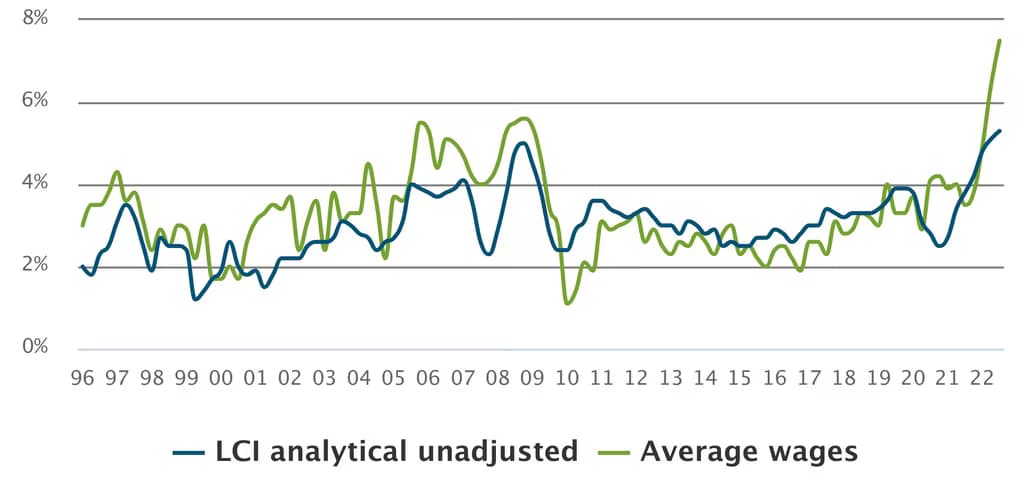
- Wage rates accelerated as anticipated to record highs, with average hourly earnings up 7.4%pa (from 6.4%pa in June), representing the largest annual increase since the current series started in 1989.
- As we expected, growth in the labour cost index (LCI) was 1.1% in the quarter, taking annual growth to 3.7% - just below the record of 4.0%pa in September 2008. Growth in the unadjusted LCI (which incorporates pay rises due to promotions etc) rose to a new record high of 5.3%pa.
Labour market pressures unabated
Annual % change, various wage and cost indicies
...and our reaction
- New Zealand’s labour market remains very tight, as expected, and wage growth continues to accelerate as employers try to attract and retain staff with more competitive pay packets.
- The wage increases in the September 2022 quarter are in line with expectations, and they reinforce the view that more monetary policy tightening is needed by the Reserve Bank to get inflation back under control.
- The increase in wage rates is inducing an employment response, with more people being drawn into the labour market by the higher wages on offer. But where are these people appearing from?
- It appears that more people are opting for a job rather than heading into study and training. The number of people not in the labour force due to being in study or training fell 6.1% in the September 2022 quarter, and it is now down 12% from a year ago. The number of people who are studying but also wanting a job is now at its lowest on record (since 2016), with the reduction in this cohort showing a move away from study with employment aspirations and into direct employment.
- The government should be alert to the distributional challenges that high inflation, and higher wages, present. Over the last year, 31% of roles in the economy have had a pay increase of more than 5%, the largest proportion on record (back to the mid-1990s). However, 35% of roles have had no change – among the lowest proportion on record, but still representing a lot of people whose purchasing power went backwards by at least 7.2% in the last year.
Latest updates
Premium

Labour market statistics
Unemployment jumps higher than expected
Wed 5 Aug 2026
Quarterly
5.6% Unemployment rate in the June 2026 quarter (s.a.) 70.7% Participation rate the highest in over a year0.5% Employment growth in June from March (s.a.)
Premium
Labour market statistics
More people, more working, more not participating
Wed 6 May 2026
Quarterly
 5.3% Unemployment rate eased slightly in the March 2026 quarter
 70.4% Participation rate fell slightly0.2% Employment rose in March from December (s.a.)
Labour market statistics
Higher participation drives unemployment increase
Wed 4 Feb 2026
Quarterly
5.4% Unemployment rate December 2025 quarter (sa)70.5% Participation rate December 2025 quarter (sa)2.0%pa Labour Cost Index Year to December 2025Labour market statistics
Unemployment rate rises to 5.3%
Wed 5 Nov 2025
Quarterly
Unemployment rate edges up to 5.3%Youth NEET rate rises to 13.2% (annual average)Labour cost growth slows to 2.1%pa