
Our take on the latest Labour market statistics (Wed 3 Aug 2022)



Unadjusted LCI growth accelerates to 5.1%pa, fastest on record
Employment levels unchanged
Unemployment rises marginally to 3.3% on sickness increases
The key numbers...
- The unemployment rate rose slightly to 3.3% in the June 2022 quarter, driven by noise in the survey and a 6.6%pa increase in the number of people not wanting a job because they were sick when asked.
- Employment stayed stagnant, with no change in underlying employment from the start of 2022.
- Total hours worked rose 0.8% in June, after a small drop in the March 2022 quarter, as the same workforce worked longer hours.
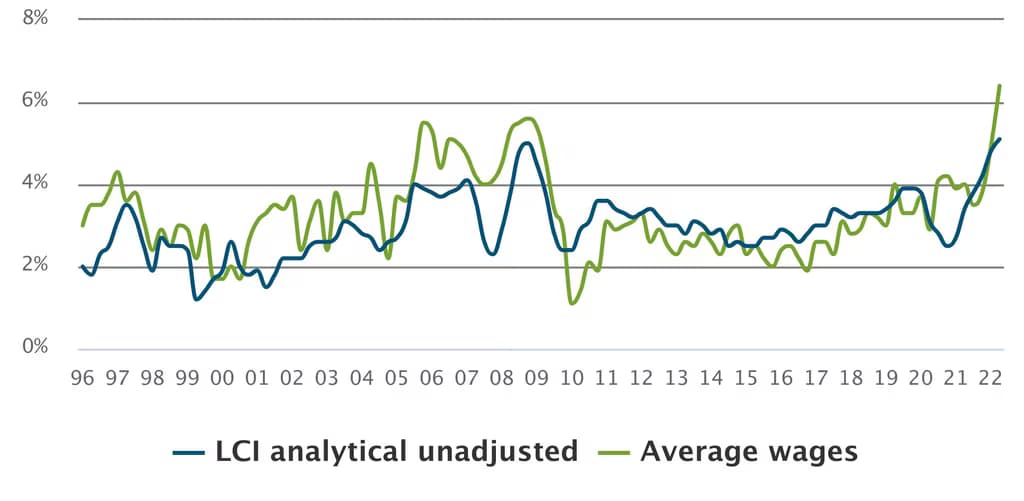
- Wages continued to rise, with rapid increases across all measures. The headline labour cost index (LCI) rose 3.4%pa, the fastest since 2008, and the unadjusted LCI rose to 5.1%, the fastest on record (since 1996). Average hourly earnings rose 6.4%, the highest on record (since 1991).
- Over the last year, 26% of roles received a pay rise of 5% or more, the largest share since 2008.
Wages accelerate as employment stagnates
Annual % change, various wage and cost indices
...and our reaction
- A rise in the unemployment rate was a rude shock, after firm views that it was likely to fall. Despite the rise, the underlying labour market remains extremely tight, and there is still limited capacity in the workforce.
- The rise in unemployed seems to be driven by a rise in the number of workers who didn’t want to work because they were sick in the reference period. COVID-19 and winter illness seems to be limiting those wanting to get into work.
- For those already employed, there’s still a lot of work to be done, with average hours per worker rising. There wasn’t as much of a rise in employed people doing no work due to sickness, but there was a sustained rise in people doing fewer hours due to sickness, showing that people are more likely to still work a bit when they’re ill.
- The lack of growth in employment underscores the challenges for the economy, with difficulties finding workers limiting economic expansion.
- Competition for workers has therefore increased even further, with a wage war building as businesses are forced to put up higher offers to secure talent. The fast rises in wage measures reinforces this point, although the increases still don’t match inflation.
- Today’s results confirm an expectation that the tight labour market, and rising wage increases, will continue to push through into wider inflation as businesses pass on their higher costs.
- We expect the Reserve Bank will see today’s labour market data as confirming their stance of needing to continue raising the official cash rate briskly, with another 50 basis point increase in August. We’d say that a 75 basis point increase also needs to be on the table for consideration, if the Bank views that it needs to move quicker to address inflationary pressures.
Latest updates
Premium

Labour market statistics
Unemployment jumps higher than expected
Wed 5 Aug 2026
Quarterly
5.6% Unemployment rate in the June 2026 quarter (s.a.)70.7% Participation rate the highest in over a year0.5% Employment growth in June from March (s.a.)Premium
Labour market statistics
More people, more working, more not participating
Wed 6 May 2026
Quarterly
 5.3% Unemployment rate eased slightly in the March 2026 quarter
 70.4% Participation rate fell slightly0.2% Employment rose in March from December (s.a.)
Labour market statistics
Higher participation drives unemployment increase
Wed 4 Feb 2026
Quarterly
5.4% Unemployment rate December 2025 quarter (sa)70.5% Participation rate December 2025 quarter (sa)2.0%pa Labour Cost Index Year to December 2025Labour market statistics
Unemployment rate rises to 5.3%
Wed 5 Nov 2025
Quarterly
Unemployment rate edges up to 5.3%Youth NEET rate rises to 13.2% (annual average)Labour cost growth slows to 2.1%pa