
Our take on the latest Labour market statistics (Wed 4 May 2022)



Unadjusted LCI growth accelerates to 4.8%pa, fastest since late 2008
Unemployment rate steady at record-low 3.2%
Hours worked fall just 0.2% (seasonally adjusted) due to Omicron
The key numbers...
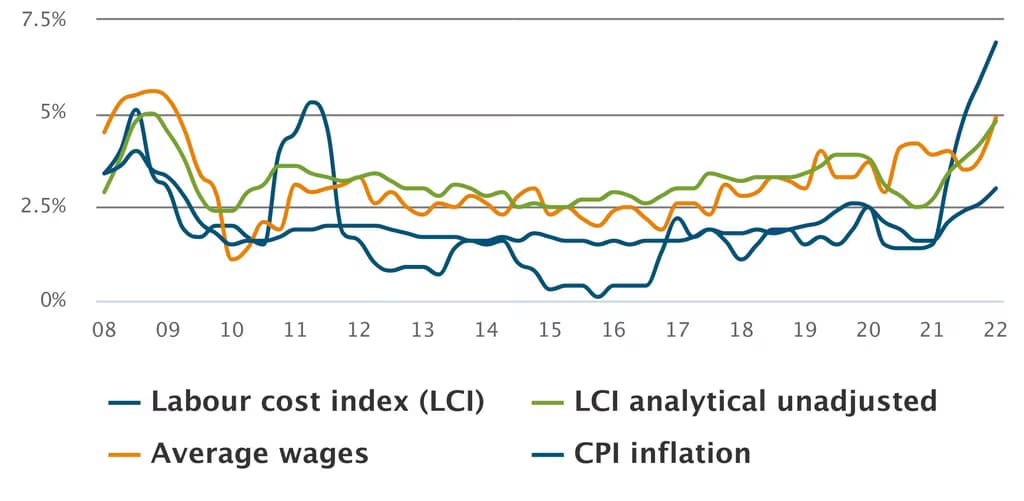
- Wage growth accelerated by more than expected in the March 2022 quarter, with all key wage indicators growing at their fastest rate since 2008. The unadjusted labour cost index (which includes the effect of promotions on pay rates) rose 4.8%pa.
- At the start of 2022, 23% of roles had had a pay increase of more than 5% over the last year, just below the peak of 26% of jobs at the end of 2008.
- The unemployment rate remained at 3.2%, as employment rose by just 0.1% from December (seasonally adjusted). The participation rate dipped to 70.9% as more people were outside the labour force, with a 0.8% rise in this group as people were unable to actively seek or be available for work.
- More people were partially or fully away from work sick or isolating, with a 37%pa increase in being off work due to sickness, and a 68%pa increase in being off work due to COVID-19 reasons. The number of people employed but who worked zero hours rose considerably.
- However, total hours worked in the economy only fell by 0.2% (seasonally adjusted), much less than feared.
Wages rising, but still not keeping up with prices
Annual % change, various wage and cost indices
...and our reaction
- Businesses are having to stump up more given the intense pressure on the labour market, with wage increases now more broad-based and accelerating faster. A continued record-low unemployment rate, strong demand conditions, and a net outflow of talent from New Zealand are all combining to drive wages higher.
- Wage growth isn’t currently keeping up with inflation, but it’s now getting a rattle on – a trend we expect to continue as the tight labour market persists.
- On the topic of a tight labour market – that certainly hasn’t changed. Employment growth was limited in the March 2022 quarter, probably because there is not a lot of talent to pick from. The fall in the participation rate and higher “not in labour force” group seems to reflect Omicron, at least partially, with higher illness and COVID-19 related reasons noted.
- The large increases in people who either worked less, or not at all, in some weeks due to Omicron was to be expected, given we estimate around 300,000 people were isolating at the Omicron peak.
- Despite these Omicron effects, the reduction in hours worked across the economy is far less than feared – an outcome that leaves us a little perplexed. One explanation is that remaining non-isolating workers have been putting in more hours to pick up the slack. Alongside increases in employed people working no or fewer hours was an increase in the number of people working more hours than usual.
- Today’s figures suggest less of a hit to economic activity from Omicron, which is certainly good news. But with sustained high demand obvious, and remaining workers having to fill the gaps, the pressure on workers and the economy remains intense.
Latest updates
Premium

Labour market statistics
Unemployment jumps higher than expected
Wed 5 Aug 2026
Quarterly
 5.6% Unemployment rate in the June 2026 quarter (s.a.)70.7% Participation rate the highest in over a year0.5% Employment growth in June from March (s.a.)
Premium
Labour market statistics
More people, more working, more not participating
Wed 6 May 2026
Quarterly
5.3% Unemployment rate eased slightly in the March 2026 quarter 70.4% Participation rate fell slightly0.2% Employment rose in March from December (s.a.)
Labour market statistics
Higher participation drives unemployment increase
Wed 4 Feb 2026
Quarterly
5.4% Unemployment rate December 2025 quarter (sa)70.5% Participation rate December 2025 quarter (sa)2.0%pa Labour Cost Index Year to December 2025Labour market statistics
Unemployment rate rises to 5.3%
Wed 5 Nov 2025
Quarterly
Unemployment rate edges up to 5.3%Youth NEET rate rises to 13.2% (annual average)Labour cost growth slows to 2.1%pa