
Our take on the latest Real estate statistics (Mon 14 Mar 2022)


Sales fell 33%pa in February
Auckland house prices down 1.7% from January (sa)
New Zealand (ex AKL) house prices up 0.5% (sa) from January
The key numbers...
- House prices in New Zealand continued to fall in February, edging down 0.6% (seasonally adjusted) from January – the third month of price drops.
- Annual house price growth is slowing further, with New Zealand house prices now sitting 14% higher than a year ago, down from steady 30%pa growth in mid-2021.
- Auckland’s house prices fell 1.7% (sa) from January, even as New Zealand house prices excluding Auckland eked out a slight gain of 0.5% (as).
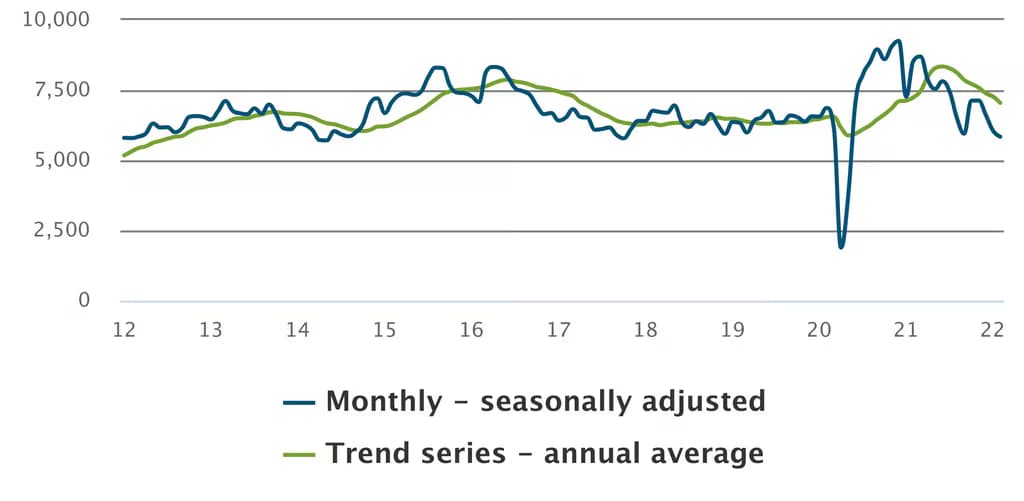
- Sales dropped 33%pa in February, with sales falling in every region of the country.
- The average number of days it takes to sell is growing fast, now sitting at 42 days in February. At the same time last year it took 31 days to sell.
Number of houses sold
Real Estate Institute
...and our reaction
- The housing market continued to soften in February, with Auckland leading the decline as buyer and seller prices moderate. On an annual basis, every region except Otago saw the annual rate of house price growth fall. Auckland remains the bellwether for the housing market.
- We expect house prices to fall further, particularly with our expectations for heightened and sustained interest rate hikes to ward off inflation in 2022.
- Sales are on a downwards tumble, with the large increase in days to sell in February also hinting that buyers aren’t willing or able to meet sellers’ price expectations, leaving more properties on the market.
- There are several things happening all at once making buyers more cautious. Rising mortgage rates have combined with difficulty obtaining finance to restrict the amount of lending a buyer has access to due to repayment serviceability tests. The increased cost of living is also exacerbating the pressure on household finances.
- The government is moving to ease the lending rule requirements of the Credit Contracts and Consumer Finance Act (CCCFA) which came into effect in December, a law which was accused of creating a credit crunch. We still view interest rate increases as more fundamental to restricting lending, given inflation, wage growth, and the size of housing loans.
Latest updates
Premium

Real estate statistics
House sales and prices still falling
Thu 13 Aug 2026
Monthly
10%pa House sales in July 20260.4%pa House prices from a year earlier 9.3%pa Stock of homes for sale in July 2026
Premium
Real estate statistics
Conflict continues to drag on housing market in June
Wed 15 Jul 2026
Monthly
8.8% House sales between Feb and Jun 2026 (seas adj)0.8% House prices since February (seas adj)4.8% Stock of homes for sale since February (seas adj)Real estate statistics
House buyers dry up ahead of interest rate rises
Mon 15 Jun 2026
Monthly
13%pa House sales in May 20260.6%pa House prices from May 2025 Stock of homes for sale at an 11-year high
Real estate statistics
House prices and sales fall
Thu 14 May 2026
Monthly
7.9%pa House sales in Apr 20260.5% House prices from Mar 2026 (sa)1.2% Stock of homes for sale since Feb 2026 (sa)