
Our take on the latest Labour market statistics (Wed 2 Feb 2022)


Unemployment rate at a record low 3.2%
Some discouraged workers, with a 0.5% (sa) increase in people not in the labour force
Wage growth accelerates, but slower than inflation
The key numbers...
- The labour market tightened even further in December 2021, with the unemployment rate hitting a new record low of 3.2%, just below our (and the market’s) pick of 3.3%.
- The underutilisation rate was steady at 9.2%, as part-time employment growth (5.6%pa) outpaced full-time employment (3.2%pa).
- Employment in December was up just 0.1% on a seasonally adjusted basis from September. The participation rate fell marginally to 71.1%, and the “not in labour force” group rose 0.5% - the first quarterly increase since the original Level 4 lockdown in 2020.
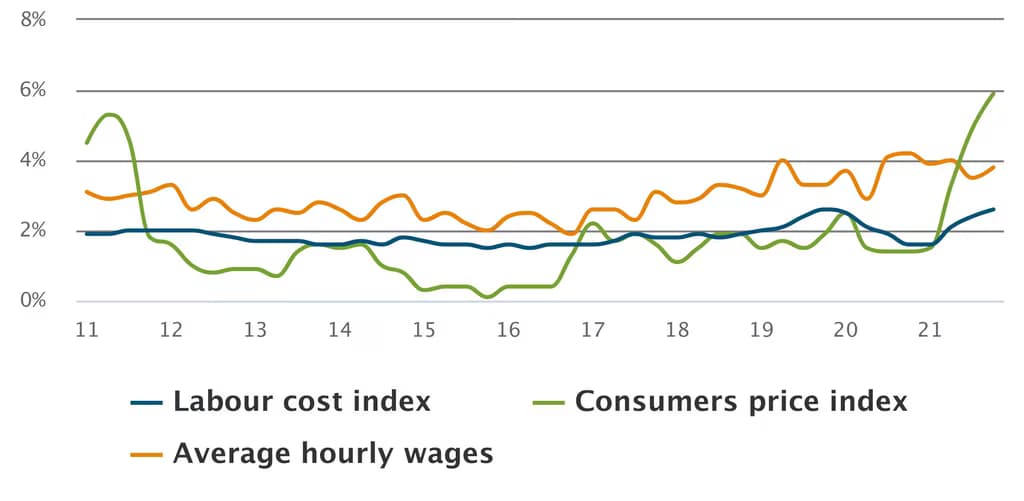
- Pay is not keeping pace with consumer price inflation of 5.9%pa, with the Labour Cost Index rising 2.6%pa and average hourly earnings up by 3.8%pa.
Pay growth accelerates, but not as fast as inflation
Annual % change
...and our reaction
- The labour market is at its tightest since the Household Labour Force Survey began in the mid-1980s, with employment struggling to grow in the face of worker shortages.
- Underneath the headline numbers, there are signs that capacity constraints in the labour market could be alleviated a bit by bringing more people into the workforce. The increase in the number of people not in the labour force suggests that some people, particularly in Auckland have been discouraged from seeking work by the Delta lockdown.
- Pay increases are happening, with 62% of jobs across the economy getting a pay rise in 2021 – the highest proportion on record (since 1994). But even with 20% of roles getting a raise of more than 5%pa, wage growth has been more sluggish than expected.
- Although growth rates in the labour cost index and average wages were always going to be slower than the recent very strong CPI result, workers have yet to really benefit from the very tight labour market. Households’ real income are now going backwards at their fastest rate since the mid-1990s (ignoring the anomaly caused by the GST rise in 2010, because it was offset by income tax cuts).
- The pressure across the labour market suggests that wage growth will have to pick up during 2022, as firms compete more for talent.
Latest updates
Premium

Labour market statistics
Unemployment jumps higher than expected
Wed 5 Aug 2026
Quarterly
 5.6% Unemployment rate in the June 2026 quarter (s.a.)70.7% Participation rate the highest in over a year0.5% Employment growth in June from March (s.a.)
Premium
Labour market statistics
More people, more working, more not participating
Wed 6 May 2026
Quarterly
 5.3% Unemployment rate eased slightly in the March 2026 quarter70.4% Participation rate fell slightly0.2% Employment rose in March from December (s.a.)
Labour market statistics
Higher participation drives unemployment increase
Wed 4 Feb 2026
Quarterly
5.4% Unemployment rate December 2025 quarter (sa)70.5% Participation rate December 2025 quarter (sa)2.0%pa Labour Cost Index Year to December 2025Labour market statistics
Unemployment rate rises to 5.3%
Wed 5 Nov 2025
Quarterly
Unemployment rate edges up to 5.3%Youth NEET rate rises to 13.2% (annual average)Labour cost growth slows to 2.1%pa