
Our take on the latest Labour market statistics (Wed 3 Nov 2021)


Employment up 2% (sa) from June
Underutilisation down to 9.2%
Labour cost index up 2.4%pa, but slower than inflation
The key numbers...
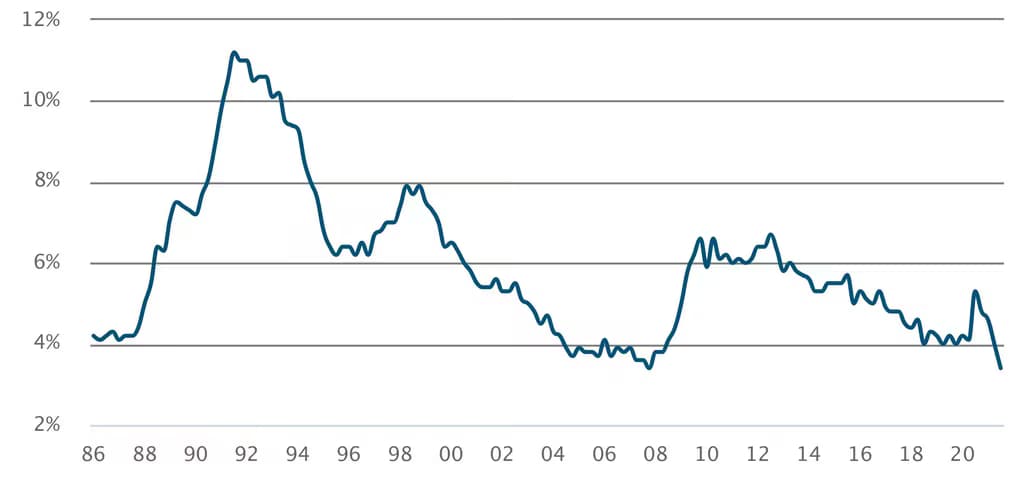
- The unemployment rate plunged further to 3.4% in the September quarter and was slightly better than our expectation of 3.5% (the median forecast was 3.9%), as employment rose and lockdown limited job searching.
- This 3.4% unemployment rate is the equal lowest on record (since 1986), in line with the December 2007 result ahead of the Global Financial Crisis. Underutilisation has also fallen to a 14-year low of 9.2%, underscoring the intense heat in the labour market.
- Employment rose an impressive 2.0% in September (seasonally adjusted), adding around 55,000 workers. This jump was driven by full-time employment, up 2.3%.
- The labour cost index was up 2.4% from a year earlier. However, labour costs are still rising at a slower pace than pre-pandemic and are certainly slower than the 4.9%pa consumer price inflation recorded in September.
Unemployment falls to equal lowest on record
Unemployment rate, % of labour force, s.a.
...and our reaction
- Employment has held up well throughout the Delta outbreak and should erase any uncertainty about the labour market’s considerable tightness.
- The plunging unemployment rate isn’t only due to the Delta lockdown – labour market fundamentals look strong, with stronger hiring leading to higher employment levels.
- Spare capacity in the labour market is virtually non-existent, with more people getting into employment and working longer hours.
- Pay will continue to increase as these pressures build, as labour costs are a lagging indicator. But so far wages haven’t responded as swiftly, meaning household costs are increasing faster than wages can.
- With GDP coming in much stronger than expected, inflation considerably hotter, and unemployment now at its lowest point on record, it’s difficult to see any path for interest rates but upwards. Indeed, these three factors continue to increase the possibility of a 50-basis point raise in November.
Latest updates
Premium

Labour market statistics
Unemployment jumps higher than expected
Wed 5 Aug 2026
Quarterly
5.6% Unemployment rate in the June 2026 quarter (s.a.) 70.7% Participation rate the highest in over a year0.5% Employment growth in June from March (s.a.)
Premium
Labour market statistics
More people, more working, more not participating
Wed 6 May 2026
Quarterly
 5.3% Unemployment rate eased slightly in the March 2026 quarter70.4% Participation rate fell slightly0.2% Employment rose in March from December (s.a.)
Labour market statistics
Higher participation drives unemployment increase
Wed 4 Feb 2026
Quarterly
5.4% Unemployment rate December 2025 quarter (sa)70.5% Participation rate December 2025 quarter (sa)2.0%pa Labour Cost Index Year to December 2025Labour market statistics
Unemployment rate rises to 5.3%
Wed 5 Nov 2025
Quarterly
Unemployment rate edges up to 5.3%Youth NEET rate rises to 13.2% (annual average)Labour cost growth slows to 2.1%pa