
Our take on the latest Labour market statistics (Wed 4 Aug 2021)


Unemployment rate falls to 4.0%
Underutilisation rate falls to 10.5%
Labour cost index up 2.1%
The key numbers...
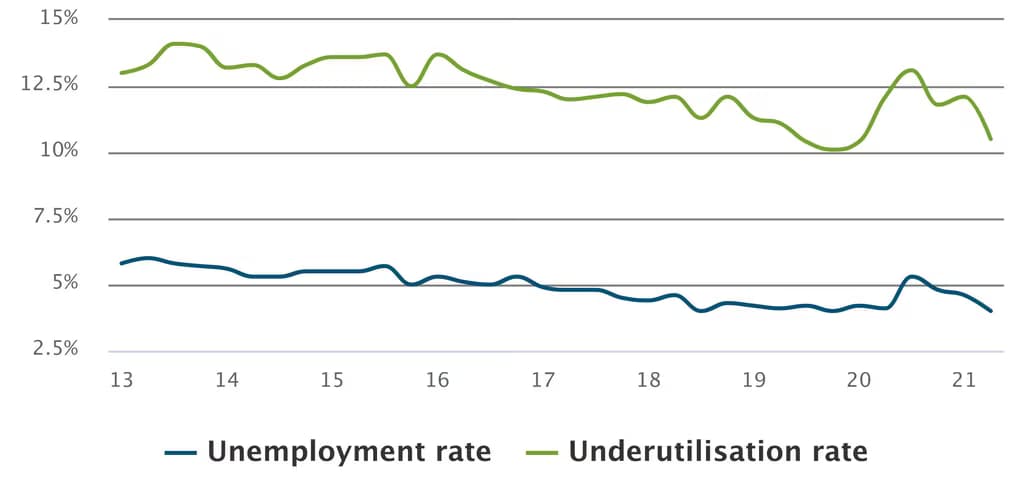
- The unemployment rate dropped sharply to 4.0% in June (seasonally adjusted), from 4.7% in March – the fastest fall on record (since 1986). The underutilisation rate also plunged to 10.5% from 12.2% previously, reinforcing the tightness of the labour market.
- Employment rose strongly, with nearly 47,000 more people in work than last June (up 1.7%pa), with strength in both part-time and full-time work. More people are in the labour force, with the first annual decline in the not-in-the-labour-force group since the start of 2018.
- The participation rate rose to 70.5% on a seasonally adjusted basis, a continued trend as more people get pressed into the labour market.
- The labour cost index rose 2.1%pa, a faster rate than in previous quarters, having been more subdued over the COVID-19 period. This rise was driven by a sharp 3.7% boost in labour costs in the private sector.
Sharp tightening in the labour market
% of labour force, seasonally adjusted
...and our reaction
- There is now substantially less spare capacity left in the labour market than expected, with the fall in unemployment and underutilisation larger than anticipated, more pressure on wages, and high expectations for a response from the Reserve Bank.
- The sharpest drop in unemployment since the Household Labour Force Survey started in 1986 is the headline-grabbing stat, but labour market tightness showed through across the board in June. Indicators since June show no signs of the economy slowing, and with such a drop in unemployment, it’s hard to see how the current pressure to find workers will dissipate any time soon.
- High job ad numbers, record difficulty finding labour, record job churn, and record falls in labour market spare capacity mean that wage pressure will build further as firms pay more to attract and retain staff.
- With such intense pressure in the labour market, and no slack to be found, it’s safe to say we’re now beyond maximum sustainable employment. With wage pressures building too, adding to inflation expectations, today’s labour market data cements an official cash rate increase in August.
- We expect a 50 basis point raise from 0.25% to 0.75%, which would jolt the market, as well as buying the Reserve Bank time to assess how sustained the current surge in inflation is.
Latest updates
Premium

Labour market statistics
Unemployment jumps higher than expected
Wed 5 Aug 2026
Quarterly
5.6% Unemployment rate in the June 2026 quarter (s.a.) 70.7% Participation rate the highest in over a year0.5% Employment growth in June from March (s.a.)
Premium
Labour market statistics
More people, more working, more not participating
Wed 6 May 2026
Quarterly
 5.3% Unemployment rate eased slightly in the March 2026 quarter70.4% Participation rate fell slightly0.2% Employment rose in March from December (s.a.)
Labour market statistics
Higher participation drives unemployment increase
Wed 4 Feb 2026
Quarterly
5.4% Unemployment rate December 2025 quarter (sa)70.5% Participation rate December 2025 quarter (sa)2.0%pa Labour Cost Index Year to December 2025Labour market statistics
Unemployment rate rises to 5.3%
Wed 5 Nov 2025
Quarterly
Unemployment rate edges up to 5.3%Youth NEET rate rises to 13.2% (annual average)Labour cost growth slows to 2.1%pa