
Our take on the latest Real estate statistics (Tue 16 Feb 2021)



NZ house price growth accelerates to 19%pa
NZ sales growth slows to 3.2%pa
Regional growth now driving higher prices
The key numbers...
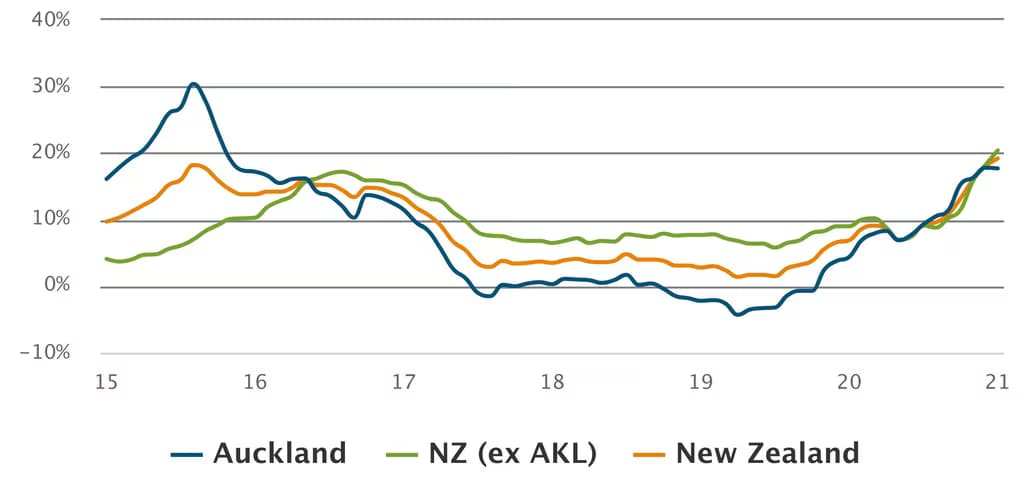
- House price growth accelerated to 19%pa across New Zealand in January, the fastest growth since mid-2004.
- Auckland price growth held steady at just below 18%pa, but prices across the rest of the country rose at an increasing pace – excluding Auckland, prices rose 20.4%pa.
- Regional price growth is at eye-watering levels - Gisborne/Hawke’s Bay saw prices rise 31%pa, followed by Wellington and Manawatū-Whanganui, which both recorded annual price growth of 26%.
- Days to sell were down to 35 in January, far quicker than the 45 days on average for January over the preceding 10 years.
- Sales growth slowed considerably, with volumes rising just 3.2%pa after a 30%+ average in the last six months. Sales growth in Auckland slowed, but was still at 38%pa, but regional sales dipped 10%pa.
House prices rise further
House price index, annual % change
...and our reaction
- The housing market still has some way to run before recent interventions take any of the heat out of surging prices, with regional housing markets roaring hottest.
- Auckland sales remain stronger than the rest of the country, and price growth has been steady in the Super City. But big drops in regional sales volumes and a shortage of listings have seen regional house price growth head higher than the nationwide average.
- The split between Auckland and regional housing markets partially reflects the strong regional economic performance, with areas of strong house price growth likely to be attractive areas for workers.
- Regional markets are also likely to be easier for investors to purchase in, particularly as larger deposit requirements are reinstated for investors. But price growth looks set to ease in future, with prices becoming too expensive for investors to make their investments pay for themselves.
- This weight of investor demand is overwhelming limited supply in the market. Sellers (particularly owner-occupiers) will generally have to buy back in the same red-hot market, which has put off some potential sellers from listing their properties, as they will have to use their housing gains to pay higher prices to secure a new property.
- Recently announced LVR restrictions from March, tightening further in May, are likely to slow house price towards the end of 2021, but house prices appear set to rise further before that acceleration pulls back. Infometrics currently expects that house price inflation could slow to below 10%pa by the end of 2021.
Latest updates
Premium

Real estate statistics
House sales and prices still falling
Thu 13 Aug 2026
Monthly
 10%pa House sales in July 20260.4%pa House prices from a year earlier9.3%pa Stock of homes for sale in July 2026
Premium
Real estate statistics
Conflict continues to drag on housing market in June
Wed 15 Jul 2026
Monthly
8.8% House sales between Feb and Jun 2026 (seas adj)0.8% House prices since February (seas adj)4.8% Stock of homes for sale since February (seas adj)Real estate statistics
House buyers dry up ahead of interest rate rises
Mon 15 Jun 2026
Monthly
13%pa House sales in May 20260.6%pa House prices from May 2025Stock of homes for sale at an 11-year highReal estate statistics
House prices and sales fall
Thu 14 May 2026
Monthly
7.9%pa House sales in Apr 20260.5% House prices from Mar 2026 (sa)1.2% Stock of homes for sale since Feb 2026 (sa)