
Our take on the latest Labour market statistics (Wed 4 Nov 2020)


Unemployment rate rises to 5.3%
22,000 fewer people employed in the September quarter
Underutilisation rate rises to 13.2%
The key numbers...
- Over the September 2020 quarter, Stats NZ estimates that employment fell by a seasonally adjusted 22,000 jobs, with a 1.2% fall in the number of full-time jobs outweighing a slight rise in the number of part-time jobs.
- The data shows that 44,600 people have lost their jobs since the March 2020 quarter, although almost one third of this decline can be attributed to the normal seasonal pattern of employment.
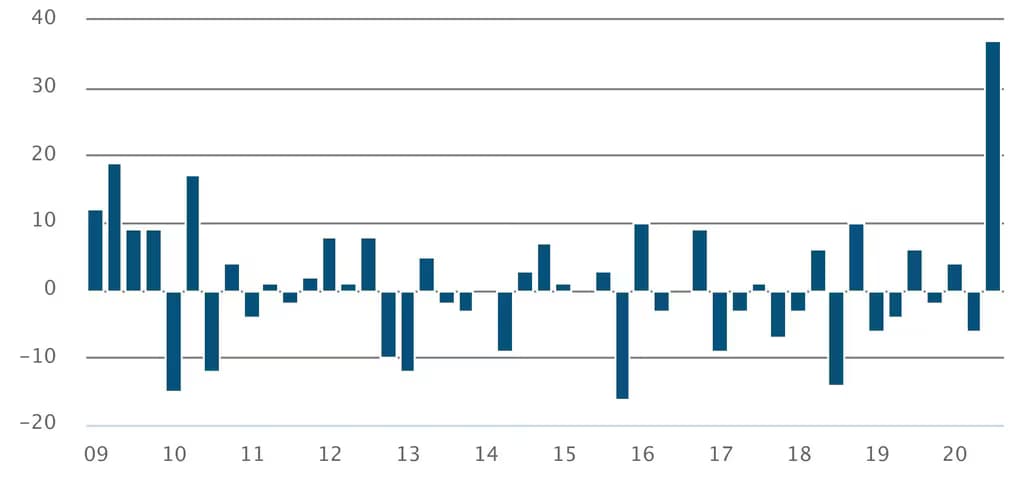
- The unemployment rate rose to 5.3%pa in the September 2020 quarter and there were 37,000 more unemployed people than in June (both figures seasonally adjusted). This increase is the largest quarterly rise in unemployment since the series began in 1986 and almost double the largest quarterly increase we saw during the GFC.
- The underutilisation rate rose from a seasonally adjusted 12.0% to 13.2% as increases in under-employment and unemployment offset a reduction in the number of available potential jobseekers. Some workers have dropped back from full-time to part-time work, leading to an increase in the number of people wanting to work more hours.
- Total hours worked bounced back in the September 2020 quarter, rising a seasonally adjusted 9.4%, following a 10.2% fall in the June 2020 quarter, but were still down 1.8% from March’s pre-COVID levels.
Change in unemployment
Quarter on quarter change in unemployment (000s)
...and our reaction
- Falling employment comes as no surprise as the September quarter saw a significant reduction in the number of jobs supported by the wage subsidy scheme.
- However, today’s result was at the better end of market predictions and reaffirms that the labour market has held together better than was expected earlier in the pandemic.
- There was a small decline in the number of jobseekers who were not actively seeking work (placing them in the “Not in Labour Force” category), but this fall was nowhere near enough to reverse the jump seen in the June quarter. The opening up of the economy following lockdown enabled and encouraged some jobseekers to look for work again, but many people who were employed up until March are now still not available for or not seeking work.
- The drop in the participation rate means that the rise in the unemployment rate does not tell the complete picture of labour market weakness. The increase in unemployment remains well short of the lift in Jobseeker Support numbers since March.
- The next few months will be crucial for employment in key areas such as tourism, hospitality, and retail. We still see ongoing risks to job numbers in these sectors that could cause further significant deterioration in the labour market next year.
Latest updates
Premium

Labour market statistics
Unemployment jumps higher than expected
Wed 5 Aug 2026
Quarterly
5.6% Unemployment rate in the June 2026 quarter (s.a.) 70.7% Participation rate the highest in over a year0.5% Employment growth in June from March (s.a.)
Premium
Labour market statistics
More people, more working, more not participating
Wed 6 May 2026
Quarterly
 5.3% Unemployment rate eased slightly in the March 2026 quarter70.4% Participation rate fell slightly0.2% Employment rose in March from December (s.a.)
Labour market statistics
Higher participation drives unemployment increase
Wed 4 Feb 2026
Quarterly
5.4% Unemployment rate December 2025 quarter (sa)70.5% Participation rate December 2025 quarter (sa)2.0%pa Labour Cost Index Year to December 2025Labour market statistics
Unemployment rate rises to 5.3%
Wed 5 Nov 2025
Quarterly
Unemployment rate edges up to 5.3%Youth NEET rate rises to 13.2% (annual average)Labour cost growth slows to 2.1%pa