Building work put in place
Strong residential intentions not flowing through
5 Dec 2019

Our take on the latest Building work put in place (Thu 5 Dec 2019)


Growth in Auckland residential building slowed to 5%pa
Non-residential construction grew 13%pa
Accommodation building up 41%pa
The key numbers...
- The total volume of construction across New Zealand grew 7.7%pa in the September quarter, similar to 7.8%pa growth in the June quarter.
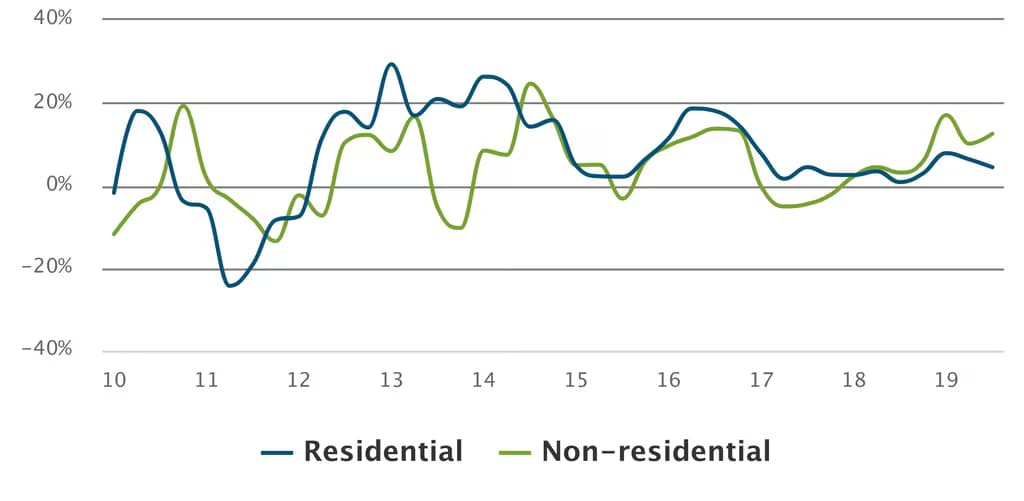
- Non-residential construction was the outstanding performer, growing at 13%pa, while residential construction disappointed, with growth easing from 6.3% in the previous quarter to 4.4%pa in the September quarter.
- Auckland, Waikato, and Wellington were the stand-out regions for non-residential construction, growing 35%, 33% and 26%pa respectively. In contrast, Canterbury’s non-residential construction has now been in decline for a year, down 5.7% in the September quarter.
- Auckland’s residential growth slowed from 16% in the June quarter to 5%pa in the September quarter.
- By building type, accommodation grew the fastest, up 41%pa. Shops, warehouses, and factories were other top performers, growing 35%, 28%, and 25%pa respectively.
Work put in place
Annual % changes, Sept 1999 prices
...and our reaction
- Total growth in the construction industry remains solid despite being marginally below our expectations, mainly because of a weak result in residential building. However, this residential weakness was mitigated by strength in non-residential construction.
- The dichotomy of non-residential construction outperforming residential construction was most pronounced in Auckland.
- Weaker-than-expected residential construction volumes could mean either weak buyer demand, capacity constraints, or developers stalling the progress between consent and completion.
- Residential dwelling consent numbers are at their highest level since the 1970s, suggesting buyer demand is there.
- Declining house prices in Auckland over the past year may have deterred some developers in the supercity, but capacity constraints are likely to be contributing to the softness.
- Client feedback suggests demand for products in the residential space has slowed since mid-2019, which is consistent with softness in the work put in place numbers.
Latest updates
Premium

Building work put in place
Construction activity at a 10-year low
Thu 4 Jun 2026
Quarterly
 13% Non-residential activity in March 2026 from March 20253.9% Residential activity from March 2025
 Total building activity at its lowest level (excl lockdowns) since 2015
Premium
Building work put in place
Non-residential work hammered as residential softens further
Thu 5 Mar 2026
Quarterly
6.5% Non-residential activity from September 2025 (sa)1.1% Residential activity from September 2025 (sa)Total building activity at its lowest level (excl lockdowns) since 2015Building work put in place
Non-residential activity continues to decline
Thu 4 Dec 2025
Quarterly
 Residential volumes up 3.3% in September from June 2025 (sa)Non-residential volumes down 1.3% in September from June 2025 (sa)Total quarterly activity now down 5.3% from September 2024
Building work put in place
Lower residential activity leads construction decline
Thu 4 Sept 2025
Quarterly
Residential volumes down 2.9% in June from March 2025 (sa)Non-residential volumes down 0.4% in June from March 2025 (sa)Total quarterly activity now down 9.6% from June 2024