
Our take on the latest Labour market statistics (Wed 1 May 2019)



Labour cost inflation edges higher to 2.0%pa
Unemployment falls to 4.2%
Employment fell 0.2% over the quarter
The key numbers...
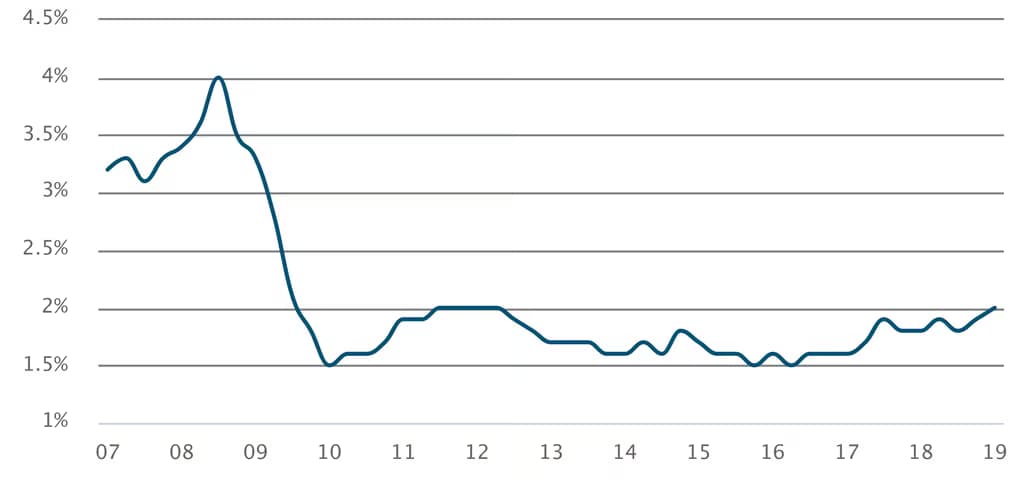
- Although labour cost inflation hit a seven-year high of 2.0%pa, in 2008 - the last time unemployment was below 5.0% - we saw labour cost inflation as high as 3.9%pa.
- Our expectations remain for labour costs to increase above 2.0%pa in the next few years as firms are forced to pay more to attract and retain workers, as well as larger minimum wage increases.
- The divergence between full-time and part-time employment suggests firms are shifting staff towards longer hours to cope with the shortage of available workers.
- We don’t expect today’s labour market data to change the Reserve Bank’s stance on interest rates. If anything, the lack of employment growth over the last six months reinforces the likelihood that the official cash rate will be cut this year
Labour cost inflation
APC (%)
...and our reaction
- Labour cost inflation increased slightly to 2.0%pa in the March 2019 quarter.
- The seasonally adjusted unemployment rate fell to 4.2% in the March 2019 quarter.
- Employment growth increased to 1.5%pa despite a 0.2% fall in employment over the quarter. Growth in full-time employment continues to be strong at 3.1%pa, but part-time employment fell 4.7%pa.
Latest updates
Premium

Labour market statistics
Unemployment jumps higher than expected
Wed 5 Aug 2026
Quarterly
 5.6% Unemployment rate in the June 2026 quarter (s.a.)70.7% Participation rate the highest in over a year0.5% Employment growth in June from March (s.a.)
Premium
Labour market statistics
More people, more working, more not participating
Wed 6 May 2026
Quarterly
5.3% Unemployment rate eased slightly in the March 2026 quarter70.4% Participation rate fell slightly0.2% Employment rose in March from December (s.a.)Labour market statistics
Higher participation drives unemployment increase
Wed 4 Feb 2026
Quarterly
5.4% Unemployment rate December 2025 quarter (sa)70.5% Participation rate December 2025 quarter (sa)2.0%pa Labour Cost Index Year to December 2025Labour market statistics
Unemployment rate rises to 5.3%
Wed 5 Nov 2025
Quarterly
Unemployment rate edges up to 5.3%Youth NEET rate rises to 13.2% (annual average)Labour cost growth slows to 2.1%pa