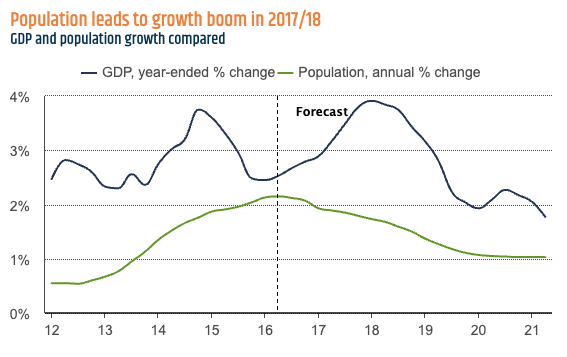
With population growth still accelerating and an increasingly large housing supply response necessary in Auckland, we have revised up our forecasts of economic growth throughout 2017 and 2018, with GDP growth expected to peak at 3.9%pa in the March 2018 year. This acceleration in growth will occur despite persistent weakness in dairy prices and the international uncertainty caused by Brexit. However, the necessary rebalancing in the housing market following another 18 months of strong growth will see domestic economic growth weaken towards 2.0%pa by 2020, even as international economic conditions become more settled.
Population underpins NZ’s near-term growth
Population growth continues to be a key driver of New Zealand’s economy. Net migration has continued its astounding climb to a record high of 68,342pa, pushing population growth up to 2.1%pa. Per-capita economic growth is at a five-year low of 0.3%pa, and growth in per-capita private consumption is running at a similar rate, which is a six-year low. In other words, New Zealand’s economic performance would look much less healthy without the rapid population growth currently taking place.
The consequences of this population growth have already shown up in the Auckland housing market over the last 2-3 years. But in terms of construction activity, there’s still a lot more to come. We expect nationwide residential consent numbers to climb from 28,387 currently to 40,044pa by mid-2018, with Auckland’s consent total rising from 9,434 to over 13,800 by the second half of 2018.
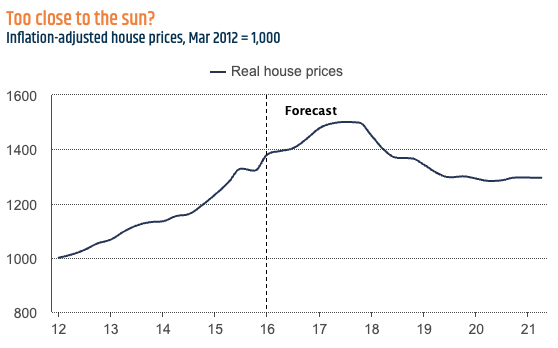
By March 2018, we expect migration to still be up at a net inflow of 53,800pa, and for population growth to have only pulled back to 1.7%pa. However, we forecast that the delayed housing response to try and accommodate all the additional people in New Zealand will have helped push GDP growth up to 3.9%pa. House prices will have risen another 17% by the end of 2017, making property, particularly in Auckland, look even more overvalued and unaffordable than it does now.
Our previous set of forecasts spoke about the potential for a housing-related hangover during 2018 and 2019. Even with more stable international economic conditions later in the forecast period, a domestic slowdown remains a central part of our medium-term outlook, as population growth fades, house prices come under downward pressure, and residential construction activity retreats from unsustainably high levels. We expect GDP growth to ease to 1.9%pa by early 2020 and hover around 2.0%pa through until at least mid-2021.
In the context of the housing market downturn and easing population growth, this forecast slowdown in the economy is a relatively mild one. The risks of a bigger downturn are centred on the imbalances in the Auckland housing market.
- The Auckland housing market and, to a lesser extent, the Queenstown market are vulnerable to higher interest rates. House-price-to-income ratios in both regions are at very high levels, and many mortgage holders will find their budgets heavily stretched even with modest rises in interest rates from their current historic lows. Although house price growth has recently been very strong in Waikato and Bay of Plenty, house-price-to-income ratios are not as stretched in these regions, so mortgage holders are less at risk from possible interest rate rises.
- Slowing demand growth, due to easing population growth, will creep into the Auckland housing market at the same time as the supply of new housing is still ramping up. With the estimated undersupply of housing in Auckland possibly as large as 32,000 dwellings, we are not suggesting that the region’s housing shortage will be rectified in the short-term. But a change in the demand and supply dynamics could have more dramatic consequences for Auckland’s property market than the house price falls we have factored in during 2018 and 2019.
- Another year and a half of significant demand pressures and rising property prices could also leave regional property markets in the “halo” around Auckland looking vulnerable once supply conditions in Auckland improve and the surge in demand across Northland, Waikato, and Bay of Plenty starts to fade. Although housing affordability is nowhere near as critical an issue in these regions as it is in Auckland, we fear that the demand-supply imbalance could make property significantly overvalued during 2017 in these areas, leading to some reversal in prices during the following two years.
At a nationwide level, we are forecasting an 11% drop in house prices between September 2017 and September 2019. By mid-2020, our forecasts see real house prices down 14% from their 2017 peak. Real house prices at this level would be 11% above the high reached in 2007 before the Global Financial Crisis.
Key influences on spending activity
Looking for sustainability in the tourism sector
Tourism continues to be a star performer for the New Zealand economy and is set to maintain that position throughout the next couple of years. Visitor numbers over the year to May were up 11% from the previous 12 months, a growth rate that has not been exceeded since 2004.
Infrastructure and protecting our brand have emerged as increasingly important issues given the massive lift in tourist numbers that has occurred over the last 2-3 years. Part of New Zealand’s appeal for overseas visitors has been the “clean, green” image, and there are some questions about how many more tourists some parts of the country can realistically cope with before the “wide open” spaces don’t feel quite so wide or open any more.
In terms of infrastructure, the accommodation stock is certainly stretched. The government’s pledge of $12m to assist tourist-oriented small areas with essential facilities such as public toilets also looks woefully inadequate given the amount of GST that is paid by overseas visitors while they are here.
Overall, the tourism industry needs to be careful that, both from the individual operators’ points of view and in terms of the broader experience offered to visitors, the reality lives up to the marketed promise. Unfettered growth in tourist numbers, without due attention being paid to the quality of the product, would have negative medium-term consequences for the industry, with New Zealand losing its international appeal as word spread about people’s negative experiences. Although further growth in arrival numbers is pretty much assured throughout 2017 and into 2018, there are risks that subsequent growth is undermined if the industry simply treats the current surge in arrivals as a cash cow.
Don’t hold your breath for a dairy recovery
The dairy sector continues to grapple with difficult international conditions. Fonterra’s opening forecast for its farm-gate payout in the 2016/17 season is $4.25/kgms, an outcome that would leave the inflation-adjusted payout close to the 25-year low recorded in the season just completed.
The Ministry for Primary Industry’s latest Situation and Outlook for Primary Industries report forecasts that the dairy payout will climb to $6.15/kgms by the 2017/18 season, a prediction that we find highly unlikely. European milk production so far this year is up 5.6% from a year ago and is failing to respond to lower prices. American production is also 1.9% higher than in the first four months of 2015. International supply conditions remain unconducive for any substantial near-term rebound in dairy export incomes. In our view, it could conceivably be 2019/20 before the dairy payout is back above $6/kgms, especially given that the massive spike in Chinese demand during 2013 and 2014 has clearly proven to be unsustainable.
This outlook reinforces the point that it is a slow road to more benign economic conditions for regions with a heavy reliance on dairy. For some areas, the negative effects of dairy’s difficulties are being mitigated by above-average population growth (eg Waikato) or the booming tourism sector (eg Northland). However, some other regions (eg Taranaki) have little to cushion the blow of dairy’s prolonged downturn, and weak milk prices will continue to constrain economic activity (despite some costs, such as interest rates and fuel, also remaining low and providing a little relief for farmers).
An environment of low inflation and low interest rates
Persistently low inflation has forced the Reserve Bank to cut the official cash rate to 2.25%, and the Brexit decision will see the OCR reduced to 2.0% in August. Financial markets will speculate about another possible interest rate cut through until early 2017, by which time some easing in international uncertainty, combined with the persistently strong housing market, will see thoughts of a further cut shelved.
Nevertheless, the absence of a further cut to take the OCR below 2% does not imply that higher inflation is about to quickly reappear. A lack of inflation internationally, combined with our relatively strong dollar, are forecast to see domestic inflation hold at about 1.5%pa between 2017 and 2019. With the path of international interest rate rises over the next few years looking less assured than it had previously, any pressure on the Reserve Bank to tighten monetary conditions here will be relatively muted. Housing market concerns are likely to be dealt with via macro-prudential tools – loan-to-value restrictions targeted at investors will be tightened before the end of this year, and we expect mortgage-to-income restrictions also to be implemented within the next 12 months. The Reserve Bank will also be willing to “look through” any inflationary pressures generated by the lift in residential construction activity that is needed to address Auckland’s undersupply of housing.
Our forecasts see the official cash rate holding at 2.0% throughout 2017, edging up to 2.5% by the end of 2019, and reaching 3.0% in 2020. This relatively low forecast for interest rates is consistent with continued low inflation both domestically and internationally.
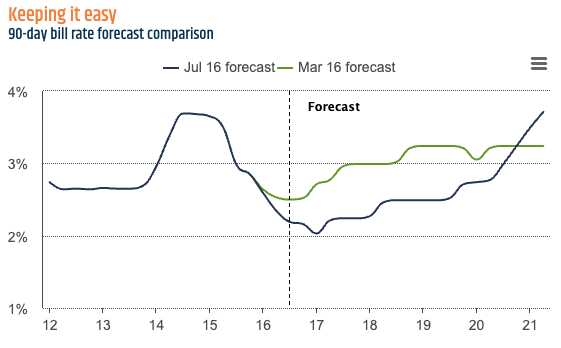
The forecast also reflects our view that average interest rates over the medium-term will be lower than the rates that prevailed last decade in the lead-up to the Global Financial Crisis. Although inflation had been brought back under control during the 1990s following the rampant price growth of the 1970s and 1980s, interest rates still included a risk component associated with the possibility of higher inflation re-emerging. Markets now appear to be more comfortable with the idea of permanently low inflation, which has allowed real interest rates to move lower on a sustained basis.
Fickle fuel prices
As anticipated in our previous forecasts, crude oil prices have lifted back to around US$50/bl. The rebound has been a bit quicker than we had expected, although the stronger New Zealand dollar has prevented a sharper lift in retail petrol and diesel prices.
The large swings in fuel prices make it difficult to settle on a medium-term outlook for households’ energy costs, as well as meaning that consumers are unlikely to adjust their discretionary spending behaviour as quickly to any price falls given the risk of that extra spending power being quickly removed again. Even with petrol prices holding in the $1.80-2.00/l range throughout the next year, which is lower than we had previously forecast, we have adopted a more conservative forecast for household spending growth. It is only from mid-2017, as residential construction booms to record high levels, where we have revised up our forecasts for household spending.
China steady, but Brexit ramps up the international risks
The uncertainty emanating from the Chinese economy might have eased since earlier in the year, but China’s growth prospects are not any better than they were at the start of 2016. At best, it’s been a case of stabilisation for Chinese indicators, with growth in electricity production staying just in positive territory, while both property and equity prices have levelled off. Hard commodity prices have also steadied, but China’s exports and imports are down from a year ago, and both road and rail freight volumes within China are also declining.
China’s economic growth is still expected to be 6.5% this year, the weakest result since 1990, before easing further towards 6.0%pa in 2017. This outlook has dragged down growth expectations across other Asian economies as well.
The latest source of global uncertainty is Brexit, its effects on UK economic growth, and its implications for the future of the European Union. Respondents to Consensus Economics’ survey in early June predicted that a leave vote would shave two percentage points off UK growth across the rest of 2016 and 2017, as well as knocking half a percentage point off growth in the Euro area.
In Does Brexit really matter for New Zealand?, we have examined the potential effects of the Brexit decision, including:
- the potential flow-on effects of a British slowdown for the rest of the global economy
- how British trade flows might change as the country exits the EU
- the risks that the unexpected decision poses to our central forecast.
We now expect the UK economy to grow by 1.0% or less over each of the next two years.