Non-residential building consents
Softness in non-res consents takes a pause
1 Dec 2025

Our take on the latest Non-residential building consents (Mon 1 Dec 2025)
Value of non-res consents
$872m


In October 2025
Total consents down 6.7% from October 2024
Education consents up to $232m
The key numbers...
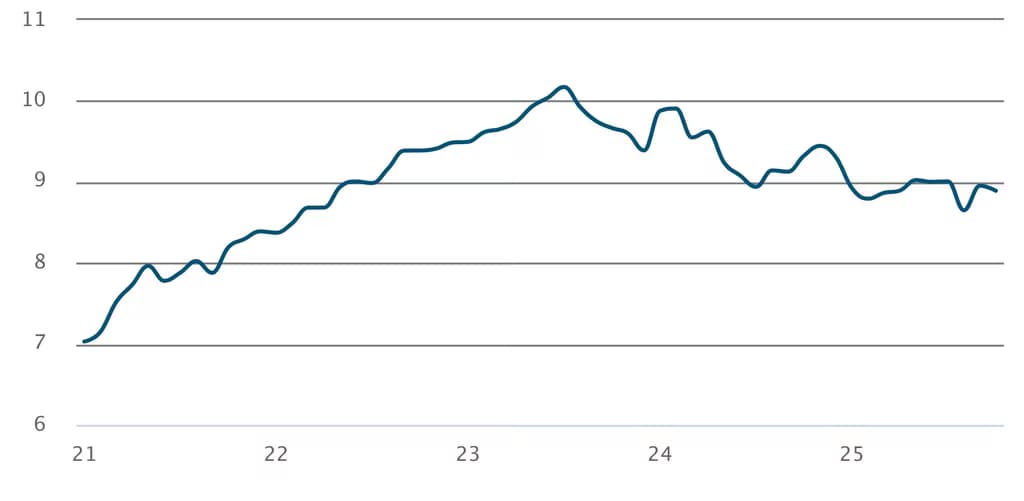
- The monthly value of non-residential consents totalled $872m in October, down 6.7% from October 2024. The annual total fell narrowly to $8.9b from $9.0b from September and now sits 13% below the peak in mid-2023 in nominal terms.
- Education consents totalled $232m, up $131m from October 2024 to the highest monthly total after adjusting for building cost inflation since May 2023. A $50m consent for the new University of Waikato medical school in Hamilton is likely to be part of this total. Education consents in Auckland totalled $92m, the highest monthly total since September 2022.
- Waikato recorded $102m of non-residential consents in October, the highest monthly total since January 2024. Tasman also saw $30m of non-residential consents, a record monthly total after adjusting for building cost inflation, driven by $24m of hospital building consents.
Annual non-res consents trending lower
Annual running total, non-residential building consents, $b
...and our reaction
- Although this marks another reasonable month for non-residential building consents, following September’s total of $947m (boosted by a $352m Auckland Airport consent), we continue to expect the weak economic conditions felt through 2025 to weigh on future non-residential consents.
- The monthly value of non-residential consents for additions and alterations totalled $345m, the second highest monthly total since April 2019 after seasonal and building cost inflation adjustments. This might reflect high vacancy rates across existing commercial buildings, driving improvements to existing stock rather than new buildings.
- There has been less upward pressure on non-residential building costs in the past year, as growth moderated to just 1.1%pa in September, compared to a year ago, the slowest rate since March 2013. Despite this, there remain pressures on the sector following strong price growth in recent years. High energy prices, as well as weakness in the exchange rate might weigh on material costs, although spare capacity as activity levels moderate in 2026 might restrict the extent of a reacceleration in cost inflation.
Latest updates
Premium

Non-residential building consents
Warehouses prevent further non-res falls in June
Mon 3 Aug 2026
Monthly
$701m Value of non-res consents in June 2026
 7.4% Total non-res consents from May 2026 (seas adj)37%pa Warehouse consents from June 2025
Premium
Non-residential building consents
Non-res consents weaker still in May
Thu 2 Jul 2026
Monthly
$789m Value of non-res consents in May 2026
19% Monthly consents from May 202549% Public sector consents from May 2025Non-residential building consents
Non-res consents mostly softer in April
Wed 3 Jun 2026
Monthly
$655m Value of non-res consents in April 2026
15% Monthly consents from April 2025 Office and education consents at lowest monthly levels in 5-6 years
Non-residential building consents
Consents strong in March, but shadow of conflict looms
Fri 1 May 2026
Monthly
$862m Value of non-res consents in March 2026
15% Monthly consents from Mar 2025$119m Hostel consents from Mar 2025