
Our take on the latest Residential building consents (Wed 1 Oct 2025)
Dwelling consents
34,078

As of August 2025
Consent numbers up 6.9% from August 2024
Apartment consents up 46%pa in year to August 2025
The key numbers...
- There were 3,080 new dwelling consents issued in August, up 6.9% from a year ago. August consents rose 5.8% from July 2025 on a seasonally adjusted basis, following a 5.3% rise in July. On an annual basis, consents are at their highest level since the year to May 2024, but the lift still represents a tentative start to recovery.
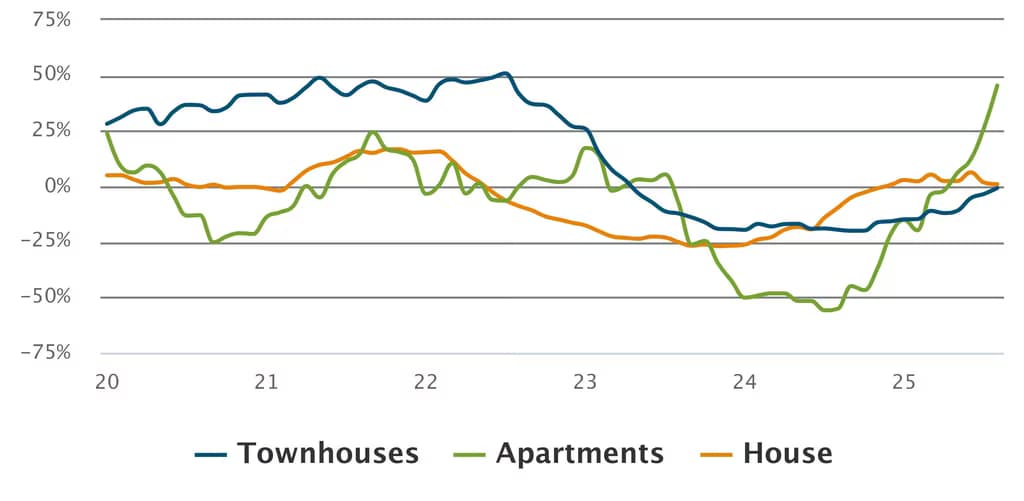
- Growth has been driven by standalone house consents, which have risen 1.0%pa in the year to August, and made up 46% of all dwelling consents. Apartment consents have risen 46%pa, but they only make up 7% of all consents. Townhouses slipped a further 0.7%pa, and retirement village units fell 22%pa, 59% below their peak in the year to March 2023.
- Most the of the apartment consents were issued for Auckland (212), followed by Manawatū-Whanganui (26). The strongest growth in standalone house consents was seen in Gisborne, Wellington, Otago, Southland, and Marlborough. House consents softened in Northland, Hawke’s Bay, Taranaki, West Coast and Tasman.
Mixed trends across dwelling types
Annual average % change
...and our reaction
- Dwelling consents are technically recovering, but it’s unlikely to feel like a recovery, with a modest uptick of 5.8% in August (seasonally adjusted) and an annual total still hovering around 34,000. Annual consents have been below 40,000 for nearly two years.
- The resurgence in apartment consents isn’t enough to drag up attached dwelling consents, with townhouse consents remaining weak, and retirement consents remaining dire. Standalone housing consents are driving the recovery, with 5.8% growth in August (seasonally adjusted).
- There doesn’t seem to be a pattern between the turnaround in consents and regional economic activity at present. Some of the strongest regional growth in consents has come from regions which have taken the greatest hits to employment – such as Auckland, Gisborne, Wellington, and Nelson.
- Market expectations of aggressive cuts to the official cash rate by the end of the year appear positive for residential consents. However, housing market activity has been muted under still-low interest rates, and the number of existing houses on the market for sale remains elevated. Realestate.co.nz data indicates that house listings rose 2.3% in the year to September 2025, to a new 10-year high, contributing to a pullback in asking prices. With such a strong supply of existing houses, it seems unlikely that interest rate cuts will spur consenting on their own. Net migration also slipped to just 11,300 in the year to July 2025, so population growth is unlikely to promote consenting either.
Latest updates
Premium

Residential building consents
Residential consents fall 3.6% in June
Mon 3 Aug 2026
Monthly
40,581 Annual consents over the June 2026 year
19% June 2026 consents over the June 2026 year 3.6% June 2026 consents from May on a seas. adj. basis
Premium
Residential building consents
Residential consents fall 4.0% in May
Thu 2 Jul 2026
Monthly
 39,737 Annual consents over May 2026 year4.0% May 2026 consents from April on a seas. adj. basis22%pa Townhouse consents over May 2026 year
Residential building consents
Residential consents jump up 11% in April
Wed 3 Jun 2026
Monthly
39,087 Annual consents over April 2026 year11% April 2026 consents from March on a seas. adj. basis19%pa Multi-unit consents over April 2026 yearResidential building consents
Residential consent momentum trends sideways
Fri 1 May 2026
Monthly
37,813 Annual consents over March 2026 year 3,300pm Consents trend sideways on a seas. adj. basis14%pa Townhouse consents over March 2026 year