
Our take on the latest Retail trade survey (Fri 23 May 2025)

Core retail sales volumes up 1.5% in March (seas. adj.)
Eight of 13 core industries saw quarterly rises (seas. adj.)
More spending growth in the South Island, North Island improving
The key numbers...
- Core retail sales volumes, which exclude motor vehicle and fuel retailing, rose 1.5% in March 2025 from the December 2024 quarter (seasonally adjusted). The rise follows a 1.6% (revised up from 1.4%) jump in the December quarter. March quarter spending volumes were 1.4% higher than a year ago, the largest annual increase since June 2023.
- Despite back-to-back, significant quarterly rises, core retail sales volumes per capita remain subdued, 11% below peak levels in mid-2021.
- Growth in spending was widespread, with eight of the 13 core industries seeing a lift in quarterly seasonally adjusted spending volumes. Clothing, footwear and personal accessory retailing rose 4.4%, its largest quarterly since September 2022.
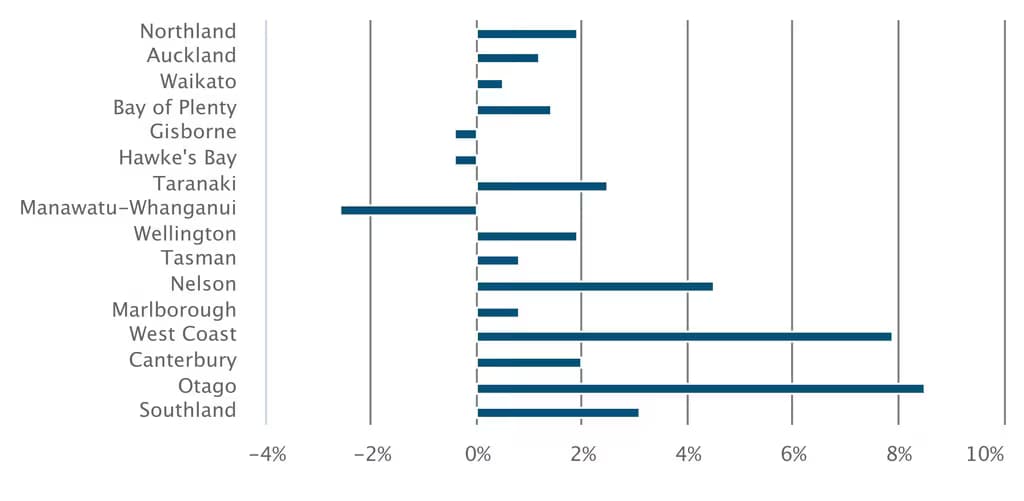
- Core spending values in March were higher than a year ago across 13 of the 16 regions. Growth in the South Island was 3.8%pa, outpacing the 1.0%pa growth in the North Island. Regional growth was led by Otago (8.5%pa), West Coast (7.9%pa), and Nelson (4.5%pa), driving the outperformance of the South Island compared to the North.
South Island spending recovery outpaces North
Core retail sales, annual % change, Mar-2025
...and our reaction
- Yesterday’s government Budget re-iterated much of what we had signalled in our April forecasts, with the economic recovery to be restricted by weaker growth in our trading partners economies. But substantial back-to-back quarterly rises in core retail sales volumes is a positive start for the economic recovery.
- The strong recovery in the South Island has likely been driven by better international tourism arrival numbers benefitting South Island tourism areas, combined with stronger primary sector commodity prices.
- Urban areas appear to be recovering a bit slower, in-line with trends across the labour market as falls in employment across professional services, administration, and media hit and restrict spending in the main centres.
- The unemployment rate is nearing a turning point, with the rate expected to be peaking in the current June 2025 quarter. As the labour market improves over the second half of 2025, combined with the continuation of households rolling onto lower mortgage rates, there should be more scope for further improvement in discretionary spending, driving retail sales higher.
Latest updates
Premium

Retail trade survey
Core retail volumes grow slower as consumers adjust to elevated fuel prices
Mon 24 Aug 2026
Quarterly
 -0.5% Total retail sales volumes in the June 2026 quarter (seas. adj.)+0.7% Core retail sales volumes in the June 2026 quarter (seas. adj.)+6.5%pa South Island core retail sales in the June 2026 quarter
Premium
Retail trade survey
Anxious consumers pull back on discretionary spending
Fri 22 May 2026
Quarterly
1.0% Core retail sales volumes in the March 2026 quarter (seas. adj.)8 of 13 core industries recorded quarterly rises (seas. adj.)-4.8% Clothing, footwear in the March 2026 quarter (seas. adj.)Retail trade survey
Retail spending continues to strengthen
Mon 23 Feb 2026
Quarterly
1.5% Core retail sales volumes in December (seas. adj.)11 of 13 core industries recorded quarterly rises (seas. adj.)South Island continues to lead the recoveryRetail trade survey
Retail spending recovery gaining traction
Thu 27 Nov 2025
Quarterly
Core retail sales volumes up 1.2% in September (seas. adj.) Seven of 13 core industries saw quarterly rises (seas. adj.)North Island growth starting to follow the South’s lead