
Our take on the latest Residential building consents (Fri 30 May 2025)
Dwelling consents
33,554


Over the year to April 2025
Total consents down 17% from Apr 2024
Auckland’s lowest apartment units consented since mid-2016
The key numbers...
- There were 2,418 new dwelling consents issued in April, down 16% from March (seasonally adjusted) and down 17% from a year earlier. The March monthly result was inflated by an unusually large number of apartment consents, so the size of the month-on-month fall is unsurprising.
- After last month’s strength, apartment consents sank back to 80 units consented, down from 495 units. This month’s result was driven by 42 units consented Waikato, the largest monthly total for the region since the beginning of 2022. Some of the apartment strength in the Waikato could be related to the Eastbank Apartments development of around 27 units. Auckland recorded just 24 units, its lowest monthly total since mid-2016. The other main centres showed similar weakness, with no units consented in Wellington and just six in Canterbury.
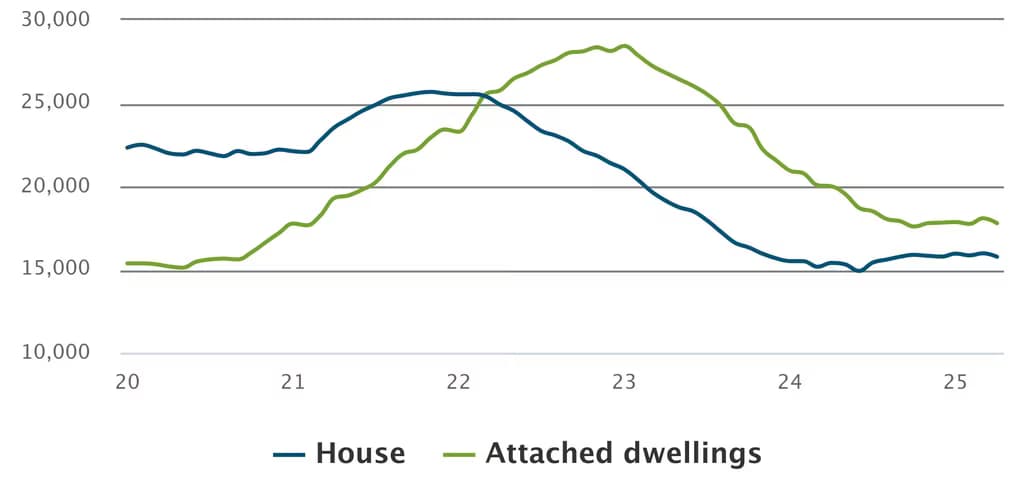
- Standalone houses and townhouses were significantly weaker than April 2024 consents, both down 15%. The annual total for house consents remains above a year ago, up 2.4%, but this result was the slowest annual growth since it turned positive in December 2024.
- The biggest regional contributors to lower consents compared to April 2024 were Marlborough (-74%), Auckland (-53%), and Hawke’s Bay (-47%). The largest positive contributors were Otago (+58%), Taranaki (+52%), and Southland (+27%).
Trends across dwelling types largely flat
Annual running total by dwelling type, 000's
...and our reaction
- Today’s figures indicate a return to the flat trend, which was expected after last month’s inflated result. In our forecasts we have communicated our expectation for residential consents to hold at around 33,000pa through until the September 2026 quarter.
- There are few regions that are showing considerable strength, but Taranaki and Otago are outperforming the rest of the country. Recording 2,649 consents in the year to April 2025, Otago is sitting at record annual levels of residential consents. Taranaki appears to have turned a corner in recent months, with the annual total up 27%pa, and higher than a year ago for the fourth consecutive month. Only three other regions have annual totals that are up from a year ago: Gisborne (+6.3%), Tasman (+2.9%), and Nelson (+0.5%).
- The Reserve Bank cut the official cash rate by a further 25 basis points this week, bringing it down to 3.25% and taking the total cuts in this easing cycle to 225bps. Further falls in mortgage rates on offer might help increase sales and reduce the surplus stock of available housing, but the large number of new listings still coming onto the market makes it difficult for sales to make a dent in the surplus.
- The attractiveness of residential investment remains low, with growth in residential rents weak at just 0.2%pa in the March quarter (according to MBIE and may be subject to revisions), and a significant volume of existing properties available for sale on the market. As the lagged effects of easing monetary policy work through the system, there is hopefully less uncertainty arising from the trade war, and the labour market starts to turn, the platform for residential investment could improve over the second half of 2025.
Latest updates
Premium

Residential building consents
Residential consents fall 3.6% in June
Mon 3 Aug 2026
Monthly
40,581 Annual consents over the June 2026 year
 19% June 2026 consents over the June 2026 year3.6% June 2026 consents from May on a seas. adj. basis
Premium
Residential building consents
Residential consents fall 4.0% in May
Thu 2 Jul 2026
Monthly
 39,737 Annual consents over May 2026 year4.0% May 2026 consents from April on a seas. adj. basis22%pa Townhouse consents over May 2026 year
Residential building consents
Residential consents jump up 11% in April
Wed 3 Jun 2026
Monthly
39,087 Annual consents over April 2026 year11% April 2026 consents from March on a seas. adj. basis19%pa Multi-unit consents over April 2026 yearResidential building consents
Residential consent momentum trends sideways
Fri 1 May 2026
Monthly
37,813 Annual consents over March 2026 year 3,300pm Consents trend sideways on a seas. adj. basis14%pa Townhouse consents over March 2026 year