Non-residential building consents
Mixed signals, as non-res not out of the woods yet
30 May 2025

Our take on the latest Non-residential building consents (Fri 30 May 2025)
Value of non-res consents
$768m


In April 2025
Office consents total $194m in April
Government policy, funding, and better sentiment offer some hope for improvement
The key numbers...
- The value of non-residential consents in April was up 3.9% from a year earlier, which was a reasonably good result given the general weakness in the sector and later timing of Easter this year. The annual total of activity remains just below $9b, a level it first dropped below during this downturn in July last year.
- This April’s result was boosted by a $130m consent in Māngere-Ōtāhuhu, which we expect is part of Auckland Airport’s construction of a new domestic terminal (and comes within the “office, administration, and public transport” building category).
- The next largest positive contributor to activity compared to a year ago was social building, up by $47m, with increased consent values in Tauranga (up $21m) and Christchurch (up $14m).
- Offsetting these increases were declines in hospital building (down $65m), retail building (down $39m), hostels (down $28m), warehouses, and hotels (each down $21m).
- Otago (down $29m, mostly due to less hospital building) and Canterbury (down $21m) recorded the largest declines in consents from April 2024. Southland (up $17m, due to education building), Bay of Plenty (up $17m), Manawatū-Whanganui (up $15m, due to storage building), and Waikato (up $13m due to factory building in Thames-Coromandel) recorded the largest increases over the same period.
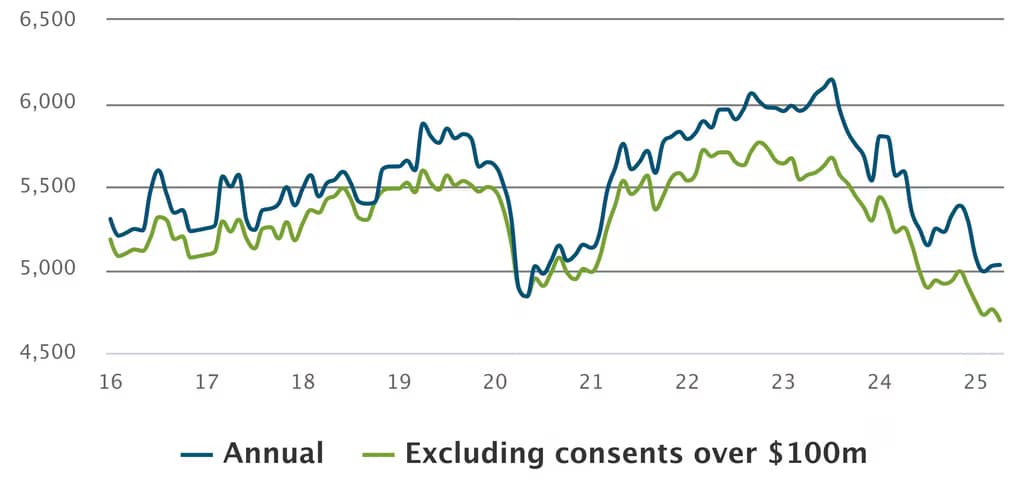
Non-residential consents still trending lower
Annual running total, adjusted for building cost inflation (2009/10 $b)
...and our reaction
- April’s non-residential result was on par with previous months, meaning that the downward trend in consents that has prevailed since mid-2023 is becoming less pronounced.
- However, we are cautious of getting too upbeat about prospects for the industry, given that results in two of the last three months have been boosted by large consents, which can be quite lumpy and distract from the underlying trend. Three-month annual growth in consents, excluding individual consents over $100m, is -6.9%, compared to -1.3% when these large consents are included.
- Weak economic conditions and the likelihood of a slower recovery due to the international trade war and associated uncertainty have the potential to delay in stabilisation or pick-up in non-residential consents. However, we note that ANZ’s latest Business Outlook survey showed an improvement in business confidence and investment intentions in late May, compared to late April and early May, providing some hope that the fall-out from international events will not be as great as initially feared.
- The announcement of the Investment Boost scheme in the government’s Budget, enabling businesses to immediately expense 20% of capex spending, has the potential to change the economics around new building projects, and lead to an earlier pick-up in activity than we had been forecasting. The effect on non-residential construction could possibly be significant, given that the effective depreciation rate on non-residential buildings is zero.
- The Budget also provided additional clarity around, and funding for, new hospital and education building going forward. Public sector consents have been a big contributor to the decline in non-residential consents over the last two years, so this additional funding could lead to some improvement in consent levels in coming quarters.
Latest updates
Premium

Non-residential building consents
Warehouses prevent further non-res falls in June
Mon 3 Aug 2026
Monthly
$701m Value of non-res consents in June 2026
 7.4% Total non-res consents from May 2026 (seas adj)37%pa Warehouse consents from June 2025
Premium
Non-residential building consents
Non-res consents weaker still in May
Thu 2 Jul 2026
Monthly
$789m Value of non-res consents in May 2026
19% Monthly consents from May 202549% Public sector consents from May 2025Non-residential building consents
Non-res consents mostly softer in April
Wed 3 Jun 2026
Monthly
$655m Value of non-res consents in April 2026
15% Monthly consents from April 2025Office and education consents at lowest monthly levels in 5-6 yearsNon-residential building consents
Consents strong in March, but shadow of conflict looms
Fri 1 May 2026
Monthly
$862m Value of non-res consents in March 2026
15% Monthly consents from Mar 2025$119m Hostel consents from Mar 2025