Residential building consents
A little more upward momentum in residential consents
2 May 2025

Our take on the latest Residential building consents (Fri 2 May 2025)
Dwelling consents
34,062


Over the year to March 2025
Total consents up 16% from Mar 2024
Otago consents at record high
The key numbers...
- There were 3,398 new dwelling consents issued in March, up 9.6% from February (seasonally adjusted) and 16% from a year earlier. The monthly result was the strongest since mid-2023, and annual growth has not been higher since March 2022, before the previous peak in activity.
- Much of the lift was driven by apartments, with 495 units consented in March, the largest number for any single month since 2022. Auckland (321 apartments) and Wellington (116 apartments) were the main contributors to this strength.
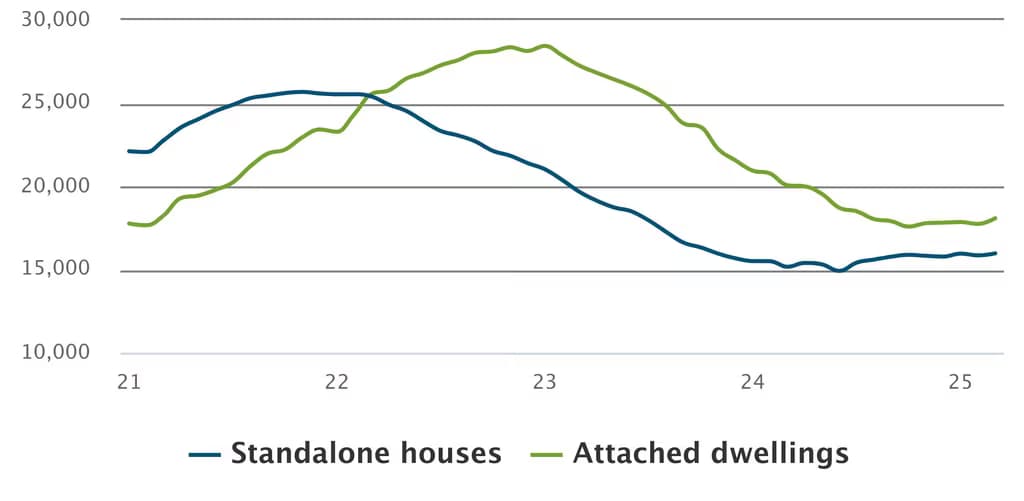
- Nevertheless, both standalone houses (+9.8%) and townhouses (+12%) were also up significantly from March 2024 consent levels. The annual total for house consents is now up 7.1% from last June’s trough to its highest level since October 2023.
- The biggest regional contributors to consent growth in the March quarter, compared with a year earlier, were Otago (up 55%), Waikato (up 20%), Auckland (up 3.3%), and Canterbury (up 8.2%). Northland recorded the largest fall in consents over the same period, down 42%.
Consent numbers climbing slightly
Consents by dwelling type, annual running totals
...and our reaction
- Today’s result represents welcome news for the residential construction industry, given the 34% decline in consent numbers from their mid-2022 peak. The annual consent total is now at its highest since May last year, and the March quarter result was 12% above the estimate published in our recent forecasts.
- Most regions have shown a stabilisation and some increase in consents in recent months. Northland is the biggest exception, where the annual consent total is at its lowest level since 2015, while Manawatū-Whanganui’s total is only just above the 6½-year low recorded in February. Otago’s consent numbers are at a record high, with consents in Queenstown-Lakes now 17% above their COVID peak.
- At this stage, we are cautious about becoming too upbeat on future consent trends, given that almost half of March’s outperformance was due to apartment consents, which are notoriously lumpy. However, continued increases in house consents, along with some emerging upward momentum in townhouse consents, do give cause for optimism about prospects for activity.
- A large supply of properties for sale suggests limited house price growth, and with slowing population growth and uncertain economic conditions due to the international trade war, we still expect any upturn in consent numbers over the next 12-18 months to be relatively modest.
Latest updates
Premium

Residential building consents
Residential consents fall 3.6% in June
Mon 3 Aug 2026
Monthly
40,581 Annual consents over the June 2026 year
19% June 2026 consents over the June 2026 year 3.6% June 2026 consents from May on a seas. adj. basis
Premium
Residential building consents
Residential consents fall 4.0% in May
Thu 2 Jul 2026
Monthly
 39,737 Annual consents over May 2026 year4.0% May 2026 consents from April on a seas. adj. basis22%pa Townhouse consents over May 2026 year
Residential building consents
Residential consents jump up 11% in April
Wed 3 Jun 2026
Monthly
39,087 Annual consents over April 2026 year11% April 2026 consents from March on a seas. adj. basis19%pa Multi-unit consents over April 2026 yearResidential building consents
Residential consent momentum trends sideways
Fri 1 May 2026
Monthly
37,813 Annual consents over March 2026 year 3,300pm Consents trend sideways on a seas. adj. basis14%pa Townhouse consents over March 2026 year