
Our take on the latest Employment indicators (Tue 29 Apr 2025)


Filled jobs rise 0.2% in March (sa)
Primary industries jobs up 0.4% in March (sa)
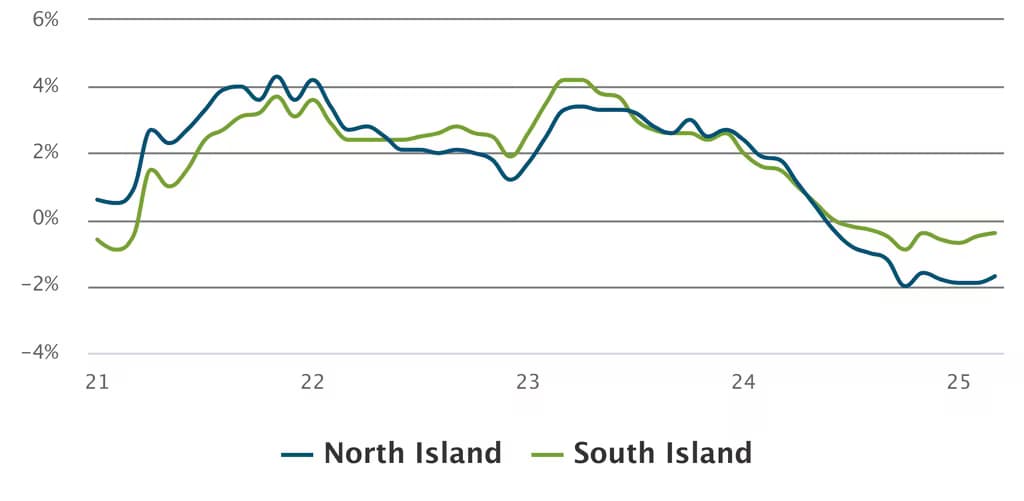
North Island jobs down 1.7%, South Island down 0.4% from Mar 2024
The key numbers...
- Filled job numbers rose 0.2% in March from February (seasonally adjusted). The month-on-month changes continue to flick between positive and negative, making the trend hard to depict.
- Filled jobs across all three broad sectors rose in March, led by primary industries (+0.4%), followed by service industries (+0.2%), and goods-producing (+0.1%). This result is the first time all three broad sectors have risen from the previous month since January 2024 (all figures seasonally adjusted).
- Strong filled jobs growth across primary industries over the past two months has driven the sector’s annual growth back into positive territory (+0.6%), the only broad sector up from a year ago. Over the same period, filled job numbers in goods-producing industries (-3.9%) and service industries (-1.0%) drove the total annual decline (-1.4%).
Decline in South Island more moderate than the North
Annual % change, monthly filled jobs
...and our reaction
- Annual jobs growth in the agriculture, forestry, and fishing industry turned positive in March, with job numbers rising 0.8% from a year ago, breaking the trend of declining job numbers compared to a year ago which had stretched for 11 consecutive months. The industry joins just five other industries out of the total of 19 that have higher filled job numbers than a year – mining (+4.2%), utilities (2.5%), health (+1.7%), arts & recreation (+1.7%), and financial services (+1.1%).
- The annual decline in filled jobs continues to be spread across all regions apart from Otago (+0.1%). The South Island is faring better than the North Island, with job numbers falling 0.4%, compared to a 1.7% decline in the North. Better job numbers across primary industries are a likely driver of the difference.
- Job ads in March rose 2.8% from February (based on Infometrics seasonal adjustment of MBIE data). Job ads are still yet to register two consecutive monthly rises, but they have largely held stable since mid-2024.
- It may take a while longer before a clear trend in filled job numbers appears, particularly given economic uncertainty caused by recent international events. We expect the unemployment rate to peak at 5.4% in the June quarter, before heading down towards 5.0% over the second half of 2025.
Latest updates
Premium

Employment indicators
Further weak employment recovery
Tue 28 Jul 2026
Monthly
0.1% Filled jobs rose in June 2026 (sa)0.6%pa Filled jobs were up from June 2025 1.5%pa South Island filled jobs incre from June 2025
Premium
Employment indicators
Public sector leads job gains
Mon 29 Jun 2026
Monthly
0.3% Filled jobs in May (sa)0.1% Filled jobs in April (sa)0.7% Filled jobs from May 2025Employment indicators
Healthcare leads job growth
Thu 28 May 2026
Monthly
0.2% Filled jobs in April (sa)0.5% Filled jobs from April 20255,527 Healthcare jobs over the year to AprilEmployment indicators
Let’s hear it for the South
Tue 28 Apr 2026
Monthly
0.3% Filled jobs in March (sa)0.2% Filled jobs in February (sa)1.5%pa South Island jobs in March