
Our take on the latest Non-residential building consents (Tue 4 Feb 2025)
Value of non-res consents
$507m

In December 2024
Weakest non-res result since May 2003 (adjusted for building cost inflation and seasonality)
Weakest result for Auckland since June 2017 (adjusted for building cost inflation)
The key numbers...
- Non-residential building in December recorded its weakest month since May 2020 (seasonally adjusted), with the $507m total value of consents down 22% from December 2023.
- Hospital consents made the biggest contribution to the decline from a year ago, falling by $63m. Education consents were the second largest contributor, declining by $47m, followed by social building, which fell by $24m. The weakness in in hospital consents in the last two months follows a very strong month in October, largely thanks to $148m of consents in Otago as part of Dunedin Hospital.
- There were a few building types where consents were up from a year ago, which was largely due to relatively weak months recorded in December 2023. Warehouses rose $10m from a year ago, followed by negligible rises in hostels ($6m), farm buildings ($6m), and hotels ($2m).
- Weakness in consents from Auckland drove the decline (down $109m to $150m), which was the lowest month of non-residential consents for the region since June 2017 (adjusted for building cost inflation). The second largest contributor to the decline was Wellington (down $57m to $27m), and we estimate that this result was Wellington’s weakest month after adjusting for building cost inflation since April 2021.
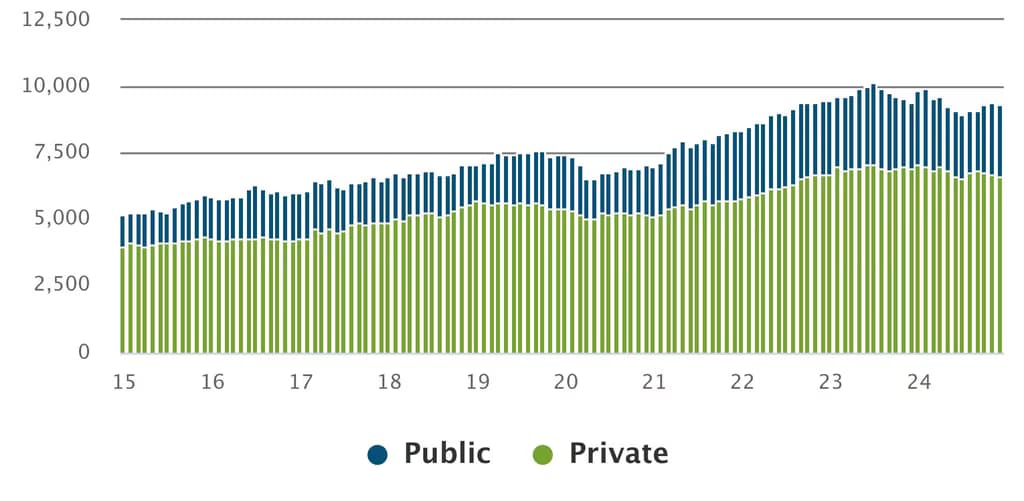
Recent strength begins to fall away again
Non-residential consents, annual running total, $m
...and our reaction
- Weakness was broad based across December’s non-residential consent figures, with both public and private sector volumes seeing considerable declines.
- Strong public sector consent figures drove strength in October and November’s non-residential consent figures. However, tight fiscal conditions are expected to show through public sector consent figures in 2025 as the government continues its efforts to balance the books.
- The weak economic conditions felt through 2024 will continue to weigh on private sector non-residential consent figures throughout 2025. Rising unemployment will continue to restrict consumer spending in the near-term, putting a lid on business revenue and investment.
Latest updates
Premium

Non-residential building consents
Warehouses prevent further non-res falls in June
Mon 3 Aug 2026
Monthly
$701m Value of non-res consents in June 2026
 7.4% Total non-res consents from May 2026 (seas adj)
 37%pa Warehouse consents from June 2025
Premium
Non-residential building consents
Non-res consents weaker still in May
Thu 2 Jul 2026
Monthly
$789m Value of non-res consents in May 2026
19% Monthly consents from May 202549% Public sector consents from May 2025Non-residential building consents
Non-res consents mostly softer in April
Wed 3 Jun 2026
Monthly
$655m Value of non-res consents in April 2026
15% Monthly consents from April 2025Office and education consents at lowest monthly levels in 5-6 yearsNon-residential building consents
Consents strong in March, but shadow of conflict looms
Fri 1 May 2026
Monthly
$862m Value of non-res consents in March 2026
15% Monthly consents from Mar 2025$119m Hostel consents from Mar 2025