
Our take on the latest Employment indicators (Tue 28 Jan 2025)


Filled jobs up 0.1% in December (sa)
Primary and service industries jobs up 0.2% in December (sa)
Job ads continue to show signs of levelling out
The key numbers...
- Filled jobs rose 0.1% in December from November (seasonally adjusted), making it the first time since October 2023 that job numbers have risen for two consecutive months. We caution that this increase might eventually be revised lower, with November’s increase revised lower by 0.1 percentage points to 0.2%.
- There remains volatility month-to-month across the broad industries, with jobs in goods-producing industries down 0.1% from November, while both primary and service industries saw narrow 0.2% rises.
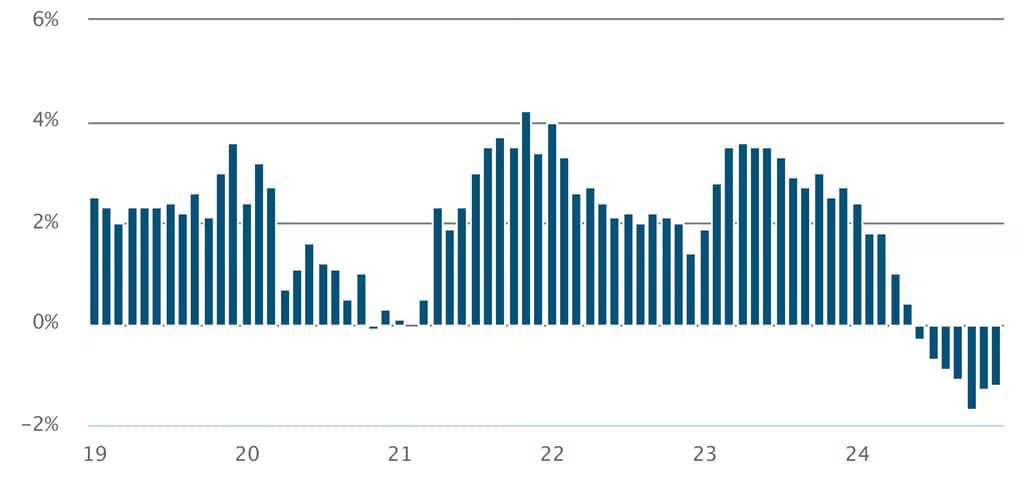
- On an annual basis, the decline in filled jobs has held at 1.2%pa for two consecutive months in December, and it appears to have peaked at 1.7%pa in October.
- The healthcare and social assistance industry (2.8%pa) continues to be the driving force limiting deeper declines in annual filled job numbers. In contrast, key industries such as construction (-6.1%pa) and administration (-6.8%pa) remain weak.
- Job ads in December fell 2.0% from November, largely reversing out November’s 3.4% rise from October (all figures based on Infometrics seasonal adjustment of MBIE data). Nevertheless, job ads appear to have largely levelled out over the second half of 2024.
Annual decline in filled jobs narrows
Filled jobs, annual % change
...and our reaction
- We continue to be cautious when analysing trends in monthly employment indicators, as narrow rises are often revised to flat or narrow declines when more data becomes available. The increase in jobs in December is likely to be revised lower in subsequent releases of employment indicators and could paint a different story.
- Nonetheless, it is encouraging to see the annual decline slowing to 1.2% with falls in some key industries slowing. Accommodation and retail trade filled jobs were 1.7% and 1.5% lower than in December 2023 respectively, the smallest annual declines since May 2024. In contrast, construction filled jobs continue to decline with the pipeline of work narrowing, down 6.1% from December 2023.
- It will take some time for the effects of easing monetary policy to work through the system to result in material employment growth. Households will continue to refix at lower mortgage rates, resulting in increased discretionary funds and higher business revenues – eventually resulting in job creation.
- Next week’s labour market statistics will give us a better indication of how the labour market developed in the December quarter, with analysts’ expecting the unemployment rate to reach almost 5.0%. We expect the unemployment rate to increase further over the next six months, peaking at 5.3% in mid-2025.
Latest updates
Premium

Employment indicators
Further weak employment recovery
Tue 28 Jul 2026
Monthly
0.1% Filled jobs rose in June 2026 (sa)0.6%pa Filled jobs were up from June 2025 1.5%pa South Island filled jobs incre from June 2025
Premium
Employment indicators
Public sector leads job gains
Mon 29 Jun 2026
Monthly
0.3% Filled jobs in May (sa) 0.1% Filled jobs in April (sa)0.7% Filled jobs from May 2025
Employment indicators
Healthcare leads job growth
Thu 28 May 2026
Monthly
0.2% Filled jobs in April (sa)0.5% Filled jobs from April 20255,527 Healthcare jobs over the year to AprilEmployment indicators
Let’s hear it for the South
Tue 28 Apr 2026
Monthly
0.3% Filled jobs in March (sa)0.2% Filled jobs in February (sa)1.5%pa South Island jobs in March