
Our take on the latest Retail trade survey (Mon 25 Nov 2024)


Core retail sales volumes down 0.8% from June 2024 quarter (sa)
Core sales values down 0.8% from June 2024 quarter (sa)
More recent electronic card data shows signs of recovery
The key numbers...
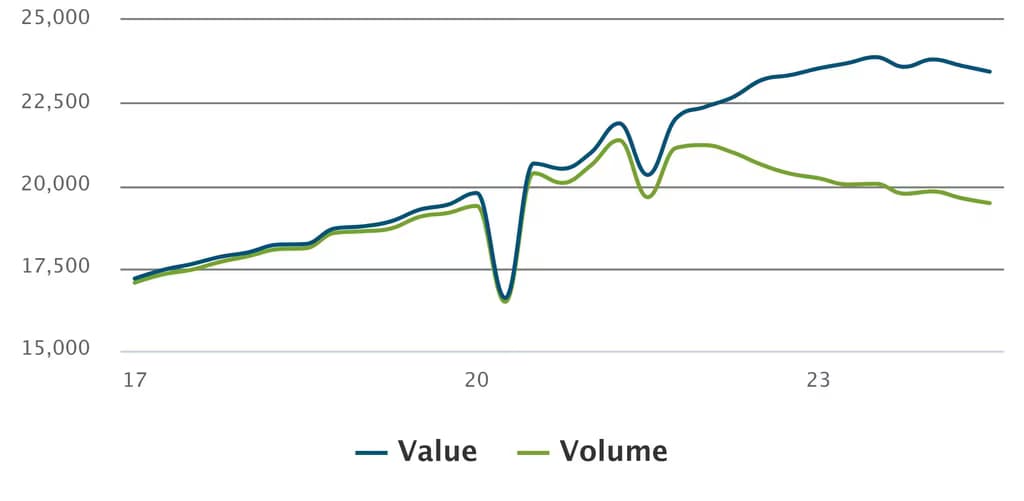
- Core retail sales volumes, which exclude motor vehicle and fuel retailing, eased 0.8% from the June 2024 quarter (seasonally adjusted). This result continues the negative pattern throughout most of the last 2½ years, with the September 2023 and March 2024 quarter increases being the only positive quarterly changes in retail volumes since March 2022.
- The value of core sales fell 0.8% (seasonally adjusted), dragging annual growth in core retail values down to -1.7%. Excluding the 2020 lockdown period, this fall is the biggest annual decline since the series began in 1995.
- The only industries with increases in quarterly sales volumes were electrical and electronic goods retailing (up 4.6%), motor vehicle and parts retailing (up 4.3%), non-store and commission-based retailing (up 3.0%), liquor retailing (up 0.8%), and hardware and gardening supplies (up 0.2%, all figures seasonally adjusted).
- Supermarket sales volumes fell after two consecutive quarters of growth, down -1.3% in September, the sharpest quarterly decline since June 2022. However, supermarket sales volumes are still 1.1% higher than in September 2023. Pharmaceutical and other store based retailing was the only other storetype to show positive annual growth (1.5%).
Falling retail spending despite interest rate relief
Retail sales, core measure, seasonally adjusted, $m
...and our reaction
- Annual growth in the core retail deflator pulled back to a 3½-year low of 1.1%pa . This moderation is consistent with the consumers price index, and household budgets are no longer being as heavily squeezed by continued increases in the cost of living.
- Today’s retail data fails to show any of the stabilisation in spending that has been suggested by electronic card data in recent months. Although electronic card data showed a 0.4% drop in the value of core spending between the June and September quarters, monthly sales values have lifted 1.5% between July and October, suggesting a more positive trend in spending is starting to emerge. This trend is likely to show through in December quarter data.
- We have expected rising unemployment and increased job uncertainty to continue to dampen consumer spending into the first half of 2025. However, there is a chance that falling mortgage rates and more moderate inflation boost consumer confidence sooner than we had been anticipating, leading to an earlier recovery in household spending. Even if that earlier recovery does occur, we would still expect the pace of the pick-up to be limited by labour market conditions.
Latest updates
Premium

Retail trade survey
Core retail volumes grow slower as consumers adjust to elevated fuel prices
Mon 24 Aug 2026
Quarterly
 -0.5% Total retail sales volumes in the June 2026 quarter (seas. adj.)
 +0.7% Core retail sales volumes in the June 2026 quarter (seas. adj.)+6.5%pa South Island core retail sales in the June 2026 quarter
Premium
Retail trade survey
Anxious consumers pull back on discretionary spending
Fri 22 May 2026
Quarterly
1.0% Core retail sales volumes in the March 2026 quarter (seas. adj.)8 of 13 core industries recorded quarterly rises (seas. adj.)-4.8% Clothing, footwear in the March 2026 quarter (seas. adj.)Retail trade survey
Retail spending continues to strengthen
Mon 23 Feb 2026
Quarterly
1.5% Core retail sales volumes in December (seas. adj.)11 of 13 core industries recorded quarterly rises (seas. adj.)South Island continues to lead the recoveryRetail trade survey
Retail spending recovery gaining traction
Thu 27 Nov 2025
Quarterly
Core retail sales volumes up 1.2% in September (seas. adj.)Seven of 13 core industries saw quarterly rises (seas. adj.)North Island growth starting to follow the South’s lead