
Our take on the latest Residential building consents (Fri 1 Nov 2024)
Dwelling consents
33,677


Over the year to September 2024
House consents up 15% from September 2023
Standalone house consents beginning to stabilise
The key numbers...
- Dwelling consent numbers in September totalled 2,943, up 1.6% from September last year.
- Standalone house consents rose 15% from September last year. The biggest contributors to the rise were Auckland (up by 73 houses from September 2023), Otago (up 52), and Manawatū-Whanganui and Nelson (both up 34).
- Retirement units continue to return to life, recording 197 consents. Projects were spread across the regions, led by Canterbury (64), Auckland (51), and Bay of Plenty (43). The annual total of 1,830 consents is down 32% from the year to September 2023, but it has recovered 14% from its trough in June 2024.
- Townhouse consent numbers remained subdued, with the monthly total falling to 1,091, down 22% from a year ago. Consents continue to be pulled down by weakness in the main centres, with Auckland, Wellington, and Canterbury each down by around 100 consents from a year ago. The nationwide annual townhouse consent total of 14,295 is the lowest since July 2021.
- Apartment consent numbers rose to 277 in September, their highest monthly total since March 2023. The result was driven by 245 apartment consents in Auckland. However, at 1,777, the annual total of apartment consents is down 45% from the year to September 2023.
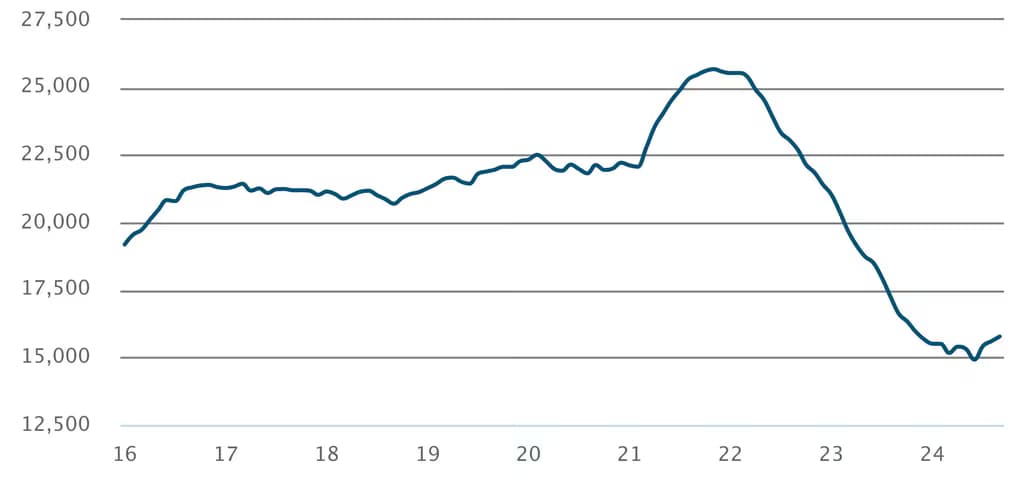
Standalones showing signs of stabilising
Annual running total
...and our reaction
- The annual standalone house total has increased for three consecutive months for the first time since October 2021 and is now down just 5.1%pa from the year to September 2023. We might be starting to see the stabilisation in standalone consent numbers that we have been forecasting.
- Weakness in townhouse consents numbers continues to be a drag on overall dwelling consents, although this is likely more of a reflection in longer lead times associated with multi-unit developments.
- It remains too early to call the trough in overall residential consents as we are yet to see an obvious trend in dwelling consent numbers, and attached dwellings (excluding retirement units) remain weak.
- The Reserve Bank’s final official cash rate review for 2024 late this month, at which we expect a 50 basis point cut, will continue to drive down mortgage rates offered by banks, although much of the likely cut could already be priced into current mortgage rates. Nonetheless, the downward trend in interest rates should continue to revive activity in the housing market and reinforce the signs of a stabilisation in consent numbers.
Latest updates
Premium

Residential building consents
Residential consents fall 3.6% in June
Mon 3 Aug 2026
Monthly
40,581 Annual consents over the June 2026 year
19% June 2026 consents over the June 2026 year 3.6% June 2026 consents from May on a seas. adj. basis
Premium
Residential building consents
Residential consents fall 4.0% in May
Thu 2 Jul 2026
Monthly
 39,737 Annual consents over May 2026 year4.0% May 2026 consents from April on a seas. adj. basis22%pa Townhouse consents over May 2026 year
Residential building consents
Residential consents jump up 11% in April
Wed 3 Jun 2026
Monthly
39,087 Annual consents over April 2026 year11% April 2026 consents from March on a seas. adj. basis19%pa Multi-unit consents over April 2026 yearResidential building consents
Residential consent momentum trends sideways
Fri 1 May 2026
Monthly
37,813 Annual consents over March 2026 year 3,300pm Consents trend sideways on a seas. adj. basis14%pa Townhouse consents over March 2026 year