
Our take on the latest Employment indicators (Tue 29 Oct 2024)


Annual filled jobs down 0.9%pa in September
Filled jobs unchanged in September from August (seasonally adjusted)
Goods-producing industries filled jobs down 3.2%pa in September
The key numbers...
- Filled job numbers were unchanged between August and September. Last month’s initial estimate of a 0.2% rise from July was revised down to also be unchanged, meaning that job numbers have not increased for any month since March (all figures seasonally adjusted).
- Annual filled jobs growth remained negative (-0.9%pa), with the annual decline deepening following downward revisions to previous results. September marks four consecutive months of annual declines in filled jobs growth for the first time since mid-2010.
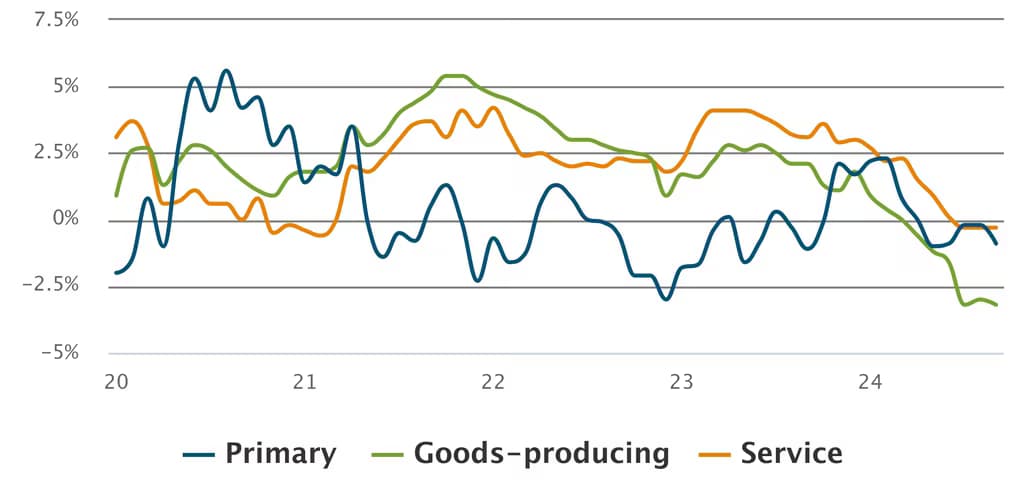
- Annual growth in filled jobs remains negative across all broad sectors. Goods-producing industries appear to be hit the hardest by the current economic downturn, down 3.2%pa. Primary and service industries have been more sheltered, down 0.9%pa and 0.3%pa respectively.
- At an industry level, results are mixed. Administrative and support services (which includes labour hire services) and construction declined the most, down 6.8%pa and 5.0%pa respectively. Some industries continue to see growth, largely due to regulatory changes, with electricity, gas, water and waste services filled jobs (+4.6%pa), health care and social assistance (+3.9%pa) and mining (+3.7%pa) recording the largest increases.
Goods-producing industries struggling
Annual % change, monthly filled jobs
...and our reaction
- Job numbers are now almost 1.0% below this time last year, the biggest annual decline since February 2010, showing just how tough it is in the labour market at the moment.
- The weaker labour market downturn continues to hit under-30s hard, with filled job numbers down 6.3%pa from a year ago, whereas over-30s filled job numbers continue to grow, up 0.8%pa from a year ago. This trend is potentially worrisome for the brain-drain problem we face, as young, agile workers look to head overseas to countries with more job opportunities and higher remuneration as the local labour market remains weak.
- Filled job numbers are mixed at a regional level, although all regions in the North Island are down from a year ago, recording falls of between 0.2% and 1.7%pa. Canterbury and Otago are the only regions with filled job numbers higher than a year ago, both up 0.1%pa.
- We continue to monitor the effects of the public sector cutbacks. Filled jobs in public administration and safety have continued to grow (up 0.5%pa), but we don’t think the full impact has shown up in the data yet. With the redundancy process ongoing for some, it might not be until late 2024 that the effects become clearer.
- Next week’s Household Labour Force Survey release will add additional context to the deteriorating labour market. Monthly employment indicators over the past three months indicate the unemployment rate could hit 5.0% for the first time in four years.
Latest updates
Premium

Employment indicators
Further weak employment recovery
Tue 28 Jul 2026
Monthly
 0.1% Filled jobs rose in June 2026 (sa)0.6%pa Filled jobs were up from June 2025
 1.5%pa South Island filled jobs incre from June 2025
Premium
Employment indicators
Public sector leads job gains
Mon 29 Jun 2026
Monthly
0.3% Filled jobs in May (sa)0.1% Filled jobs in April (sa)0.7% Filled jobs from May 2025Employment indicators
Healthcare leads job growth
Thu 28 May 2026
Monthly
0.2% Filled jobs in April (sa)0.5% Filled jobs from April 20255,527 Healthcare jobs over the year to AprilEmployment indicators
Let’s hear it for the South
Tue 28 Apr 2026
Monthly
0.3% Filled jobs in March (sa)0.2% Filled jobs in February (sa)1.5%pa South Island jobs in March