
Our take on the latest Non-residential building consents (Fri 30 Aug 2024)
Value of non-res consents
$682m

In July 2024
Total consents down 17% from July 2023
Hospital consents down $138m from July 2023
The key numbers...
- Total non-residential consents fell 17%pa in July 2024 to $682m, the third consecutive monthly decline from a year ago.
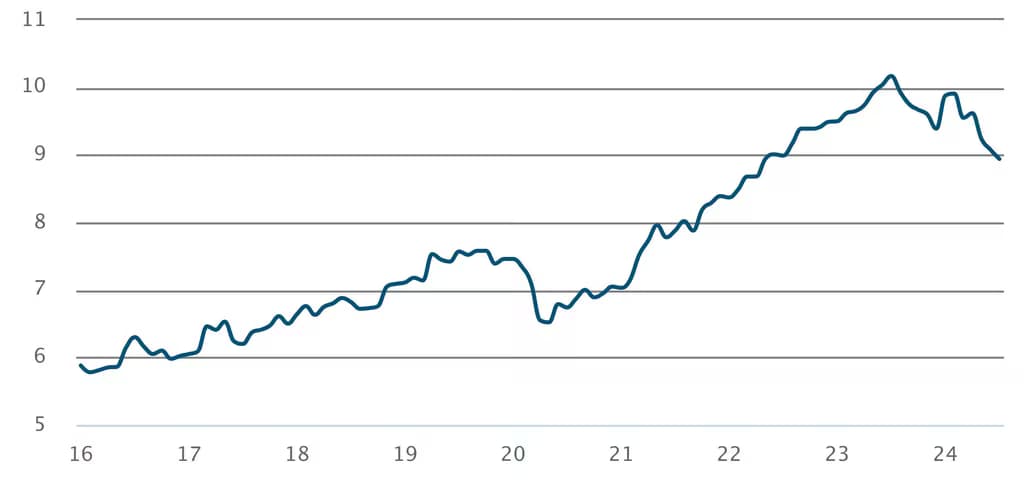
- Annual consent values are now down 12%pa the biggest fall (excluding the initial COVID-19 lockdown) since March 2011. Adjusted for building cost inflation, the decline in consented work is 16%pa, with annual cost-adjusted consent volumes now at their lowest since September 2016 (excluding lockdown).
- The largest falls by building type were for hospitals (down $138m), warehouses (down $33m) and factories (down $33m) compared to July last year.
- However, there was a large increase in education building consent values in July, with $136m consented, up $72m from last July, and the best month for education consents since December last year. This result was largely due to $75m worth of education consents in Auckland.
Downward trend in consent values continues
Annual running total of non-residential consents, $b
...and our reaction
- Non-residential consents continue to fall, reducing the future pipeline of non-residential building work.
- Falls continue to be spread across most regions, with increases in total annual non-residential consent values only recorded in Nelson (up 42%pa), West Coast (up 10%pa), Northland (up 3%pa), while Wellington was unchanged.
- Public sector consents continue to fall sharply, with the annual total down 22%pa, while private sector consents are down a more modest 8.0%pa. The decline in public sector consents is driven by hospital consents, down 22%pa, the largest fall since April 2018, and education, down 25%pa despite this month’s strong result.
- Annual falls across build types related to business and consumer spending continue. Weak demand is limiting investment in retail building (down 22%pa), factories (down 12%pa), and warehouses (down 5.3%pa).
- The recent official cash rate cut by the Reserve Bank is the first step towards improved economic conditions, and business confidence has improved markedly over the last two months to a 10-year high. However, businesses will continue to face tough demand conditions through until mid-2025 as the labour market weakens further and household spending remains subdued. Non-residential construction tends to lag the economic cycle, so we expect businesses will remain reluctant to invest in new buildings for some time yet.
Latest updates
Premium

Non-residential building consents
Warehouses prevent further non-res falls in June
Mon 3 Aug 2026
Monthly
$701m Value of non-res consents in June 2026
7.4% Total non-res consents from May 2026 (seas adj) 37%pa Warehouse consents from June 2025
Premium
Non-residential building consents
Non-res consents weaker still in May
Thu 2 Jul 2026
Monthly
$789m Value of non-res consents in May 2026
19% Monthly consents from May 202549% Public sector consents from May 2025Non-residential building consents
Non-res consents mostly softer in April
Wed 3 Jun 2026
Monthly
$655m Value of non-res consents in April 2026
15% Monthly consents from April 2025 Office and education consents at lowest monthly levels in 5-6 years
Non-residential building consents
Consents strong in March, but shadow of conflict looms
Fri 1 May 2026
Monthly
$862m Value of non-res consents in March 2026
15% Monthly consents from Mar 2025$119m Hostel consents from Mar 2025