Residential building consents
House consents surge; too early to call the trough yet
30 Aug 2024

Our take on the latest Residential building consents (Fri 30 Aug 2024)
Dwelling consents
33,921


Over the year to July 2024
House consents up 42% from July 2023
Queenstown-Lakes house consents triple previous monthly record
The key numbers...
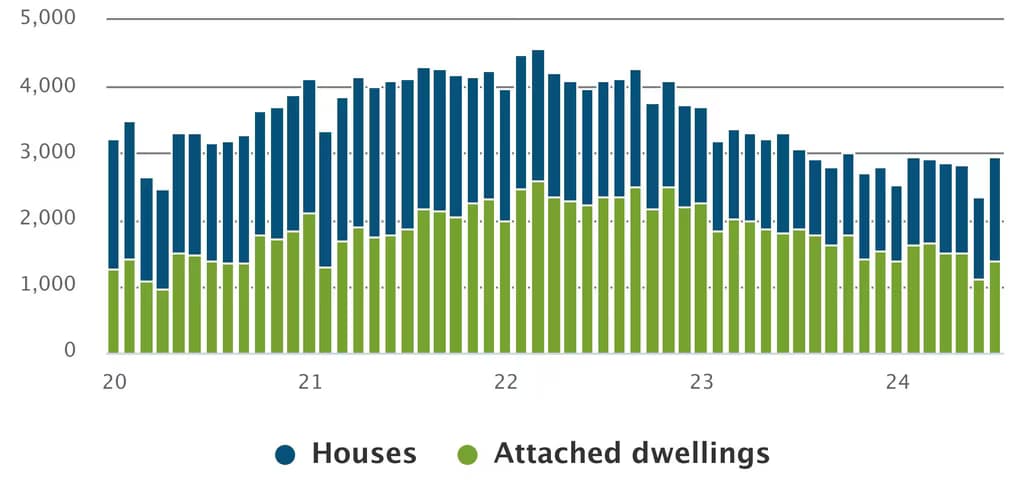
- Dwelling consent numbers in July totalled 3,352, up 9.6% from July last year. This was only the second month of positive annual growth for the monthly total since September 2022, and the biggest annual increase since March 2022.
- A 42% jump in the number of standalone house consents was the main driver of the increase in overall residential consent numbers.
- The biggest contributors to the lift in house consents were Otago (up 239 from July 2023), Auckland (up 160), and Canterbury (up 100). Queenstown-Lakes recorded a scarcely believable 279 standalone house consents last month – the previous monthly record was 91 consents in 2017. Queenstown-Lakes’ total number of new dwelling consents was also a record, at 385.
- With 234 consents, retirement units recorded their biggest month since August last year. There were projects across several regions, but the main driver of the strong result was 140 units in Auckland, spread across the Puketapapa, Rodney, and Franklin local boards.
- Townhouse consent numbers in July were still down 14% from a year ago, a decline that was essentially driven by a reduction in consents in Auckland of 291 dwellings. The nationwide annual townhouse consent total is now below 15,000 for the first time since August 2021.
- Apartment consents remain under considerable downward pressure, although Otago bucked the trend, with 48 consents the region’s strongest month in two years. At 1,796, the annual apartment total has not been lower since early 2015.
Consents are still volatile, despite hints of a stabilisation
Monthly dwelling consent numbers, seasonally adjusted
...and our reaction
- Although we have been forecasting a stabilisation in consent numbers over the second half of 2024, we see two reasons to be cautious about the apparent strength in the latest data.
- Firstly, the Queenstown-Lakes result looks like an anomaly, and we would not expect consent numbers for the District to be sustained at this rate in coming months.
- Secondly, the timing of Matariki means that July last year would have been weaker due to the additional public holiday, which took place in June this year. This timing issue will have affected both the annual comparisons, as well as monthly seasonally adjusted numbers (which Stats NZ notes do not account for Matariki).
- House consent numbers for June and July combined were 4.0% higher than for June and July 2023. However, stripping out 300 consents to adjust for the one-off Queenstown-Lakes result would lead to a decline of about 7%.
- The figures are more negative when we look at total dwelling numbers, with a 14% decline from June and July 2023, worsening to a 19% fall after adjusting for the Queenstown-Lakes result.
- In short, although today’s figures are positive in terms of consent numbers, it would be wrong to call an end to the declines in residential consents yet based on one month’s data. However, there is enough in the figures to suggest that the annual consent total, currently at just under 34,000, should bottom out at over 30,000.
Latest updates
Premium

Residential building consents
Residential consents fall 3.6% in June
Mon 3 Aug 2026
Monthly
40,581 Annual consents over the June 2026 year
19% June 2026 consents over the June 2026 year 3.6% June 2026 consents from May on a seas. adj. basis
Premium
Residential building consents
Residential consents fall 4.0% in May
Thu 2 Jul 2026
Monthly
 39,737 Annual consents over May 2026 year4.0% May 2026 consents from April on a seas. adj. basis22%pa Townhouse consents over May 2026 year
Residential building consents
Residential consents jump up 11% in April
Wed 3 Jun 2026
Monthly
39,087 Annual consents over April 2026 year11% April 2026 consents from March on a seas. adj. basis19%pa Multi-unit consents over April 2026 yearResidential building consents
Residential consent momentum trends sideways
Fri 1 May 2026
Monthly
37,813 Annual consents over March 2026 year 3,300pm Consents trend sideways on a seas. adj. basis14%pa Townhouse consents over March 2026 year