Non-residential building consents
Weakness returns to non-residential consents
2 May 2024

Our take on the latest Non-residential building consents (Thu 2 May 2024)
Value of non-res consents
$680m


In March 2024
Total consents down 34% from Mar 2023
Volume of private sector consents down 5.5% from previous 12 months
The key numbers...
- The seasonally adjusted value of non-residential consents fell sharply for the second consecutive month. After stronger January and February figures, monthly consents in March are back in line with the weaker results seen in the second half of 2023.
- Social building consents were $205m lower than a year ago, with a large consent for Te Kaha Stadium in Christchurch having boosted the March 2023 figure. Other large declines from March 2023 included education building (down $91m) and retail building (down $68m).
- The fall in education building was widespread, with sizable declines in consents in Rodney and Ōrakei in Auckland, Whangārei, Palmerston North, and Christchurch. Nationally, education consents over the last six months are 29% lower than a year earlier.
- Hospital building bucked the general trend of weakness, with total consents in the quarter more than double the March 2023 quarterly result. Areas of strength in the latest month included Whangārei, Kāpiti Coast, and Dunedin.
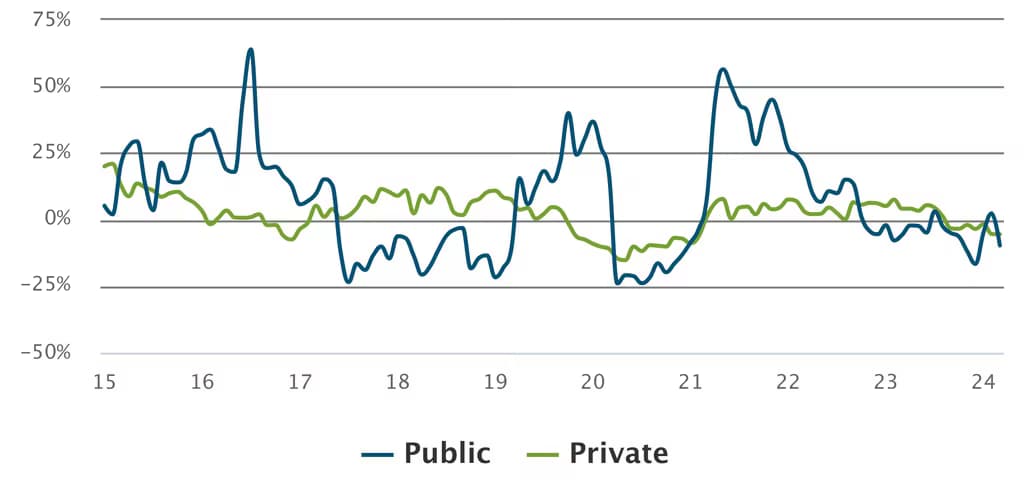
- Trends in public sector consents remain volatile, as evidenced by the conflicting results for hospital and education building. However, private sector work continues to gradually weaken, in line with difficult economic conditions.
Consent volumes falling across the board
Non-residential consents after adjusting for building cost inflation, year-end % change
...and our reaction
- The weaker result in the latest month leaves total non-residential consents for the March quarter about $360m below the estimate included in our recent forecasts. Although there is a still a sizable pipeline of consented work to be completed, today’s result appears to confirm our expectations that work put in place will moderate during 2024 and 2025.
- Only accommodation consents exceeded our (low) expectations for the quarter, while hospital and farm consents were broadly in line with our estimate.
- Renewed weakness in private sector consents is apparent across several building types, including retail and storage buildings. This weakness is being compounded by tighter government spending hitting public investment, with only hospital building immune from the budgetary squeeze at the moment.
- We expect further falls in non-residential consents to occur in the June quarter.
Latest updates
Premium

Non-residential building consents
Warehouses prevent further non-res falls in June
Mon 3 Aug 2026
Monthly
$701m Value of non-res consents in June 2026
7.4% Total non-res consents from May 2026 (seas adj) 37%pa Warehouse consents from June 2025
Premium
Non-residential building consents
Non-res consents weaker still in May
Thu 2 Jul 2026
Monthly
$789m Value of non-res consents in May 2026
19% Monthly consents from May 202549% Public sector consents from May 2025Non-residential building consents
Non-res consents mostly softer in April
Wed 3 Jun 2026
Monthly
$655m Value of non-res consents in April 2026
15% Monthly consents from April 2025 Office and education consents at lowest monthly levels in 5-6 years
Non-residential building consents
Consents strong in March, but shadow of conflict looms
Fri 1 May 2026
Monthly
$862m Value of non-res consents in March 2026
15% Monthly consents from Mar 2025$119m Hostel consents from Mar 2025