Residential building consents
Consents still falling, but possible signs of stabilisation
2 May 2024

Our take on the latest Residential building consents (Thu 2 May 2024)
Annual dwelling consents
35,236


As of March 2024
Total consents down 25%pa in year to March 2024
Trend in consents appears to be stabilising
The key numbers...
- There were 2,931 new dwellings consented in March 2024, down 0.2% from February on a seasonally adjusted basis.
- Annual consents fell back to 35,236 over the year to March 2024, down by 25%pa, and edging below 36,000pa for the first time since August 2019.
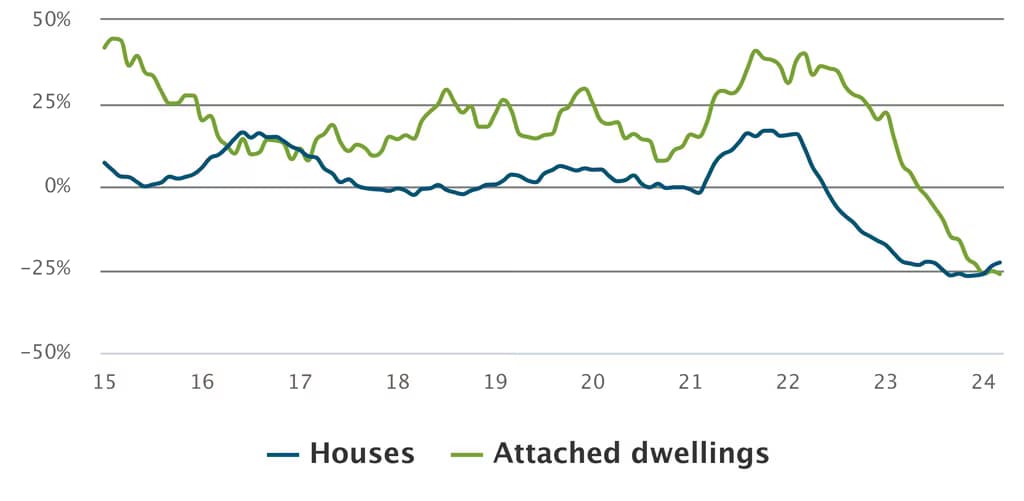
- Annual standalone house consents are back to levels last seen in the May 2013 year, although consents for this building type now look to be stabilising at around 14,500-15,000pa.
- Townhouses continue to fall further, down 18%pa over the year to March 2024. However, townhouses are coming off a high base, with annual townhouse consents only back to November 2021 levels.
- Apartment consents remain in freefall, down by 48%pa, and now at their lowest annual total since May 2016. Retirement units are also down 48%pa, back to July 2017 annual levels.
- Tasman and Wellington continue to be the two regions suffering the sharpest declines for a fourth consecutive month, down 58%pa and 35%pa respectively in the year to March 2024. Taranaki’s decline has accelerated to a 35%pa fall, and Northland’s decline remains steep at 31%pa.
Building activity shifts type
Dwelling consents, year-end % changes
...and our reaction
- The annual decline in consents has stopped accelerating and started to stabilise in the past few months, and trend consents in February and March 2024 were higher than November 2023 to January 2024 – not by much, but enough to add to this stabilising view.
- Most of this stabilising trend is driven by standalone house consents, with attached consents continuing to fall – either at an accelerating pace (townhouses) or of a larger magnitude (apartment and retirement units).
- The larger falls for apartments and retirement units reflects tighter funding conditions, the greater risk, and the more interest-rate sensitive nature of these building types.
- Although townhouse consents continue to fall at a faster pace, annual consents for this build type remain above standalone houses, suggesting there’s a sustained preference shift towards medium-density builds.
- Interest rates continue to be largely responsible for the trend in residential consents, rather than net migration. With the beginning of interest rate cuts not expected until late 2024 or early 2025, there is limited upside for consents this year.
Latest updates
Premium

Residential building consents
Residential consents fall 3.6% in June
Mon 3 Aug 2026
Monthly
40,581 Annual consents over the June 2026 year
 19% June 2026 consents over the June 2026 year3.6% June 2026 consents from May on a seas. adj. basis
Premium
Residential building consents
Residential consents fall 4.0% in May
Thu 2 Jul 2026
Monthly
 39,737 Annual consents over May 2026 year4.0% May 2026 consents from April on a seas. adj. basis22%pa Townhouse consents over May 2026 year
Residential building consents
Residential consents jump up 11% in April
Wed 3 Jun 2026
Monthly
39,087 Annual consents over April 2026 year11% April 2026 consents from March on a seas. adj. basis19%pa Multi-unit consents over April 2026 yearResidential building consents
Residential consent momentum trends sideways
Fri 1 May 2026
Monthly
37,813 Annual consents over March 2026 year 3,300pm Consents trend sideways on a seas. adj. basis14%pa Townhouse consents over March 2026 year