Non-residential building consents
Better non-res result likely to be temporary
30 May 2024

Our take on the latest Non-residential building consents (Thu 30 May 2024)
Value of non-res consents
$739m


In Apr 2024
Total consents up 11% from Apr 2023
Auckland consents up $170m from Apr 2023
The key numbers...
- The earlier timing of Easter, in March this year, contributed to an 11% lift in the value of non-residential consents in April compared with April 2023. However, after adjusting for seasonal factors, the value of consents was down 1.8% from its level in March.
- The biggest contributions to the annual increase came from retail building (up $62m), factories (up $43m), warehouses (up $35m), and hostels (up $32m).
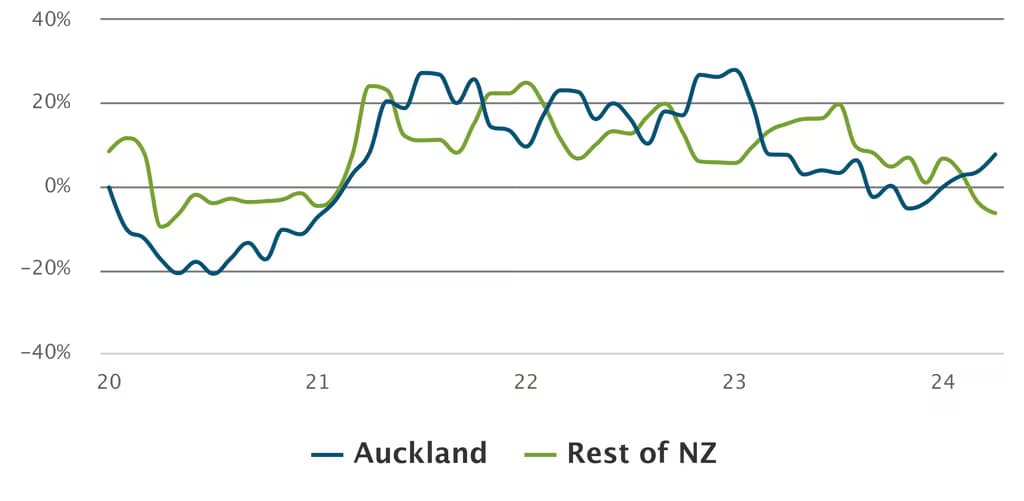
- This strength was very much an Auckland story, with total consents in the region lifting from $231m in April 2023 to $401m last month. Key contributions included a $47m consent as part of the new Ikea store in Mt Wellington, a $32m student hostel in the central city, a $30m factory and a $25m warehouse complex in Hobsonville, and a $26m medical centre in Papakura. There were also sizable lifts in consent values for warehousing in Maungakiekie-Tamaki, retail building in Albert-Eden, and health buildings in Franklin.
- In contrast, there was a $72m decline in office building consents from April last year, primarily because of less activity in central Auckland. Hospital building recorded a $26m decline (due to drops in Palmerston North, Hastings, Wellington, and Devonport-Takapuna), and social building slipped $20m due to a fall in activity in New Plymouth.
Auckland consents buck the declining trend
Value of non-residential consents, year-end % changes
...and our reaction
- Today’s result, which was generally driven by strength in private sector consents, indicates there is still some appetite for non-residential investment. However, with the timing of Easter partly inflating the results, and some large consent totals occurring in mid-2023, we continue to expect annual declines in consents over the next few months.
- Recent signals from the Reserve Bank that interest rates will stay higher for longer will maintain downward pressure on property values. This trend is likely to be compounded by significant increases in operating costs, particularly around insurance and local government rates.
- Non-residential building cost growth eased to a three-year low of 4.6%pa in the March quarter. However, the 26% lift in construction costs over the last three years, in combination with falling property prices, significantly undermines the viability of new developments.
- Weak economic conditions, in terms of both employment and household spending, combined with the tight fiscal environment, will continue to weigh on non-residential consents throughout the rest of 2024 and into 2025.
Latest updates
Premium

Non-residential building consents
Warehouses prevent further non-res falls in June
Mon 3 Aug 2026
Monthly
$701m Value of non-res consents in June 2026
 7.4% Total non-res consents from May 2026 (seas adj)37%pa Warehouse consents from June 2025
Premium
Non-residential building consents
Non-res consents weaker still in May
Thu 2 Jul 2026
Monthly
$789m Value of non-res consents in May 2026
19% Monthly consents from May 202549% Public sector consents from May 2025Non-residential building consents
Non-res consents mostly softer in April
Wed 3 Jun 2026
Monthly
$655m Value of non-res consents in April 2026
15% Monthly consents from April 2025 Office and education consents at lowest monthly levels in 5-6 years
Non-residential building consents
Consents strong in March, but shadow of conflict looms
Fri 1 May 2026
Monthly
$862m Value of non-res consents in March 2026
15% Monthly consents from Mar 2025$119m Hostel consents from Mar 2025