
Our take on the latest Employment indicators (Mon 29 Apr 2024)


Filled jobs up 2.0%pa in March
Services industries filled jobs up 2.6%pa in March
Earnings per filled job up 5.5% over year to March 2024
The key numbers...
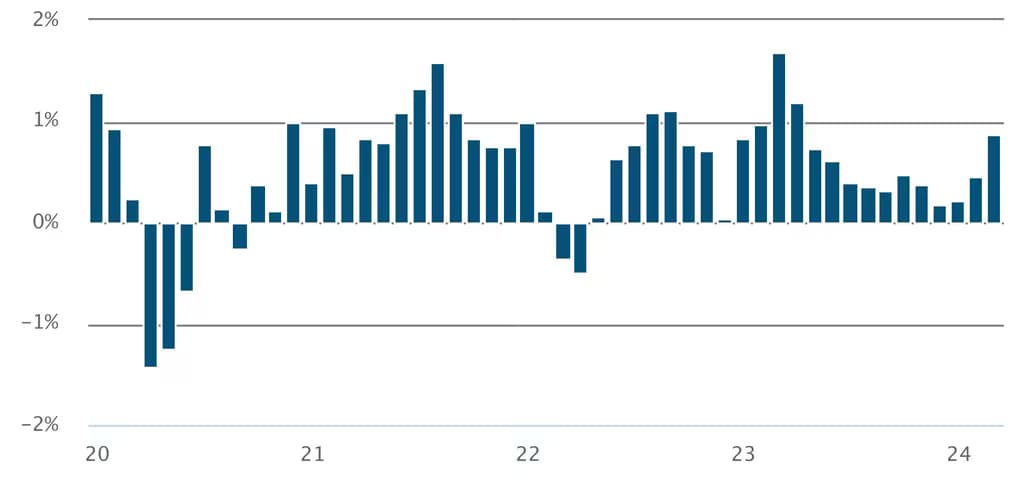
- Filled jobs in March 2024 were 0.4% higher than in February, a third consecutive monthly lift in job numbers for the first time since April 2023. Annual growth remained relatively modest, at 2.0%, due to the limited growth in job numbers between May and December last year.
- Services industries continue to be the main driver of growth, with filled jobs up 2.6%pa in March, but goods-producing industries continued an easing growth trend, with growth slipping to a 12-year low of 0.4%pa. Primary industries were the outlier of the three broad segments of the economy, with filled jobs falling 0.6%pa.
- Wage inflation remains strong, with 5.5%pa growth in earnings per filled job in the year ended March 2024. Wage inflation mirrors jobs growth, with the strongest wage inflation in service industries (5.8%), followed by goods-producing (4.4%) and primary industries (4.3%pa).
Renewed momentum in job numbers
Growth in filled job numbers, last three months
...and our reaction
- Employment continues to rise steadily at 2.0%pa, with momentum in jobs growth picking up in the first quarter of this year. Filled jobs hit 2.41m in March 2024, driven by the strength of public administration up 5.2%pa, underpinning the growth in services industries. Education and training job numbers were up 4.3%pa, the highest increase since January 2022, but administrative and support services jobs fell 2.8%, the largest decline since May 2021, during the pandemic. The fall in administrative and support services reflects slowing recruitment services and expectations of general labour market weakness.
- Slowing growth in job numbers for construction (0.8%) and accommodation and food services (1.0%) reflect weaker demand as activity levels in these industries come under pressure.
- It will still be some time before we see the headline grabbing public sector “back office” job cuts to hit the employment indicators, with many departments still to announce the extent of the restructures on headcount and a large proportion of redundancies not to take effect until June or September quarters.
- We expect net migration to gradually slow to more sustainable levels in coming months with the recent implementation of changes to the Accredited Employer Worker Visa (AEWV). The post-pandemic migration surge added over 100,000 working-age people to the population in the last year. Consequently, we expect earnings growth to reduce throughout the remainder of 2024, with slowing population growth aligning with expectations of a weaker labour market.
Latest updates
Premium

Employment indicators
Further weak employment recovery
Tue 28 Jul 2026
Monthly
0.1% Filled jobs rose in June 2026 (sa)0.6%pa Filled jobs were up from June 20251.5%pa South Island filled jobs incre from June 2025Premium
Employment indicators
Public sector leads job gains
Mon 29 Jun 2026
Monthly
0.3% Filled jobs in May (sa) 0.1% Filled jobs in April (sa)0.7% Filled jobs from May 2025
Employment indicators
Healthcare leads job growth
Thu 28 May 2026
Monthly
0.2% Filled jobs in April (sa)0.5% Filled jobs from April 20255,527 Healthcare jobs over the year to AprilEmployment indicators
Let’s hear it for the South
Tue 28 Apr 2026
Monthly
0.3% Filled jobs in March (sa)0.2% Filled jobs in February (sa)1.5%pa South Island jobs in March